Top themes: Seven forces shaping capital decisions in 2026
The Active Capital Survey 2026 series.

The Active Capital Survey 2026 series.

The Knight Frank Active Capital Survey 2026 identifies seven tightly clustered forces that will define investment decisions in the year ahead.
Together, they form the strategic backdrop for capital deployment, where macro-economic and financial anchors meet geopolitical headwinds and structural tailwinds.
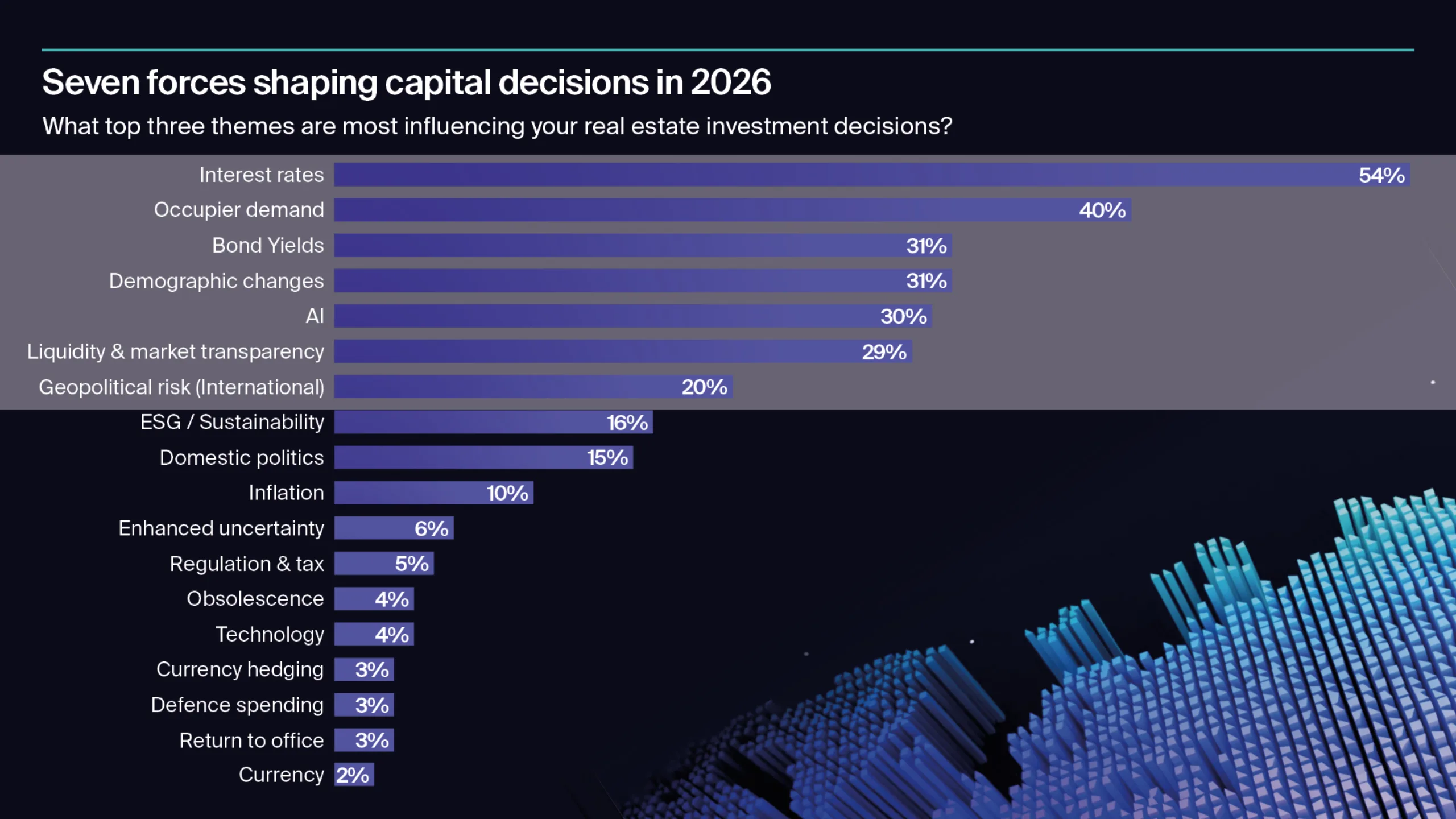
1. Interest rates: 54% of respondents cite this as a top three theme influencing their real estate decisions.
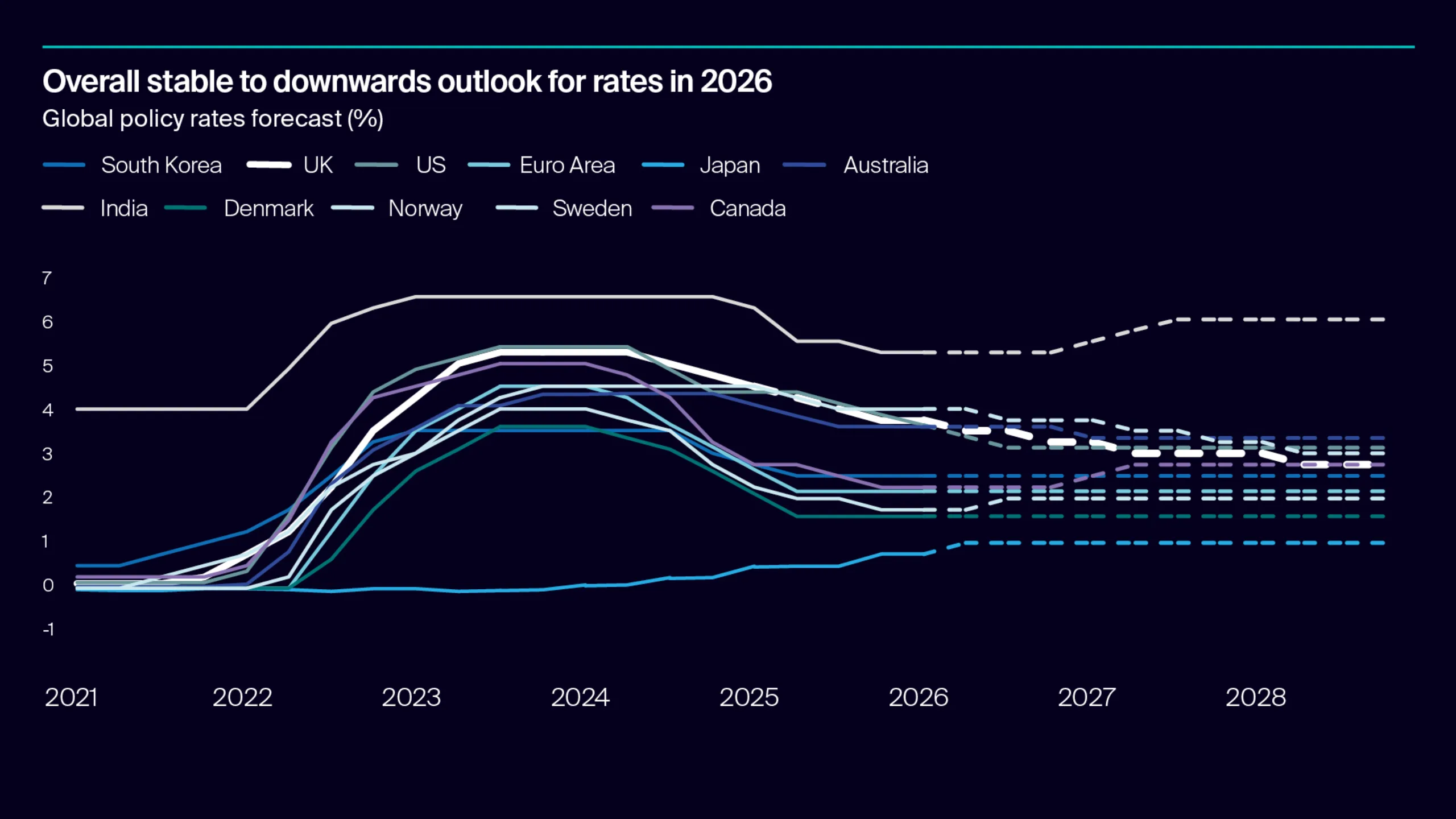
Even modest reductions may help narrows bid–ask spreads and unlock liquidity in transparent markets. Volatility is set to persist but, in most geographies, (except some geographies such as Japan), forecasts suggest rates have reduced from their recent peak.
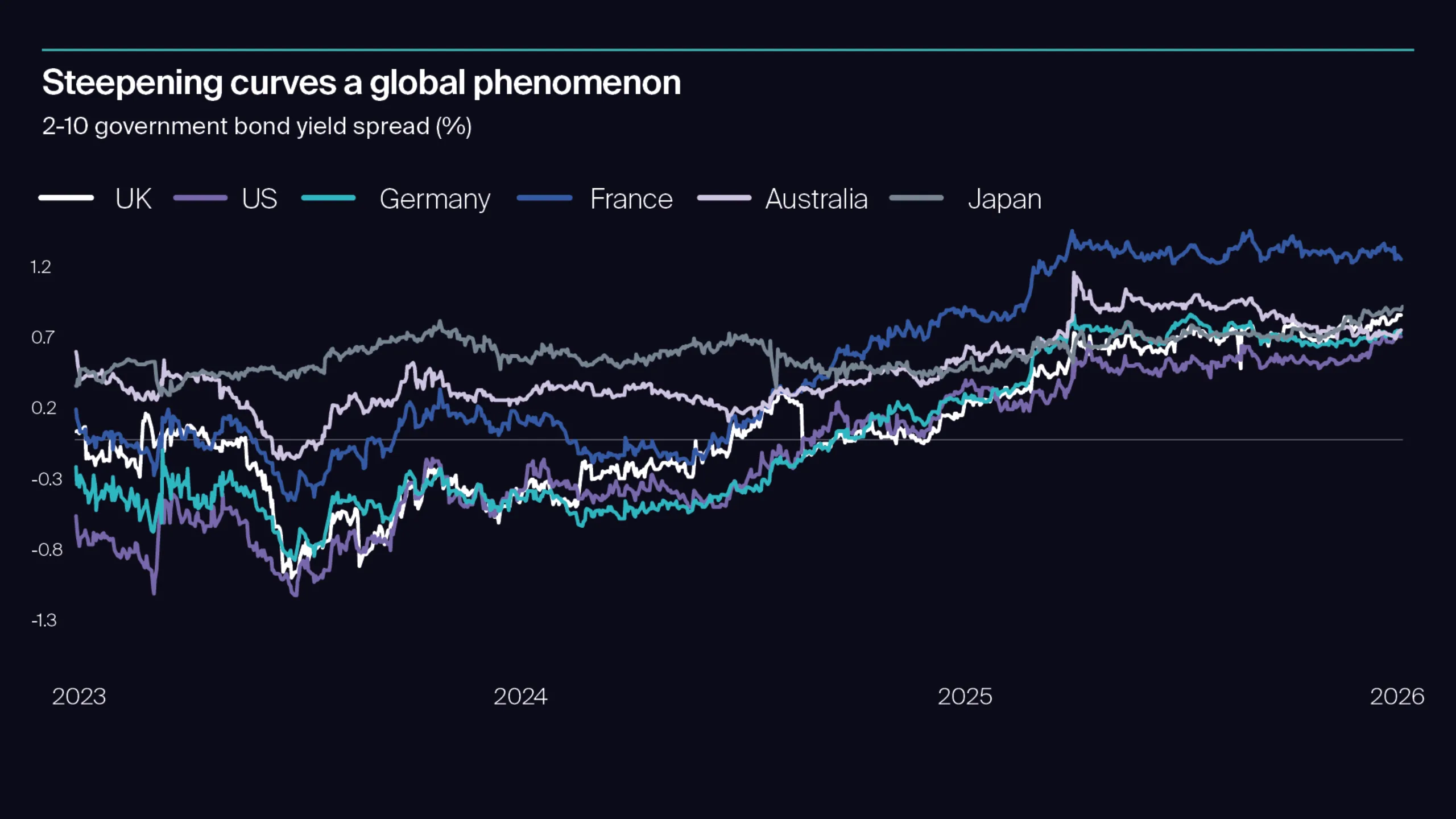
3. Bond yields: (31%). Bond yields function as a critical ‘risk-free rate’ anchor particularly for core pricing and relative value. Elevated bond yields have meant that for multi-asset investors, including some pension funds, bonds have had the edge, albeit as we head into 2026 10-year government bond yields have been easing, albeit yield curves have been steepening, meaning that long-income strategies may face higher risk-free rates. Rental growth, of course, also plays into the real estate yield calculation, underpinning the investor interest in occupier demand – the second most cited top-three theme influencing commercial real estate investment.
2. Occupier demand (40%) ranks second, underscoring that income quality, not just headline yield, is regarded by a significant proportion of investors as separating winners from losers in offices, retail and logistics. Unpacking the motivations and drivers of occupier decision making has become more complex in the post-covid landscape. The quantum and underlying qualities of office space required by occupiers is subject to change but not in a single, universal direction. Occupiers are focused on rightsizing, creating workplaces that are commensurate with a more flexible workstyle, and, in contrast to previous cycles, managing space to bolster operational resilience rather than simply delivering a streamlined footprint.
4. Demographic change (31%) is driving allocations to living sectors and healthcare, reflecting ageing populations and urbanisation trends. This dynamic is also encouraging investors in low or negative growth locations such as Japan and South Korea to diversify into regions with stronger fundamentals – from India to London, UK. However, the APAC market still sees the strongest interests in Japan and South Korea real estate, particularly in the multifamily space which is aligned with long term demographic trends such as the preference to rent rather than buy, and for smaller units. At the same time, APAC’s position as home to the fastest-growing middle class globally is additionally creating significant upside for India and South-East Asia, reinforcing investor appetite for these markets.
5. AI (30%) is supporting demand for data centres, energy infrastructure and operational real estate, signalling the convergence of digital infrastructure and property. Respondents also indicate they are alert to potential impacts across other sectors.
6. Liquidity & market transparency (29%) Investors are concentrating on markets where liquidity supports confidence in both entry and exit, reducing exposure to unwanted prolonged hold periods. Transparency helps delivers credible pricing and reliable comparables, reduces cost of initial analysis and strategy formation and makes analysis and underwriting more straightforward. These conditions are especially important for international capital, where distance amplifies risk and investors need certainty – and product - to deploy capital at scale.
7. Geopolitical risk (international) (20%) continues to influence underwriting assumptions and risk premia. Although not considered a top thematic by 80% of investors, this likely provides a reason for planned increases in investment as investors become more comfortable with deploying capital amid noise and uncertainty. They understand that these dynamics are structural not transitory and require scenario modelling and sensitivity testing as standard.
This suggests that, despite prolonged local debate and headline focus on political and fiscal changes, most real estate investors are prioritising broader macro drivers such as interest rates, liquidity and demographic trends when shaping strategy.
Based on the survey responses the following emerge as strategic priorities for 2026:
1. Follow the cost of capital: Pricing clarity will emerge first in markets where debt costs stabilise and swap rates are accretive. We are already seeing this in Euro-denominated countries, Singapore and Japan.
2. Underwrite income quality: Occupier fundamentals – such as portfolio rightsizing, navigating changing global trading arrangements, enhancing the quality of occupied space to support employee wellbeing, and using the office as a locus for employee upskilling and reskilling - will drive resilience in offices, retail and logistics.
3. Position for structural tailwinds: Living sectors and digital infrastructure are on the radar of a widening set of commercial real estate investors.
4. Stay agile: Liquidity and transparency dictates where capital can move quickly; geopolitical risk to a lesser extent determines how.
Investors who incorporate these forces into portfolio construction, balancing defensive allocations with thematic growth and maintaining tactical agility within a strategic framework aligned to structural trends, will likely be better positioned to navigate a backdrop characterised by repricing, ongoing uncertainty and transformation. Acting decisively to build resilience while capturing growth opportunities can create a robust foundation as structural change accelerates.
1. Act where pricing clarity is real: Bid–ask spreads will not close uniformly. Markets with transparency and liquidity will lead recovery, particularly in Europe and the UK.
2. Blend resilience with thematic growth: Diversification into living sectors, logistics/industrial and operational real estate is set to accelerate, driven by demographic shifts and technology adoption. At the same time, there is renewed space in investor strategies for offices and retail, reflecting selective confidence in repriced sectors.
3. Leverage partnerships as accelerators: With 68% of respondents open to joint ventures or co-investment, the majority of investors see careful and considered partnering as a key option for accessing complexity and scale in sectors from data centres to healthcare, infrastructure and beyond.
Sign up to receive regular Active Capital insights.
Explore the rest of our Active Capital insights.

Active Capital
Investor sentiment is shifting from caution to conviction following higher interest rates, pricing uncertainty and constrained liquidity.
20 January 2026

Active Capital
The survey reveals how capital flows, sector priorities and strategic positioning will shape 2026.
20 January 2026

Active Capital
How optimistic investors are targeting direct commercial real estate in 2026.
20 January 2026

Active Capital
Offices will be the top targeted sector in 2026. Investors will likely focus on prime assets in core CBDs where there is income resilience.
20 January 2026

Active Capital
The Active Capital Survey 2026 indicates an investor base delicately balanced between caution and conviction.
20 January 2026

Active Capital
Core investment is set to regain momentum, driven by stabilising debt, narrowing bid–ask spreads and improving return profiles.
20 January 2026

Active Capital
Investor hurdle rates follow a hierarchy across strategies. The gap shows liquidity, complexity, execution risk and market volatility.
20 January 2026

Active Capital
Respondents to the survey identify three dominant opportunity clusters shaping investor strategy for the year ahead.
20 January 2026

Active Capital
The Active Capital Survey 2026 identifies seven tightly clustered forces that will define investment decisions in the year ahead.
20 January 2026
Sorry!
An unexpected error has occurred.
Please try again later.
