

The Rural Update: Rural reset window shutting soon
Your weekly dose of news, views and insight from Knight Frank on the world of farming, food and landownership.
21 September 2026

Viewpoint
Every review of how government policy can better support rural communities and the food and farming industry draws a similar conclusion: improved cooperation between ministerial departments to ensure their policies don’t inadvertently have an adverse impact on the countryside.
Last week, however, the Countryside Alliance released a list of 27 bits of legislation produced since the current administration took power in 2024 that it claims will damage rural communities. Unsurprisingly, changes to Agricultural and Business Property Reliefs on inheritance tax were top of the list. To make matters worse, any pretence that the implications of the reforms on farms and rural estates had been seriously considered was shattered by revelations from a former farming minister.
Daniel Zeichner said that Defra was not even told about the changes before they were announced in the 2024 Autumn Budget. With only 15% of rural dwellers believing the Labour government cares about their communities, Andy Burnham’s window for a “rural reset” is closing fast.
Sign up to receive this newsletter and other Knight Frank research directly to your inbox.
In this week's update
- Middle East breakthrough?
- Grain sale debate
- SFI funds falling short
- Pre-budget speculation
- EDP consultation
- Rent review advice
- Drought expectations
- Interest rates on hold
- Countryside Alliance hit list
- Government IHT silo revealed
- Nitrite-free bacon boost
- Property of the week
- Property markets Q2 26
Middle East breakthrough?
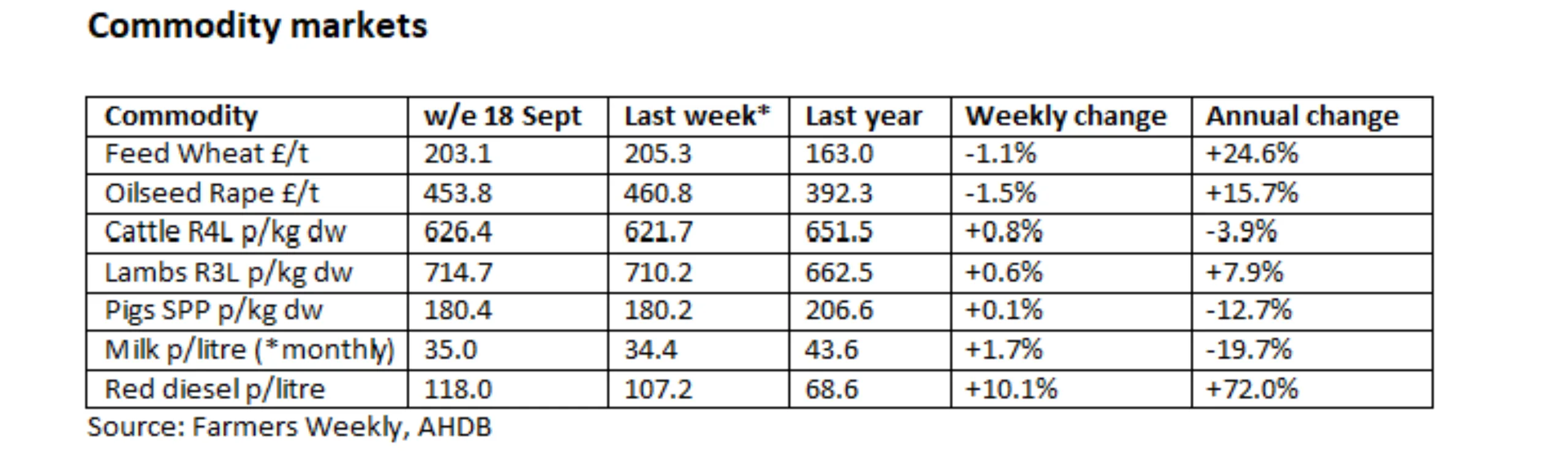
Farmers facing rocketing red-diesel costs will be praying the markets are right about potential peace talks between the US and Iran that are reportedly set to take place later this week. Brent Crude prices nudged back towards US$100/barrel in early trading on Monday morning as hopes for a breakthrough rose.
Grain sale debate
Arable businesses yet to sell this year’s harvest have some tricky decisions to make with grain prices falling back from recent highs. Although there are few signs that Russia and Ukraine are in the mood to scale back the attacks on each other’s Black Sea export hubs that have been supporting prices, the latest global supply and demand estimates from the USDA reveal the world is well stocked with grain. Predicting which way the markets move next will not be easy.
The headlines
NFU food security warning
A report released by the NFU last week to coincide with Back British Farming Day further highlights the vulnerability of Britain’s food chain.
According to Ready to Grow, 65% of wheat and barley grown on cereal farms last year came from farm businesses operating at a loss. On lowland livestock farms, only 26% of some sheep products came from profitable farms.
At the same time, the country is becoming less able to feed itself, says the report. Over the past 30 years, the UK’s self-sufficiency in 10 out of 11 everyday foods, such as wheat, vegetables, beef, poultry meat and eggs has fallen.
Food import volumes have climbed 70% over the period, while exports have dropped by 50%.
The NFU is calling on the government to implement a number of measures to help prevent even more damage being done to the farming sector.
In the immediate term, it is asking for a government-backed, interest-free ‘Keep Britain Growing’ loan, linked to losses caused by drought, to give farm businesses the working capital to produce next year’s food, as well as more support to help livestock farmers affected by bluetongue disease.
Longer term, it wants defined government targets for domestic food production and a set of core production standards that apply to both domestically produced and imported food sold in the UK.
The union is also calling for an increase in the Annual Investment Allowance to at least £5 million and for it to include assets qualifying for Structures and Buildings Allowance to support longer-term investments in efficiency and productivity improvements, including energy and water usage.
Pre-budget speculation
The new Chancellor John Healey is reported to be mulling several new tax raids as he prepares for his first Autumn Budget next month.
Speculation is mounting that Healey will move to reclassify holiday cottages as second homes rather than businesses for tax purposes, thus removing a number of valuable tax reliefs.
He is also said to be considering reducing the lower threshold for the government’s proposed “mansion tax”, which is due to kick in from April 2028, from £2 million to £1.5 million.
Under the scheme, officially known as the High Value Council Tax Surcharge, properties worth over £2 million are currently set to pay a £2,500 annual charge, while those valued at £2.5m to £3.5m will be hit with a £3,500 fee.
SFI funds falling short
Anybody thinking of making an application to the latest round of the sustainable farming incentive (SFI26) needs to act quickly to avoid missing out.
Although the government has said £230 million remains available for Window 2 of SFI26, which opens today (22 September), estimates suggest the scheme will still be vastly oversubscribed.
Mark Topliff, a grants and environmental scheme expert in our Rural Consultancy team, says he had a number of claims ready to be submitted as soon as the application system went live.
For those yet to finalise their claims, Mark advises: “Remember, before submitting your SFI application, check that your land details and mapping are up to date.
“Also, it will be your responsibility to check that the actions you apply for are compatible with the land types and other actions that you may have or are looking to have on the same parcel of land,” he adds.
To make the budget for SFI26 go further, Defra has stripped out a number of options and reduced the payment rates for others. Claims are also capped at £100,000.
For help and advice, please contact Mark.
News in brief
EDP consultation
Natural England (NE) has just put its first Environmental Delivery Plan (EDP) out for consultation. EDPs will be funded by the government’s new nature restoration levy (NRL) that developers can pay instead of having to go to the market to buy credits to offset things such as phosphate or nitrate pollution from their projects. Defra says the first EDP will unlock almost 16,000 new homes in Norfolk. Campaigners argue EDPs and NRLs will not adequately protect the environment. The consultation closes on 27 October.
Rent review advice
Landlords presented with a rent review notice before the Michaelmas deadline on 29 September should take the opportunity to engage collaboratively and constructively with their tenants, urges Alastair Paul, Head of our Rural Consultancy team in the East of England. “Ideally, in a long-term relationship rents should be discussed on an ongoing basis, rather than just going from notice to notice.” Please contact Alastair for advice on landlord/tenant issues.
Drought expectations
Over 70% of England is still officially experiencing drought conditions, with the situation likely to continue until the spring in some parts of the country. In most areas, 100% of long-term average rainfall between now and March will see a full recovery from water supply drought. However, even under the Environment Agency’s “most likely” rainfall scenario, East Anglia and Devon and Cornwall could still be experiencing drought conditions until March.
Interest rates on hold
The Bank of England’s Monetary Policy Committee voted 6-3 to keep the Bank’s base rate on hold at 3.75% last week. The outlook for the rest of the year and 2027 looks uncertain, with much hinging on events in the Middle East. Surging energy costs pushed the UK’s rate of inflation to 3.1% in August. If they fall back relatively quickly, the Bank can probably look through the temporary inflation spike. If they remain high and start producing higher wage settlements and broader price increases, a rate hike to 4% looks much more likely. Please contact Bradley Smith of Knight Frank Finance for more insight on borrowing costs.
Countryside Alliance hit list
Launching its Campaign for the Countryside last week, the Countryside Alliance identified 27 policies introduced by the current government that it claims have damaged rural communities. These include the family farm tax, higher taxes on employment, increases to firearms licensing fees, and plans to ban trail hunting. New polling conducted on behalf of the organisation found just 15% of those living in rural communities agree that the Labour Party cares about the people who live and work there.
Government IHT silo revealed
Meanwhile, a thought-provoking interview with a former Labour farming minister further lays bare the extent to which the “rural-proofing” and greater departmental cooperation that new governments always promise actually happens. Speaking to Farmers Weekly, Daniel Zeichner reveals that neither he nor the then Defra Secretary of State Steve Reed were told about Chancellor Rachel Reeves’s raid on Inheritance Tax before it was announced as part of her first Autumn Budget in 2024.
Nitrite-free bacon boost
Tesco is the latest retailer to launch an own-label range of nitrite-free ham and bacon products. The UK’s largest supermarket said searches for products without added nitrites had risen almost 400% year-on-year. Nitrites are used in the curing process for ham and bacon, but research has linked excessive consumption to a higher risk of developing cancer.
Property of the week
High Weald opportunity
Bassetts Manor, near Hartfield in East Sussex, offers a wealth of residential, agricultural and commercial property opportunities. A seven-bedroom Grade II listed manor house and traditional converted oast house sit at the heart of the 234-acre property, while a barn conversion and cottage provide further accommodation. A thriving 55,000 sq ft business centre, which includes studios, light industrial, storage and equestrian businesses, generates a significant income. The scenic farmland is mainly down to grass and is let to a local farmer until September 2027. The guide price for the whole is £5.95 million. The property is also available in three lots. Please contact Will Matthews for more information.

Discover more of the farms and estates on the market with Knight Frank
Property markets Q2 2026
Farmland
The farmland market remains in a state of inertia, according to the Q2 2026 edition of the Knight Frank Farmland Index, which tracks the value of bare land in England and Wales. Average values fell by just 1.5% over the quarter to just under £8,500/acre. Download the full report for more farmland insight and data.
Development land
The value of greenfield development sites fell 5.5% in the second quarter of the year, according to the Knight Frank Residential Land Index. Weak sales, elevated build costs driven by the Middle East conflict and uncertainty around scheme viability have all contributed to the drop, notes the report’s author Oliver Knight. There is, however, still demand for ‘shovel-ready’ sites. Download the full report for more numbers and analysis.
Country houses
The average price of rural properties fell 5% in the year to June, according to the Knight Frank Prime Country House Index, which tracks the value of homes worth over £750,000. The drop was slightly narrower than the decline of 5.5% recorded in March.
