
The Rural Update: Learn lessons from SFI debacle
Your weekly dose of news, views and insight from Knight Frank on the world of farming, food and landownership.
29 September 2026

Viewpoint
Hard lessons need to be learnt from last week’s Sustainable Farming Incentive (SFI) fiasco. If the government really wants farmers to produce food in a more nature-friendly way, forcing them to join an online lottery that had more in common with the bunfight for tickets to the latest Oasis gig than applying to a complex, business-critical environmental support scheme was not the way to do it.
Even businesses that had spent weeks preparing their applications missed out. As a result, some have angrily vowed to plough up their land under existing environmental schemes that will now go unfunded. Defra claims it is already looking at ways to improve the SFI application process in 2027, but tweaks will not be enough.
The entire scheme and the amount of funding available for it need to be rethought from the ground up. But English farmers also need to accept that they must now adapt their businesses to survive in an environment where guaranteed funding streams to supplement their returns from growing crops or rearing livestock no longer exist. If a particular enterprise is not viable without support payments, its future needs to be considered carefully.
Sign up to receive this newsletter and other Knight Frank research directly to your inbox
In this week's update
- Milk price relief
- Beat the nitrogen tax
- Oil price rollercoaster
- Wool auction boost
- SFI claims debacle
- Red Tractor changes
- Regional TIFF figures
- Harvest 2026 update
- Dairy regulation call
- The cost of bad diets
- Property of the week
- Property markets Q2 26
Milk price relief
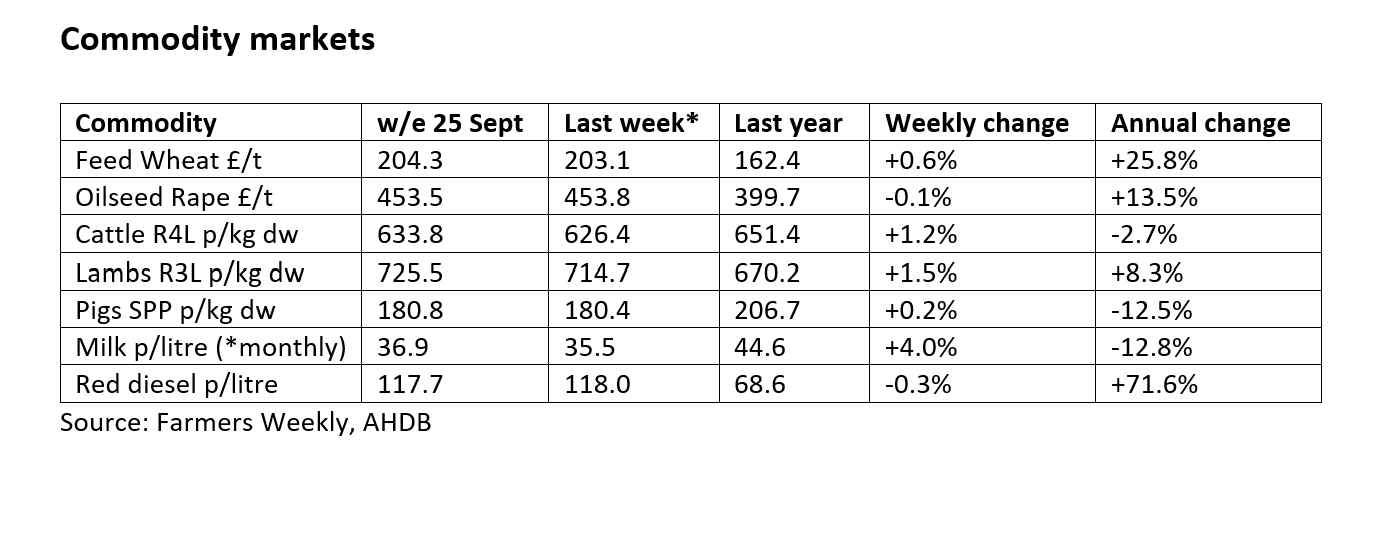
The average price paid to dairy farmers rose 4% in August to 36.9p/litre, according to the latest data from Defra . The jump came as production fell almost 5% on the month and nearly 4% compared with the same period in 2025. Prices remain 17% down on the year.
Beat the nitrogen tax
From 1 January 2027, fertiliser imports into the UK will be subject to the Carbon Border Adjustment Mechanism (CBAM), which will increase prices. Farming businesses wishing to avoid the hikes for their spring fertiliser requirements are being advised by traders to get their orders in soon, as logistics for packing and delivery will become increasingly constrained in the run-up to Christmas.
Oil price rollercoaster
Brent crude started the week closing in on US$110/barrel again after US President Donald Trump rejected a ceasefire offer to reopen the Strait of Hormuz from the Iranian government. Oil prices had been falling last week as hopes for a diplomatic breakthrough between the two countries rose. Forecourt diesel prices have hit an all-time high of 199.18p/litre, reports the RAC.
Wool auction boost
The British Wool Board is reporting a firm start to the 2026 selling season. With four auctions complete, the board says it has sold 3,000 tonnes of new-season wool at an average price of £1.70/kg, 70p/kg higher than after the first four sales in 2025.
The headline
SFI claims debacle
Thousands of English farmers were left angry and disenchanted last week when £233 million of funding for the second window of the 2026 round of the Sustainable Farming Incentive ran out within six hours of the application process opening.
Despite having planned their applications carefully, numerous farmers reported that the online portal refused to allow them to submit certain aspects of their claims. “It was a pretty nerve-wracking process,” reports Mark Topliff of our Rural Consultancy team, who managed to get all his clients’ applications in on time.
“Defra promised to share how quickly the funds were being allocated, but when the first email arrived just before midday to say 25% had already been claimed, and then 50% not much more than an hour later, it really ramped up the pressure.”
Around 12,200 SFI applications were received, equating to an average claim of £20,700, according to Defra. The five most popular options were: manage grassland with very low nutrient inputs, manage hedgerows, herbal leys, winter bird food on arable land and no insecticide on arable crops.
Defra says it will be looking at how it can improve SFI 2027 and is “exploring alternatives to a first come, first served application process”.
For help and advice on environmental schemes, please contact Mark .
News in brief
Red Tractor changes
Average farmgate feed-wheat spot values broke the £200/t mark for the first time in around three years last week as the full extent of the damage to Russian ports by Ukrainian drone attacks became clear. Repair work at NKHP, one of the country’s key Black Sea terminals, is expected to last up to four months, reports trader Frontier. November 26 feed wheat futures are now around £215/t.
Regional TIFF figures
Defra has released a regional breakdown of Total Income from Farming (TIFF) figures in England during 2025. TIFF increased in five of the country’s eight statistical regions. The biggest jump was in the South West, where incomes rose 38% from £819 million to £1.13 billion. Incomes in the North East saw the biggest fall, dropping 25% from £153 million to £115 million.
Harvest 2026 update
The AHDB has issued its final round-up of this year’s harvest . On average, wheat crops yielded 6.9t/ha, an almost 13% drop on the 10-year average. There was, however, huge variability across the country, with yields ranging from 3.8t/ha to 11.5t/ha. At 4.0t/ha, average oilseed rape yields were up on the 10-year average of 3.3t/ha.
Dairy regulation call
The Wildlife Trusts have just published a report calling for the UK’s largest dairy farms to be covered by environmental permitting laws. Doing Dairy Differently points to the growing number of permanently housed herds, as well as the rise of the ‘megadairy’. “Larger herds and longer housing periods mean more slurry must be stored, managed and spread safely. Existing infrastructure and advice systems are not keeping pace,” says the report.
The cost of bad diets
The economic cost of the UK's unhealthy food system has risen to £298 billion a year, up from £268 billion just two years ago, according to updated analysis from the Food, Farming and Countryside Commission. Direct costs to the NHS, social care and the welfare system, paid by the Treasury, the taxpayer and private citizens, now stand at £104 billion a year, up from £92 billion in 2024. Reduced productivity and diminished quality of life add £194 billion to the bill.
Property of the week
New Warwickshire launch
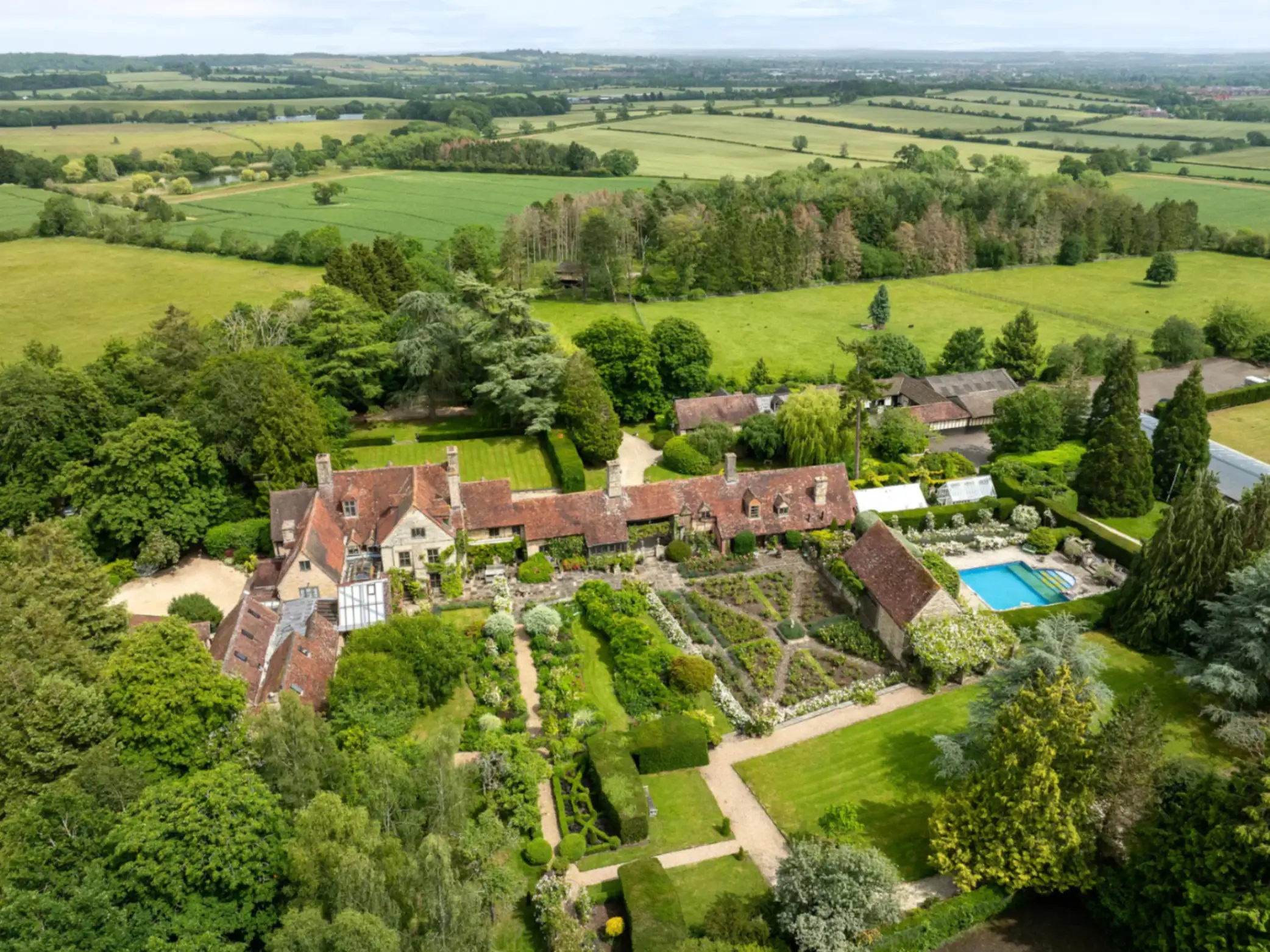
Upper Billesley House, near Stratford-upon-Avon, is a welcome arrival to a thin early autumn market. The 211-acre property will certainly appeal to buyers looking for a compact country estate with a period house and ample leisure and sporting opportunities. The seven-bed main house is surrounded by formal gardens, woodland, parkland and a mix of arable and pastureland with a 1.5-acre lake. There is a swimming pool, tennis court, large function barn and equestrian facilities, plus a cottage and two flats. The property is guided at £6.5 million. Please contact Will Matthews for more information.
Discover more of the farms and estates on the market with Knight Frank
Property markets Q2 2026
Farmland
The farmland market remains in a state of inertia, according to the Q2 2026 edition of the Knight Frank Farmland Index, which tracks the value of bare land in England and Wales. Average values fell by just 1.5% over the quarter to just under £8,500/acre. Download the full report for more farmland insight and data.
Development land
The value of greenfield development sites fell 5.5% in the second quarter of the year, according to the Knight Frank Residential Land Index. Weak sales, elevated build costs driven by the Middle East conflict and uncertainty around scheme viability have all contributed to the drop, notes the report’s author Oliver Knight. There is, however, still demand for ‘shovel-ready’ sites, he points out. Download the full report for more numbers and analysis.
Country houses
The average price of rural properties fell 5% in the year to June, according to the Knight Frank Prime Country House Index, which tracks the value of homes worth over £750,000. The drop was slightly narrower than the decline of 5.5% recorded in March.
