
The Rural Update: The food chain must help build climate resilience
Your weekly dose of news, views and insight from Knight Frank on the world of farming, food and landownership.
10 August 2026

Viewpoint
It’s relatively easy to quantify the potential impact of weather extremes on arable profits. Yields are tracked in detail, and prices are set by global markets. It’s more difficult, however, to assess the economic damage done to livestock and dairy businesses. Poor grass growth now could have far-reaching impacts that may gnaw away at the bottom line for several seasons. What seems clear though is that increasingly volatile weather conditions are more than just a passing phenomenon.
All producers need to carefully assess future cropping and rearing plans to build long-term climate resilience into their farming systems. But farming’s customers also need to play their part. Heineken is the latest food and drinks business to reward its suppliers for adopting regenerative farming methods, which could make soils more resilient to extremes of weather. Others must follow suit to protect their own supply chains.
Sign up to receive this newsletter and other Knight Frank research directly to your inbox
Commodity markets
Milk price green shoots
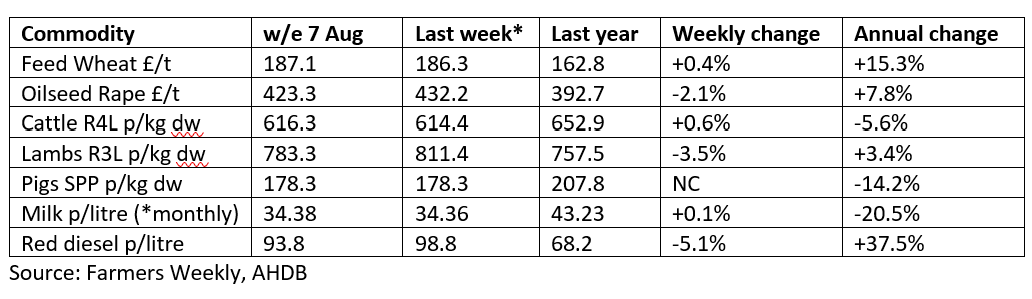
The latest milk price figures from AHDB show that the average payment to farmers increased very slightly between May and June. Although the difference is only marginal, it is the first increase since September 2025, and producers will be hoping it marks the beginning of a recovery with values still over 20% down on 12 months ago. Production dropped 8% month on month in June, and the current hot weather means further falls were likely in July. Several milk processors have announced price rises for August and September deliveries.
OSR Rhine warning
The range of geopolitical, economic and climatic factors influencing cereal and oilseed prices is already extremely wide, but now river levels in Germany could be added to the list. A significant volume of the country’s oilseed rape crop is moved by barge along the Rhine and falling water levels means some of the river’s ports are no longer accessible. Depending on other factors, such as attacks on Russian and Ukrainian Black Sea ports, this could provide some support for UK farmgate prices, reports trader Frontier.
The headline
Drought cost estimate
Analysis from the Energy and Climate Intelligence Unit (ECIU) has quantified the potential impact of this summer’s dry and hot weather on arable and livestock businesses.
Based on current wheat yield trends, the ECIU predicts that this year’s harvest has the potential to be the worst since 1984. Pre-heat wave estimates suggested a UK cereal and oilseeds crop of around 22m tonnes, but that could now drop to just 19.5m tonnes costing farmers up to £340 million.
Grass growth has also been badly hit, says the ECIU. During the first week of July growth fell to 63% of usual output. If the trend continues, livestock farmers could see a shortfall of 2,200 kg of dry matter per hectare, the equivalent of four months’ feed for one dairy cow.
News in brief
Bluetongue plea
Livestock farmers across Britain are being urged by vets to consider vaccinating their beef herds and sheep flocks to combat a surge in bluetongue cases. Incidents of the midge-borne disease, particularly in sheep, are rising rapidly in England with the wave expected to spread to Wales and Scotland over the coming months.
BNG exemptions
A reminder to all developers and those planning to build their own homes that biodiversity net gain (BNG) rules changed last week. Sites under 0.2ha (excluding priority habitats) are now exempt, but self-build houses are no longer automatically excluded. For more information on what the updates might mean for you, please contact Mark Topliff.
Muirburn rethink call
NFU Scotland has called for a further delay to the introduction of a muirburn licensing scheme, which is due to kick in on 15 September. The farming union says muirburn (controlled upland burning) is a valuable vegetation management tool that can help limit wildfires and more work needs to be done on the potential impact of licensing.
Scottish support boost
Speaking before last week’s Turriff Show, Scotland’s First Minister John Swinney announced that grants of up to £20,000 to help farmers and crofters invest in their businesses and modernise operations will open for applications from winter 2026. The £14.25 million of funding will support a range of initiatives, including improving soil quality, creating hedgerows and upgrading livestock management infrastructure.
Heineken regen move
Brewer Heineken has just announced that arable businesses supplying it with malting barley will be paid a premium for adopting regenerative farming practices. The producer of beer brands including John Smith’s and Cruzcampo hopes that 50% of its malting barley will be produced regeneratively by 2027.
Robot grant opens
Round two of the £20 million Farming Futures Automation and Robotics competition is now open. The fund supports collaborative projects developing practical automation and robotics technologies that help farmers, growers and foresters improve productivity, manage labour pressures and make everyday tasks more efficient. Applications close on 30 September.
Electricity PDR plan
Landowners can have their say on government plans to introduce a permitted development right (PDR) for ground investigations and surveys for electricity networks in England. The PDR would allow some low-impact, temporary ground investigations and surveys for electricity network projects to proceed without the need for a planning application, subject to a set of conditions and limitations. The consultation closes on 4 September.
Property of the week
Dorset downland for sale
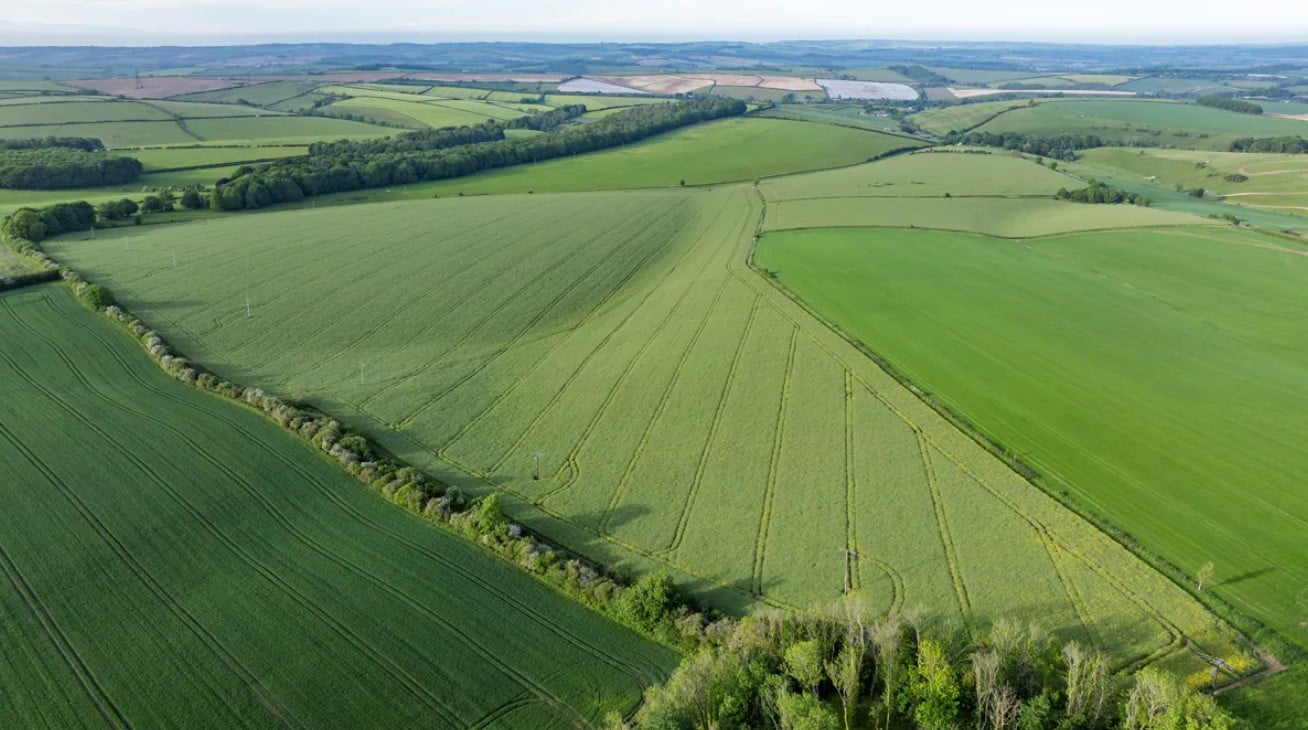
Landlords Knapp, a 194-acre block of chalk downland near Dorchester, has just been launched. Priced at £1.3 million, the arable fields enjoy an elevated setting amid the rolling countryside of the Dorset National Landscape near the world-renowned Jurassic Coast - designated a UNESCO World Heritage Site. Please contact Will Matthews for more details.
Property markets Q2 2026
Farmland
The farmland market remains in a state of inertia, according to the Q2 2026 edition of the Knight Frank Farmland Index, which tracks the value of bare land in England and Wales. Average values fell by just 1.5% over the quarter to just under £8,500/acre. Download the full report for more farmland insight and data.
Country houses
The average price of rural properties fell 5% in the year to June, according to the Knight Frank Prime Country House Index, which tracks the value of homes worth over £750,000. The drop was slightly narrower than the decline of 5.5% recorded in March.
