
The Rural Update: Ensure a level playing field for farmers
Your weekly dose of news, views and insight from Knight Frank on the world of farming, food and landownership.
30 August 2026

Viewpoint
Farmers across the UK adhere to some of the world’s highest animal welfare, food safety and environmental regulations. Meeting those standards builds trust with customers and consumers, but also incurs significant extra costs. Producers therefore have every right to expect food imports, often from countries with much lower costs of production, to be of the same quality that they must produce themselves. The recent salmonella cases thought to be from imported eggs, not to mention lopsided trade deals and the use of grain falling short of Red Tractor standards, suggest policymakers should consider listening to the UK’s farmers when it comes to Brazilian meat imports if they want to win back their trust.
Sign up to receive this newsletter and other Knight Frank research directly to your inbox
In this week's update
- Wheat gains ground
- Oil bounces back
- Milk rise continues
- SFI date announced
- Gun licence overhaul
- Brazilian ban urged
- Garden planning fury
- Salmon DNA concerns
- Property of the week
- Property markets Q2 26
Commodity markets
Wheat gains ground
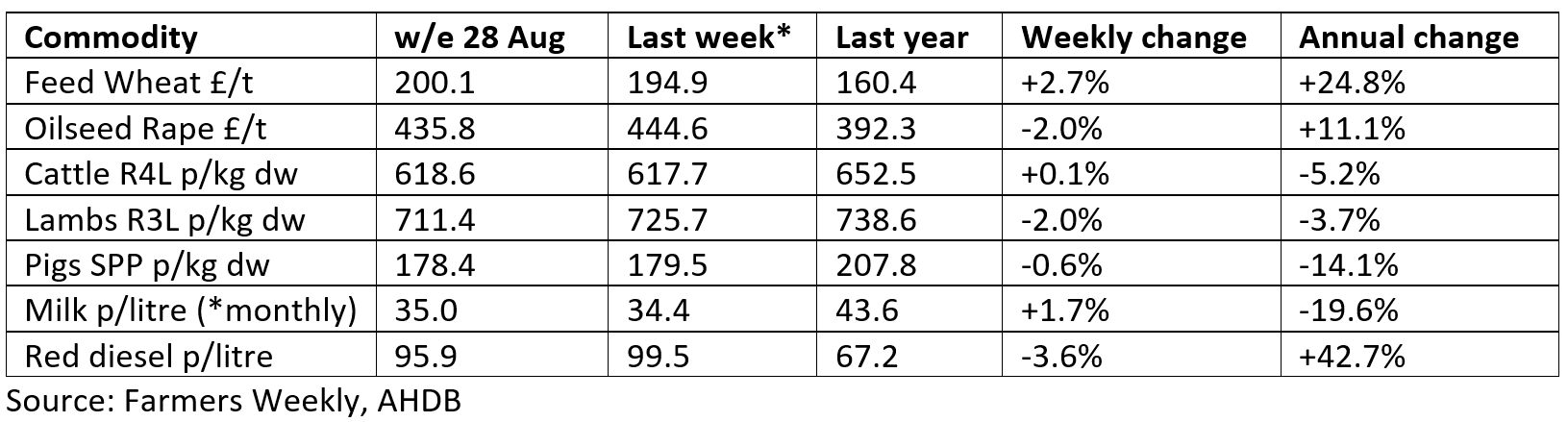
Average farmgate feed-wheat spot values broke the £200/t mark for the first time in around three years last week as the full extent of the damage to Russian ports by Ukrainian drone attacks became clear. Repair work at NKHP, one of the country’s key Black Sea terminals, is expected to last up to four months, reports trader Frontier. November 26 feed wheat futures are now around £215/t.
Oil bounces back
Brent crude prices are also on the rise again with oil trading at over US$90/barrel yesterday (31 August). Prices jumped after the US and Iran traded blows for the first time in a month. The US attacked Iranian forces attempting to disperse sea mines in the Strait of Hormuz, while Iran said it fired missiles at American air bases in Jordan.
Milk rise continues
The average price of milk supplied by dairy farmers across the UK rose for the second month in a row in July, according to the latest data from Defra. Values nudged up by almost 2% to 35p/litre but are still significantly below year-ago figures. July production was down almost 4% on the month and 2.4% lower than the same period in 2025.
The headline
SFI date announced
Defra has just announced that the second window of the 2026 round of the Sustainable Farming Incentive (SFI) will open on 22 September.
It also said that the first SFI window, which closed last week and was restricted to farms under 50 hectares and those that were not already enrolled in an environmental land management scheme, attracted 6,500 applications.
Just under 70% were from small farms and almost 90% were from farms without an existing agreement. Around 60% met both requirements and the average annual agreement value was just under £10,000.
Mark Topliff of our Rural Consultancy team has compiled a handy SFI guide for those planning to make an application to the second window.
“The most profitable SFI agreements are not necessarily those with the highest payment rates. The best returns often come from actions that require little change to existing management,” says Mark.
“SFI should form part of a wider farm business and natural capital strategy rather than being viewed in isolation,” he adds.
Please contact Mark for advice on SFI or other environmental schemes.
News in brief
Gun licence overhaul
The firearms and shotgun licensing system in England and Wales is not fit for purpose and a new national licensing authority should be created to better protect public safety, a new report from the policing inspectorate has found. The report’s 23 recommendations also include requiring an in-person medical assessment for all applicants and aligning the rules for firearms and shotguns.
Brazilian ban urged
The UK should copy the EU’s ban on Brazilian meat and animal imports that kicks in later this week (3 September), according to farm leaders. The ban follows Brazil’s inability to demonstrate compliance with EU rules on antimicrobial resistance, which are designed to prevent the development of antibiotic-resistant infections. There are concerns the ban will drive more Brazilian product into the UK.
Garden planning fury
Some of England’s cherished parklands and gardens could be at risk, following the government’s decision to remove The Gardens Trust as a statutory consultee in the planning system as part of its latest overhaul of planning policy. Trust Chair, John Watkins, said: “This devalues these special places and makes them vulnerable to poorly informed development.”
Salmon DNA concerns
Keen anglers might be concerned by new research that confirms the extent to which the DNA of wild salmon caught in some Scottish rivers is being diluted by farmed fish. According to a recent paper published in the ICES Journal of Marine Science, over 70% of the wild salmon in some west-coast river systems contained hybrid DNA, with almost 7% of their genetic material affected in the worst cases.
Property of the week
Multi-faceted Cotswold estate
Rupert Sturgis, Head of Knight Frank’s Cirencester office, is helping to sell a 230-acre opportunity-laden country estate. Rendcomb Park, formerly home to a public school, includes a large Grade II* listed mansion, numerous other historic buildings, including an old rectory, seven cottages and five houses, a wide range of leisure facilities and a theatre, all of which are surrounded by rolling parkland. The guide price is £20 million. Please contact Rupert for more information.

Property markets Q2 2026
Farmland
The farmland market remains in a state of inertia, according to the Q2 2026 edition of the Knight Frank Farmland Index, which tracks the value of bare land in England and Wales. Average values fell by just 1.5% over the quarter to just under £8,500/acre. Download the full report for more farmland insight and data.
Development land
The value of greenfield development sites fell 5.5% in the second quarter of the year, according to the Knight Frank Residential Land Index. Weak sales, elevated build costs driven by the Middle East conflict and uncertainty around scheme viability have all contributed to the drop, notes the report’s author Oliver Knight. There is, however, still demand for ‘shovel-ready’ sites, he points out. Download the full report for more numbers and analysis.
Country houses
The average price of rural properties fell 5% in the year to June, according to the Knight Frank Prime Country House Index, which tracks the value of homes worth over £750,000. The drop was slightly narrower than the decline of 5.5% recorded in March.
