
The Rural Update: Delivering win-win food and climate policies
Your weekly dose of news, views and insight from Knight Frank on the world of farming, food and landownership.
18 August 2026

Viewpoint
Sustain is spot on when it says local authorities should be doing more to encourage the sourcing of locally produced food. However, the pressure group’s recently published recommendation of a national model to “restrict advertising for the most climate-damaging foods” is more controversial. Inevitably, campaigners would want this to include UK-produced dairy and meat products, due to their claimed high level of carbon emissions. But research suggests this assumption is far from settled, with evidence mounting that grassland livestock systems can actually sequester carbon. Meanwhile, another lobby group, the Green Alliance, argues that a modest increase in the amount of land given over to horticulture, coupled with greater support for growers, could slash food imports and boost farm incomes. Slashing cross-channel lorry journeys while improving our self-sufficiency, rather than pursuing policies based on polarised viewpoints, seems a climate and economic win-win that the government should embrace when it eventually publishes its long-awaited horticultural strategy.
Sign up to receive this newsletter and other Knight Frank research directly to your inbox
Commodity markets
Mixed wheat/OSR signals
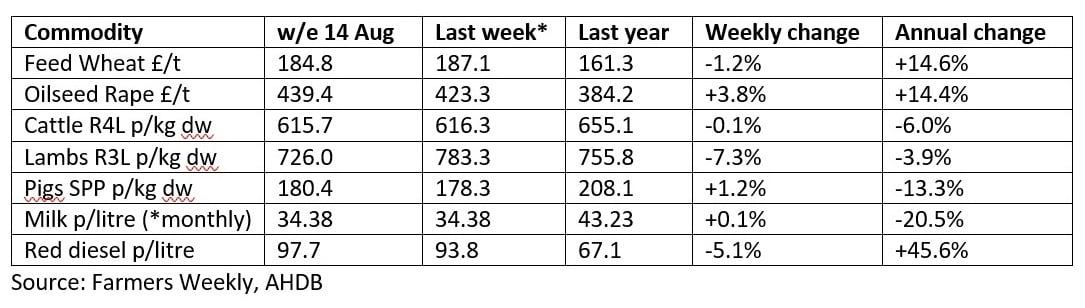
Farmgate wheat prices for immediate delivery remain under pressure with relatively weak demand for EU exports. However, concerns over US crop quality and attacks on Black Sea port infrastructure by Russia and Ukraine are supporting forward prices with November futures nudging over £200/t last week. The oilseed rape market is the reverse. Spot prices are firming as more European rivers become unnavigable due to the drought, but forward prices are weaker with no significant bearish supply-and-demand fundamentals to support the market.
Oil price malaise
The price of Brent crude continued to hover just below US$90/barrel at the start of the week as talks between the US and Iran remain deadlocked and official traffic through the Strait of Hormuz dwindled to zero. With Ukrainian drones also pummelling Russian oil infrastructure, prices might have been expected to rise more sharply. But a drop in demand – the International Energy Agency now projects that global oil demand will decline by 1.6 million barrels per day in 2026 – and the increasing use of a “shadow fleet” of smaller tankers is keeping prices in check.
The headlines
SFI drought action
Over 70% of England is now officially suffering from drought conditions. The East Midlands, Lincolnshire & Northamptonshire, Kent & East Sussex, and Solent & the South Downs moved into drought status last week.
In response, Prime Minister Andy Burnham announced a package of help for English farmers over the weekend. “The ability to grow our own food is national security, and I will treat it that way,” he said.
The measures included some temporary adjustments to Defra’s environmental land management schemes, which it says will help mitigate fire risk; ease shortages of grazing, fodder, forage crops and bedding; and give some flexibility on the planting and establishment of seed mixes.
For example, depending on which specific schemes and actions they are entered into, farmers running out of fodder and bedding for their livestock will have the option to cut or graze parcels of land under environmental agreements, such as buffer strips and pollen and wildflower mixes.
Anybody taking advantage of the adjustments must record them on Defra’s temporary adjustment form. Unless stated otherwise, the adjustment window ends when the Environment Agency’s drought status for the county the farm is located within returns to ‘normal’.
Other actions announced by Burnham included an extra £50 million for the Sustainable Farming Incentive in 2026 and £15 million of funding for on-farm reservoir construction. Critics, however, noted that the money was just being reshuffled from within Defra’s existing budget.
Actions to make it easier to build on-farm reservoirs were also included as part of an update to the National Planning Policy Framework announced yesterday (17 August).
Horticultural blueprint
The UK, which now relies on imports for 44% of its vegetables and 86% of its fruit, could enjoy a significant jump in self-sufficiency, farm incomes and health under a horticultural blueprint published last week by the Green Alliance.
Expanding horticultural production by under 50,000 hectares (123,000 acres) of land would allow the UK to grow half of what it currently imports in crops suited to the UK’s climate.
This expansion would return the UK to 66% self-sufficiency across all food eaten, a level last seen in 2000, and add £1.9 billion to the value of farmgate production, the report claims.
Some of the measures proposed include lowering and stabilising energy costs for producers by improving access to affordable clean power and supporting the sector to transition away from gas.
News in brief
BNG guide published
Following on from the introduction of changes to the government’s Biodiversity Net Gain (BNG) scheme earlier this month, Mark Topliff of our Rural Consultancy team has published a handy guide as to what the BNG updates could mean for developers and habitat banks. Please contact Mark for more information.
SFI round 1 still open
Smaller farming businesses and those not already signed up to an environmental land management scheme have until 28 August at the latest to apply for the first round of this year’s Sustainable Farming Incentive (SFI26), which opened on 30 June. Although an early rush of applications quickly used up over 75% of the £60 million available, some funds remain. The second round of the scheme, which is available to all farmers, opens in September.
Climate food policies
Andy Burnham should help more local councils to use their powers to “reduce the climate impacts of our diets”, according to new research analysing the food policies of local authorities by pressure group Sustain. The research notes that “many local authorities are introducing policies to support healthier food. However, the emphasis on nutrition within food policy, to the exclusion of wider health and environmental factors, limits the opportunity for local governments to take action on these issues.”
Development land fall
The value of greenfield development sites fell 5.5% in the second quarter of the year, according to the Knight Frank Residential Land Index. Weak sales, elevated build costs driven by the Middle East conflict and uncertainty around scheme viability have all contributed to the drop, notes the report’s author Oliver Knight. There is, however, still demand for ‘shovel-ready’ sites, he points out. Download the full report for more numbers and insights.
Pylon discounts revealed
The government has revealed the first 43 locations that will benefit from reduced electricity bills due to their proximity to new energy transmission infrastructure. Homes within 500 metres of a pylon will receive an annual £250 discount for 10 years. The discount should be applied automatically for residential properties, but those on commercial meters may need to apply.
Property of the week
King’s Island for sale

A stunning private island on Loch Craignish, off Scotland’s dramatic west coast, would make the perfect hideaway for anybody looking to get away from it all and be surrounded by nature. However, 261-acre Eilean Righ, which translates as the King’s Island, isn’t short of creature comforts. It is connected to the mainland by an underwater electricity cable and features two luxurious three-bed properties as well as a large helicopter hangar and a pontoon for docking a flying boat. The guide price is £6.5 million. Please contact Tom Stewart-Moore for more details and other island opportunities.
Property markets Q2 2026
Farmland
The farmland market remains in a state of inertia, according to the Q2 2026 edition of the Knight Frank Farmland Index, which tracks the value of bare land in England and Wales. Average values fell by just 1.5% over the quarter to just under £8,500/acre. Download the full report for more farmland insight and data.
Country houses
The average price of rural properties fell 5% in the year to June, according to the Knight Frank Prime Country House Index, which tracks the value of homes worth over £750,000. The drop was slightly narrower than the decline of 5.5% recorded in March.
