

The Rural Update: Don’t miss nature payment opportunities
Your weekly dose of news, views and insight from Knight Frank on the world of farming, food and landownership.
06 July 2026

Viewpoint
With much of this year’s barley crop already in the barn and wheat beckoning soon, arable farmers at least will be relieved that this year’s harvest isn’t set to be another washout. Grain prices are also slightly up on last year’s, but the hike in fuel and other input costs will probably cancel out those gains. To plug the gap, income from environmental schemes could be increasingly important. Defra kept its promise to be transparent about applications for this year’s Sustainable Farming Incentive (SFI) scheme. But the speed at which the available funding for the scheme’s first application window for small farms was claimed means those larger businesses looking to apply during the second window in September need to start planning now. The same applies to the Countryside Stewardship (CS) Higher Tier, which will open for direct applications soon. Harvest may be the focus now, but don’t let valuable environmental payments slip through your fingers.
Sign up to receive this newsletter and other Knight Frank research directly to your inbox
Commodity markets
Milk steadies
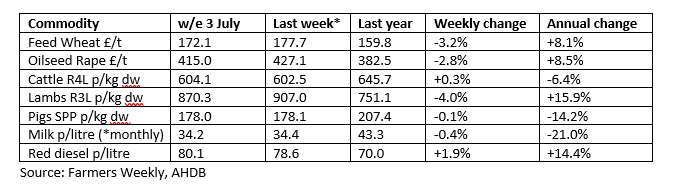
Average farmgate milk prices dropped by just 0.4% in May compared to April, according to the latest Defra statistics. Although prices are still 21% below what farmers were receiving 12 months ago, analysts are hoping that a 1.9% drop in milk output will set the scene for a recovery over the summer. Several processors, including Arla, have announced price rises in July or August.
Grains wobble
With combines already rolling across much of the country, wheat markets are caught in a tussle between a bearish North American harvest scenario and more bullish prospects in the Black Sea. The latest USDA update puts total US wheat plantings at 17.3m hectares, the lowest since 1877. However, Russia’s 2026/27 harvest forecast has been raised to 91.2m tonnes, with good harvest progress across the region bringing plenty of competitively priced grain to the market.
The headline
SFI stampede
Farmers have clearly heeded the warnings to get their Sustainable Farming Incentive (SFI26) claims for this year in as quickly as possible.
Although the first round of SFI26, which is open to farms smaller than 50 hectares and those without an existing environmental agreement, only opened at the end of June, 25% of the available £60 million of funding had already been claimed by 1 July, with 50% accounted for by Friday (3 July), according to Defra.
However, after this early surge, Defra says the volume of claims has levelled out. It will provide another update when 75% of funding has been allocated.
Businesses that miss out will be able to put in a claim when the second window for SFI26 opens. Defra advises that this will be at some point in September.
Please contact Mark Topliff for help with SFI26 claims or other grant applications.
News in brief
CS higher-tier expanded
Farms and estates will soon be able to apply directly for Countryside Stewardship Higher-Tier (CSHT) funding. Entry to the environmental scheme has been by invitation only, but later this summer claimants will be able to begin the application process by submitting an Expression of Interest for agroforestry, woodland, and new single-focus agreements, which will initially cover ancient monuments and species-rich grassland. Defra says at least £50 million will be available for new CSHT agreements this year, hopefully including common land.
Direct payment cuts
Environmental payments like SFI26 and CSHT will be increasingly important for land managers in England, with Defra confirming the delinked payments that replaced the Basic Payment Scheme (BPS) in 2024 will dwindle to virtually nothing in 2026 and 2027. Payments will be cut by 98% of a claimant’s reference amount (based on previous BPS claims) for the first £30,000 of any claim and by 100% for any additional amount. Defra has a handy online calculator to check what you will receive.
BNG boost
The annual market for Biodiversity Net Gain (BNG) is close to breaking the £100 million barrier, according to a new report from Biodiversity Units UK. It estimates that developers will spend £93 million on BNG units in 2026, with the market worth £500 million by 2035. However, the planned introduction of Local Nature Recovery Strategy Zones later this year could see the market become more competitive with developers having a greater range of BNG options to choose from.
Trail hunting support
The recently closed public consultation on banning trail hunting received a record 91,000 responses from people urging the government to reconsider the controversial move, which campaigners say will damage rural economies and traditions. Opponents, however, claim that trail hunting, where hounds follow a pre-laid scent, is often used as a cover for fox hunting, which was banned in 2004. The government’s response, expected soon, could be an early test as to whether Andy Burnham really wants to reset Labour’s relationship with the countryside.
Property of the week
Scottish island idyll
With the summer holidays just around the corner, the sandy coves of Inchmarnock Island’s 4.75 miles of coastline offer the perfect secluded getaway location. Located in the Firth of Clyde near the Isle of Bute, the 661-acre island has significant farming, recreational, conservation and development potential. There is a productive in-hand organic herd of Highland cattle, two former farmhouses and a range of modern and traditional buildings. A dedicated ferry, the Marnock, which is currently used to transport livestock and machinery between Inchmarnock and Bute, is available separately, as is the Port House on Bute, which has its own slipway that provides practical and attractive access to the island. Offers in excess of £1.4 million are invited. For more information, please contact Tom Stewart-Moore.
