
The Rural Update: A roadmap for farming resilience?
Your weekly dose of news, views and insight from Knight Frank on the world of farming, food and landownership.
29 June 2026

Viewpoint
The government’s new farming roadmap is in some ways a very belated acknowledgement by an administration, often accused of not understanding the countryside, that farming is actually quite important. Defra Secretary Emma Reynolds explicitly talks about the wider £153 billion contribution that the agri-food industry makes to the economy. The words are warm and generally quite sensible, even if many of them are just common sense. None of the recommendations seem crazy; some are entirely sensible, and many come from Minette Batters’ well-received Farming Profitability Review.
There is, of course, an elephant in the room. Money. There is no ringfenced funding commitment to match the report’s ambitions, and there is no guarantee that the next Labour leader will feel bound by them, let alone the next government. And, of course, there is no mention of Inheritance Tax. Farms and landed estates looking for a path to a resilient future will probably want to plot out their own 25-year roadmap.
Sign up to receive this newsletter and other Knight Frank research directly to your inbox
Commodity markets
Oil falls sustained
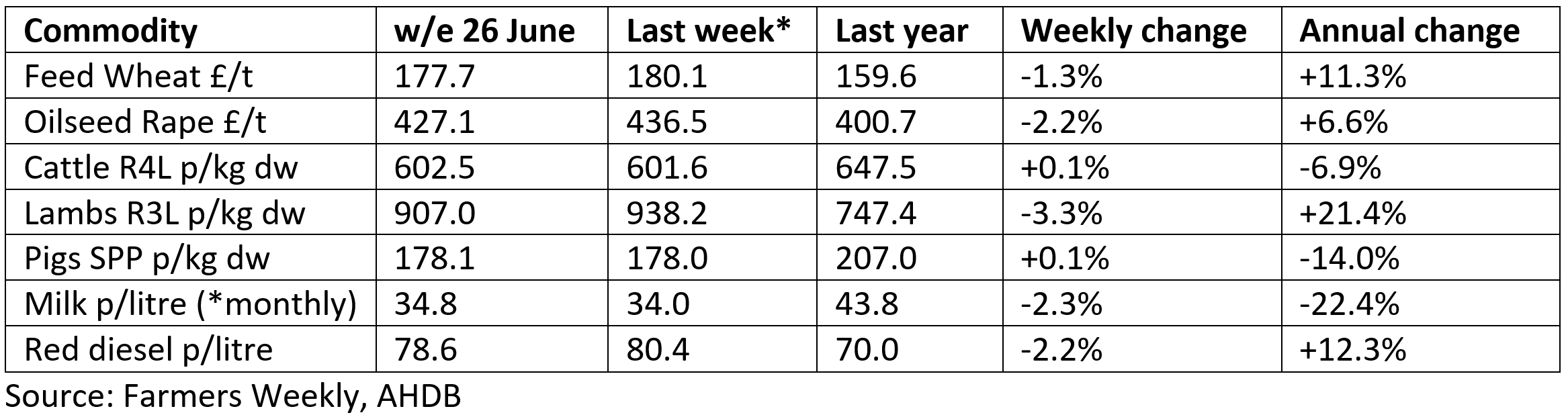
Oil markets seem to be shrugging off a return to blows by Iran and the US, with red diesel prices falling further on the week. Despite Iran attacking several oil tankers and subsequent retaliatory strikes on Iranian military targets by America, Brent Crude futures remained below US$73/barrel on Monday morning. An estimated 20 million barrels of crude are now passing through the Strait of Hormuz each day.
Outputs down, inputs up
The value of agricultural outputs fell by almost 7% in the 12 months to April 2026, according to Defra’s latest Agricultural Price Index. Although there were five upward contributions, including sheep and lambs (+1.2%) and fresh vegetables (+0.6%), there were seven fallers, with milk dropping 4.7%. Conversely, the cost of inputs rose by 6.7% over the same period. The largest upward contribution was energy and lubricants (+2.5%), followed by fertilisers and soil improvers (+2.3%).
The headline
Farm roadmap published
The government has finally published its long-awaited 25-year vision for agriculture, although the report has received a fairly lukewarm welcome from farming organisations.
Writing in the foreword to Farming Roadmap 2050: Growing England’s Future, Defra Secretary Emma Reynolds says: “For too long, farmers have been asked to navigate profound change without a clear sense of where government is heading over the long term.”
Split into two sections, the roadmap first sets out the government's vision for farming before detailing the three themes it says are needed to deliver that vision.
- Profitable and productive: supporting farm business performance
- Sustainable: farming for environmental and sector sustainability
- Resilient: building a resilient farm business
Many of the themes include recommendations from Minette Batters’ Farming Profitability Review, such as changing how the wider contribution of farming to the UK’s economy is measured, cutting red tape by removing multiple overlapping government interfaces, and better connecting the industry to private capital.
Although the report is focused on food production, there is a heavy emphasis on lower-input, nature-friendly farming systems. It also says that the government’s environmental land management schemes will become tighter and more targeted.
“In order for farms and estates to keep receiving money under these schemes they will increasingly need to look at their natural assets rather than just their farming operations,” says Mark Topliff, a grants expert in our Rural Consultancy team.
News in brief
Profit review response
In addition to its new farming roadmap, the government has also just published its response to the 57 recommendations contained in Minette Batters’ Farming Profitability Review commissioned by former Defra Minister Steve Reid. It claims that most of the recommendations from Baroness Batters, a former NFU President, are “already underway or will be implemented in the near future”.
Meat methane misunderstood
A new report claims that the metrics used to suggest pasture-fed beef and dairy animals have a bigger impact on the climate than intensively reared herds are misleading. Although the paper, Beyond methane: Why an efficient food system requires inefficient animals, recognises that grass-reared animals do emit more methane per unit of milk or meat, it says that the apparent efficiency of intensive systems largely disappears when measured against the “metric that actually matters for food security”: human-edible protein output.
Climate change veg hike
Another report, meanwhile, says that heatwaves caused by climate change could cause the price of the UK’s 20 most popular fruit and veg to rise an extra 11% by 2035 and 60% by 2050 under a high emissions scenario. The Price of 5 a Day by the Autonomy Institute says the calculations don’t take into account other climate-related issues such as flooding, soil erosion and water degradation.
Peat restoration cash
Applications are now open for lowland farmers in England to claim their share of peatland restoration funding. For those with a water management implementation plan in place, grants of £100,000 to £2 million are available under the £36 million Lowland Peat Water Implementation Grant to cover 100% of eligible costs. The closing date is 18 September. A further £10 million to help develop markets for wetland crops used in industrial products is available through the Paludiculture and Wetter Farming Fund, which closes on 21 August.
Nature investment boost
The volume of private capital being invested in nature each year has increased from US$2.8 billion ten years ago to US$14 billion today, according to a new report by environmental organisations Forest Trends and The Nature Conservancy. Gaining Ground: State of Private Investment in Nature 2026, highlights that sustainable agriculture has accounted for almost US$33 billion of the US$60 billion invested over the past decade.
Pig sector survey
Pork producers are being invited to share their views on food chain fairness in a new survey launched by Richard Thompson, the Agricultural Supply Chain Adjudicator. Thompson says the survey will help him better understand awareness of the Fair Dealing Obligations (Pigs) Regulations 2025, which are intended to support clearer and more transparent contractual relationships between producers and purchasers, and whether further government engagement is required.
Win wine!

If you want to stay ahead in the UK wine market, our UK Wine Insights newsletter is your go-to.
Delivered monthly, it brings together the trends, analysis and commentary shaping the sector - designed for investors, industry professionals and anyone with a serious interest in UK wine.
As a thank you, when you sign up, you can also enter our prize draw to win a case of Folc wine. Sign up and enter the draw.
Properties of the week
Rare Windermere opportunity
Grade I listed Calgarth Hall and 298 acres of surrounding undulating pasture offer a stunning lakeside opportunity for anybody looking to create a picturesque Cumbrian lifestyle estate. The six-bedroomed hall, which includes 300 metres of rare frontage onto Lake Windermere, requires renovation, but would make a striking home.
Two other properties offer secondary accommodation in idyllic locations. There are also 26 acres of woodland, a range of buildings previously used as a stud farm, and a further 600 metres of lake frontage. The property is available in seven lots with a £5.55 million guide price. Please contact Zara Elliot for more information.
