

The Rural Update: Weak supply chains need new thinking
Your weekly dose of news, views and insight from Knight Frank on the world of farming, food and landownership.
18 May 2026
Viewpoint
Thankfully, the UK’s farmers haven’t yet been forced into anything as dramatic as California’s peach producers, who may have to fell over 400,000 trees following the bankruptcy of the region’s main buyer Del Monte Foods.
But a predicted loss of almost £140/acre for wheat growers in 2027 should force many arable farmers to seriously consider what crops they put in the ground this autumn. Although unlike their Californian counterparts, they don’t rely on just one customer, they are still highly vulnerable to supply-chain choke points, such as the Strait of Hormuz.
That’s why the government’s consultation on reforming the UK’s fertiliser market is so crucial. Whilst it will be tempting to rely on new types of fertiliser, the government also needs to accept the folly of losing virtually all of our domestic nitrogen manufacturing capacity.
It would also do well to recognise that a lack of regional processing facilities for alternative crops, such as beans and peas, leaves farmers too reliant on loss-making cereal crops. We need more home-grown capacity and regional thinking across the farming sector to boost our food chain resilience.
Sign up to receive this newsletter and other Knight Frank research directly to your inbox
Commodity markets
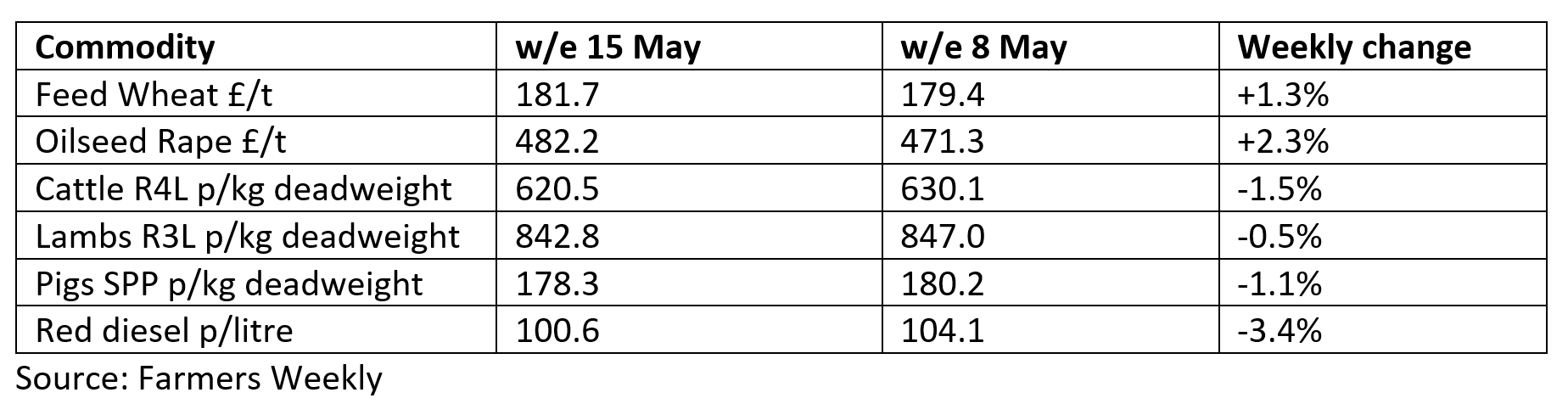
Lock in wheat prices
Grain markets remain incredibly volatile, meaning arable farmers who have not already sold their 2026 crop need to retain a laser focus on prices. November futures contracts broke the £190/t mark at one point last week but have since fallen back to £187/t (as of 18th May). Bullish sentiment is being driven by concern about the state of the US crop and a potential drop in Australian wheat plantings, but decent global stocks and strong levels of Black Sea exports are tempering the upside.
Fertiliser warning
Producers, particularly those planning to grow nitrogen-hungry milling wheat, also need to think hard about their 2027 fertiliser requirements, suppliers are warning. The ongoing stalemate between the US and Iran around the Strait of Hormuz means the high price of ammonia, which is the crucial gas-derived feedstock for nitrogen fertilisers, could force some manufacturers to halt production completely. The introduction of the UK’s Carbon Border Adjustment Mechanism (CBAM) on imported fertiliser from next January will put further pressure on prices.
The headline
IHT case fails
An application for a judicial review of the consultation process carried out before the government’s reform of agricultural and business property relief, commonly referred to as the Family Farm Tax, was thrown out by the High Court last week.
The court said the application, which argued that higher inheritance tax bills would have a devastating impact on many family farms, failed for three reasons:
No legitimate expectation: The policy documents relied on did not contain a clear and unambiguous promise that the government would consult on the merits of tax policy changes in every case. The documents contained qualifications and exceptions and offered essentially political commitments which were not legally binding.
Delay: The relevant decision was announced on 30 October 2024. The claim was not brought until May 2025 and was therefore out of time.
Non‑justiciability: The decision challenged formed part of the Budget and Finance Bill process, which falls within parliament’s constitutional responsibility. Reviewing the scope or adequacy of consultation in that context would infringe parliamentary privilege and the separation of powers.
News in brief
CAAV cereal loss warning
A new analysis of first wheat profitability by the CAAV suggests it will be “both economically rational and, for some, impractical or unaffordable to plant less productive land for 2027”. The organisation’s figures predict that growers are already set to lose £56/acre for the 2026 harvest, but spiralling fuel and fertiliser costs due to war in the Middle East will see losses soar to £139/acre in 2027.
Regional food focus needed
A new report from Place Finance Lab is calling for targeted financial structures to support regional food economies and reduce our vulnerability to fragile global supply chains. Collaborative Financial Innovation for Regional Food Systems highlights three key issues hampering food chain resilience: a lack of local infrastructure, the absence of mechanisms for collaborative landscape regeneration, and a critically thin pipeline of new farming entrants.
Ecosystem services tax
The Treasury has just published a technical note confirming how the delivery of ecosystem services will be taxed for both buyers and sellers. In terms of statutory schemes, the note covers the provision of biodiversity net gain (BNG) and nutrient neutrality credits. It also looks at the voluntary provision of carbon credits under the Woodland and Peatland Carbon Codes.
Fertiliser consultation extended
Following the market chaos created by the closure of the Strait of Hormuz, Defra has extended the deadline for its consultation on reform of the UK’s fertiliser market until 10 June. The reforms aim to make it easier for innovative new fertiliser products to be brought to market, reduce the UK’s reliance on imported fertiliser and protect the environment. Take part in the consultation.
Sea eagle release approved
Natural England has just approved the release of 20 white-tailed eagles, the UK’s largest raptor, into Exmoor National Park over the next three years. Livestock farmers are concerned the birds, also known as sea eagles, could prey on newly born lambs, but Natural England said there was no evidence of this occurring following a previous release scheme on the Isle of Wight.
Scottish food price cap
Despite losing six seats following the country’s recent parliamentary elections, the Scottish National Party (SNP) is still comfortably Scotland’s largest political party. As a result, First Minister John Swinney has pledged to continue with his controversial plan to introduce price caps on 50 shopping-basket staples like milk, eggs and butter. Measures would be put in place to protect farmers from supermarkets passing the costs back down the supply chain, he said.
Peach tree apocalypse
Over 400,000 Californian peach trees are likely to be felled following the bankruptcy of Del Monte Foods. The 139-year-old canned fruit business has permanently closed its canneries in Modesto and Hughson, leaving growers with no other buyers. State politicians have just announced a US$9 million aid package to remove the trees before this season’s harvest to allow farmers to grow other crops and reduce their losses.
Sign up for vineyard insights
If you manage your own vines or are interested in the English wine sector, the regular subscriber-only newsletter written by Ed Mansel Lewis, Head of our specialist Viticulture team, could be of interest. Commenting on his latest article, Ed says: “As the industry matures, we are seeing an increasing range of business models in English wine. Some are navigating the challenges of our times better than others, although each has its benefits and drawbacks.” Sign up to find out more.
Next Gen Dales discussion
Our Northern Rural team is helping to host a CLA Next Generation event at the stunning Ingleborough Estate in the Yorkshire Dales on 5 June. The day will help equip those managing a diversified rural business or planning for the next generation. Attendees will also hear how the Farrer family has strengthened Ingleborough’s financial resilience, from a café renovation to land-use planning, offering an honest insight into the estate’s development so far. Sign up for the event.
Property of the week
Cotswolds classic
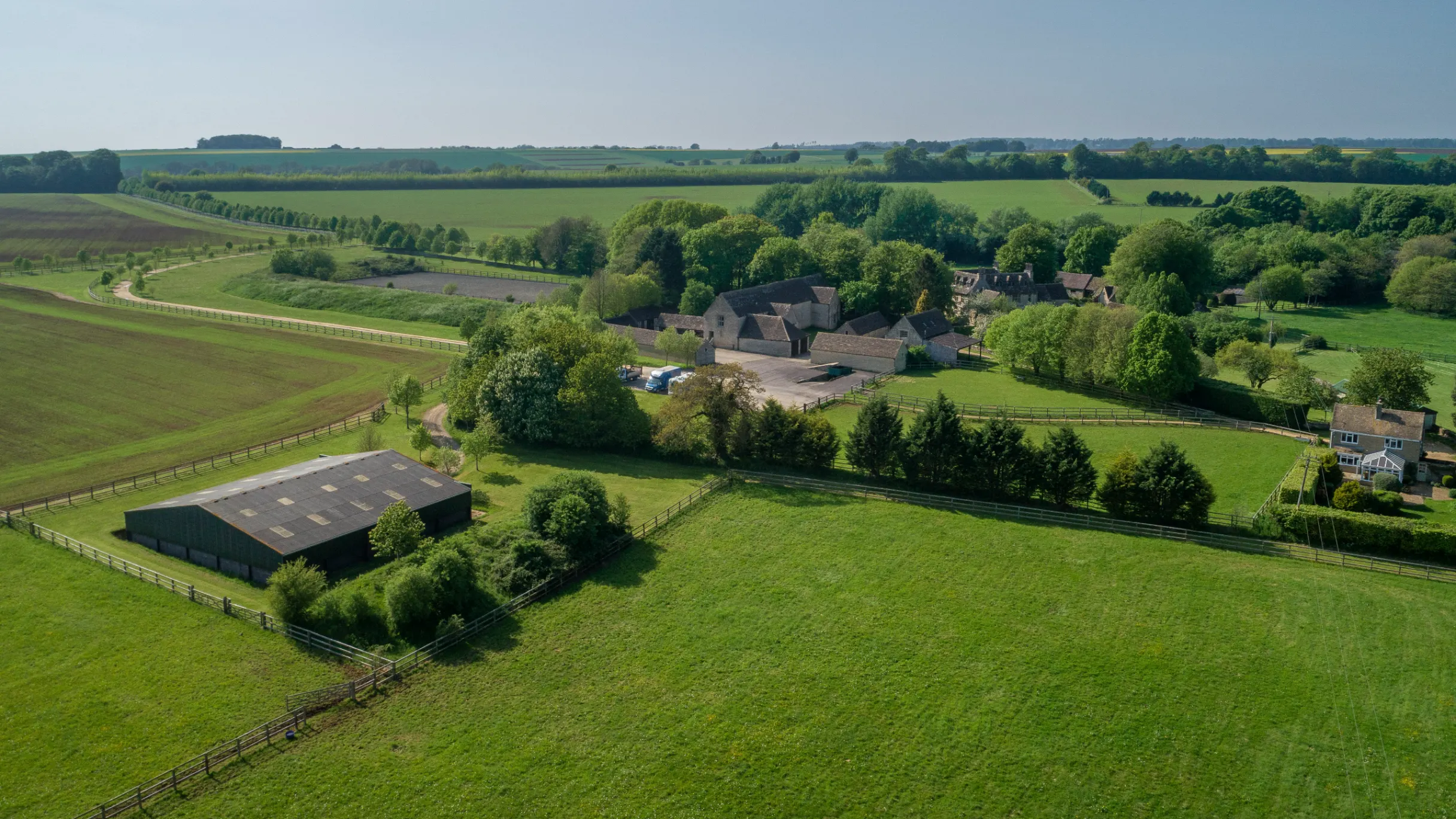
Anyone looking for a compact farming and lifestyle estate in the heart of the Cotswolds will want to check out Saddlewood Manor, near Tetbury, which has just been launched by Zara Elliot. The 172-acre ring-fenced property comes with a 17th-century, six-bedroom Grade II listed manor house, which enjoys “fabulous, big-sky sunsets”, an indoor swimming pool complex, a range of equestrian facilities and two secondary homes. Most of the land has previously been farmed as part of an arable rotation, but is currently down to grass. The guide price is £6.95 million. Please contact Zara for more information.
Discover more of the farms and estates on the market with Knight Frank
Property markets Q1 2026
Development land – Green fields flat
The average value of urban brownfield and prime central London development land fell by 2.5% in the first quarter of the year, according to the Knight Frank Residential Development Land Index. Geopolitical instability, higher borrowing costs and an easing yet still onerous planning and regulatory environment weighed on demand, says our head of Res Dev research, Oliver Knight. Greenfield values, however, remained flat, reflecting more resilient conditions for volume housebuilders in suburban markets, where lower-density schemes, simpler build requirements and steadier underlying demand have supported viability, adds Oliver. Download the full report for more data and insight.
Farmland – market treads water
The average value of farmland remained relatively unchanged in the first three months of the year, according to the Knight Frank Farmland Index. Continued political and economic uncertainty, exacerbated by the current conflict in the Middle East, which has seen input costs like fuel and fertiliser spiral, and poor weather, mean few new farms, blocks of land or estates were put up for sale during the traditional spring selling season. But despite a perception by vendors that now is not a good time to sell, demand remains firm from a range of buyers. If you are thinking of selling, please contact Will Matthews.
Country houses – values stabilising
The average price of houses in the countryside fell 5.5% in the 12 months to the end of the first quarter of 2026, which was a modest improvement on the 5.7% decline recorded in December, despite the uncertainty caused by the Middle East crisis, according to the Knight Frank Country House Index. The annual price decline for flats (-3.8%) and townhouses (-5.1%) was lower than for farmhouses (-7.1%), underlining how demand has been stronger in needs-driven markets. Prices are now 13% lower than their pandemic-era peak in Q2 2022, when demand increased for more space and greenery. Contact Tom Bill for more insight and data.
