

The Rural Update: Government and farmers must be ready for black swans
Your weekly dose of news, views and insight from Knight Frank on the world of farming, food and landownership.
26 May 2026

Viewpoint
Politicians might argue that it is unfair to expect them to be ready for every so-called black swan event, such as the current energy price spike that followed the US and Israeli attacks on Iran. However, in recent years, such events have hardly been rare, including the Covid-19 outbreak and the Russian invasion of Ukraine, all set against an ongoing backdrop of increasingly volatile weather patterns.
If we are being generous, policymakers can be excused for not predicting the exact nature of the next crisis, even if some of them don’t seem that surprising, but they should, at the very least, expect something to happen and plan accordingly, especially as threats to food security seem to be a recurring theme.
However, the knee-jerk reaction to the effects of the Iran war, including talk of a price cap on certain foods, suggests lessons have not been learned. The unwillingness to concede that the new carbon tax on imported fertilisers, set to kick in on 1 January 2027, will further hit farmers’ profit margins is also concerning, given that the UK no longer has a domestic fertiliser industry of any scale to protect.
However, farmers and landowners also need to prepare for the government’s lack of preparation. As highlighted in some of the reports discussed below, making businesses more resilient to commodity price and climatic volatility has to be a priority.
Sign up to receive this newsletter and other Knight Frank research directly to your inbox
Commodity markets
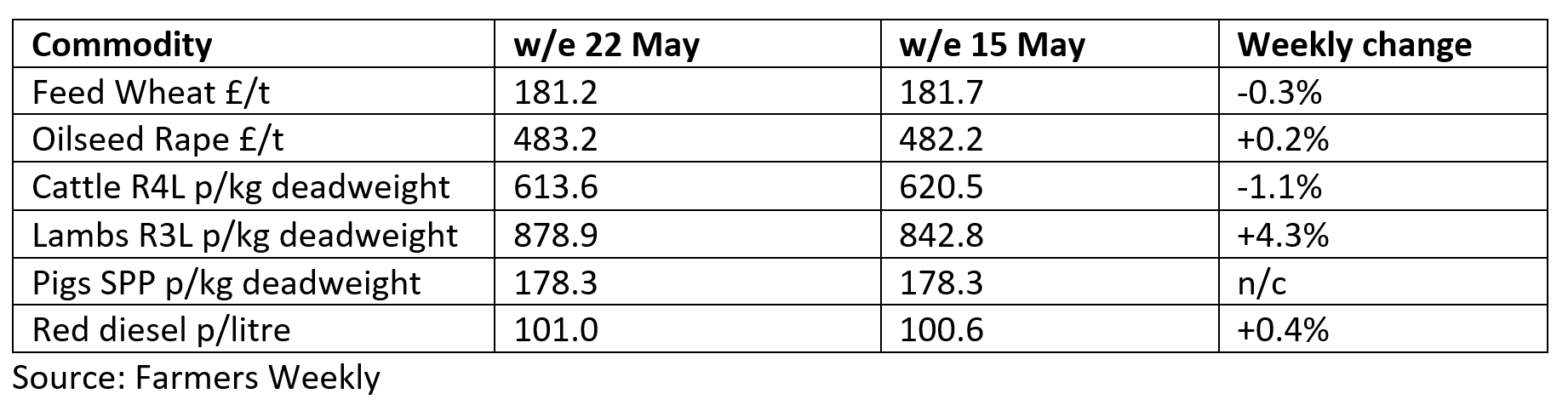
Oil price rollercoaster
Crude prices fell to their lowest levels in a fortnight earlier this week as hopes of a successful peace deal between Iran and the US grew, which would see the critical Strait of Hormuz back in action. Brent crude, the international benchmark, dropped almost 7% in value on Monday. However, by yesterday morning (25 May), prices were rising again after the US fired missiles at Iranian targets around the Strait.
Wheat weather boost
UK wheat prices could benefit from escalating weather issues in key growing areas. According to trader Frontier, the latest USDA crop condition report has sent “shockwaves” through the wheat market, projecting the smallest US harvest since 1972. The growing prospect of an El Niño weather event in the southern hemisphere, which could bring drought conditions to Australia, parts of Latin America and Southeast Asia over the summer, is also providing support for forward grain prices. Farmers in the region are already considering scaling back production due to rocketing fertiliser prices.
The headlines
Energy crisis action
The government has announced a range of measures designed to mitigate the impact of the Iran war, which has sent energy and fertiliser costs spiralling.
In a welcome move for farmers, the Treasury has postponed a planned 5p/litre hike in fuel duty until the end of the year and cut the duty on red diesel, which is almost 40p/litre more expensive than it was 12 months ago, by over a third.
A suspension of import tariffs on more than 100 food items, including biscuits, chocolate, baked beans, dried fruit and nuts has also been announced, which could save shoppers £150 million a year.
However, the government has been forced to scrap a proposal for supermarkets to voluntarily cap the price of food staples such as milk, bread and butter. Some retailers branded the move as “completely preposterous”, while farming organisations claimed it would lead to more downward pressure on farmgate prices.
Industry calls for a delay in the implementation of the UK’s Carbon Border Adjustment Mechanism, which would see a carbon tax levied on fertiliser imports, potentially hiking prices by up to 30% from 1 January 2027, have so far been slapped down by the Treasury.
Land tax worries
Manchester mayor Andy Burnham, who will fight Keir Starmer for leadership of Labour if he holds off a resurgent Reform party in the Makerfield by-election, has caused consternation for farmers and rural estate owners by saying that he will consider introducing a land value tax (LVT) if he becomes Prime Minister.
Some economists and think tanks, not all of them left-leaning, argue that such a tax, if properly implemented on the undeveloped value of land, could be a fairer way to tax property, especially if it replaces existing taxes such as business rates, stamp duty, council tax, and even inheritance tax.
However, if applied to agricultural land, which is exempt from business rates, an LVT would be a bitter blow for businesses that are already struggling to turn a profit and worrying about the implications of the controversial ‘family farm tax’.
News in brief
UK climate risks
Stockpiling essential foods, helping farmers adapt to climate change, digging more reservoirs and maintaining the country’s food self-sufficiency at 60% are all recommendations in the Climate Change Committee’s fourth five-year independent assessment of UK climate risk. A Well-Adapted UK also calls for the government’s nature targets to move away from historical baselines that may no longer be achievable.
Climate hits food prices
Meanwhile, another report claims that climate shocks are to blame for the most significant slice of the UK’s recent food-price inflation, rather than increased regulation or wage rises. The Energy and Climate Intelligence Unit said annual price inflation for milk, butter, beef, chocolate and coffee hit 16% last July, over six times higher than the 2.6% rise for other foods and beverages.
Put nature at farming’s heart
The Nature Friendly Farming Network has also just published a new report that argues putting nature at the heart of food production is the right choice for viable farm businesses.
Delivering resilience, food security and economic value through nature-friendly farming sets out how high levels of inputs, including fossil fuels and chemicals, leave farms without the resilience to climate change they need. It claims that emphasising soil health, water management and nature on farms will help farmers navigate the growing economic and environmental pressures they face.
Green energy planning review
Chancellor Rachel Reeves has just published controversial new proposals to help speed up the delivery of renewable energy projects, including nuclear schemes. Applied on a “case-by-case” basis, projects deemed of sufficient national importance by Parliament would be protected from judicial review on issues other than human rights grounds.
Protected landscape funding
An additional £30 million of funding for nature restoration in England’s protected landscapes was announced by Defra yesterday (25 May). The Wildlife-Rich Habitat Fund, which will be delivered through the existing Farming in Protected Landscapes programme, provides £10 million per financial year from 2026-2029. Projects will be prioritised in line with Protected Landscapes management plans and Local Nature Recovery Strategies.
Chemical protesters arrested
Over 40 people were arrested last week as they protested outside Syngenta’s Yorkshire headquarters. The campaigners said they were trying to raise awareness of the impact that pesticides produced by the chemical firm had on nature. A Syngenta spokesperson said: “Without effective crop protection, significant proportions of crops can be lost to pests, weeds and disease, with serious consequences for food availability and cost.”
English wine winners
Wines produced in England won the highest percentage of gold medals per entry at the recent International Wine Challenge (IWC). This year, local winemakers scooped 25 golds at the awards, compared with just 10 in 2025. Oz Clarke, the co-chair of the IWC, said: “Growers now understand their vineyards far better, winemaking has become more precise, and there’s a real confidence about what England can achieve.” The judges said the Wiston Estate’s Vintage Cuvée Magnum 2009 was among the standout English wines. Read our interview with the owners of the estate.
Sign up for vineyard insights
Inspired by the IWC results? If you manage your own vines or are interested in the English wine sector, the regular subscriber-only newsletter written by Ed Mansel Lewis, Head of our specialist Viticulture team, could be of interest. Commenting on his latest article, Ed says: “As the industry matures, we are seeing an increasing range of business models in English wine. Some are navigating the challenges of our times better than others, although each has its benefits and drawbacks.” Sign up to find out more.
Next Gen Dales discussion
Our Northern Rural team is helping to host a CLA Next Generation event at the stunning Ingleborough Estate in the Yorkshire Dales on 5 June. The day will help equip those managing a diversified rural business or planning for the next generation. Attendees will also hear how the Farrer family has strengthened Ingleborough’s financial resilience, from a café renovation to land-use planning, offering an honest insight into the estate’s development so far. Sign up for the event.
Property of the week
Herefordshire haven
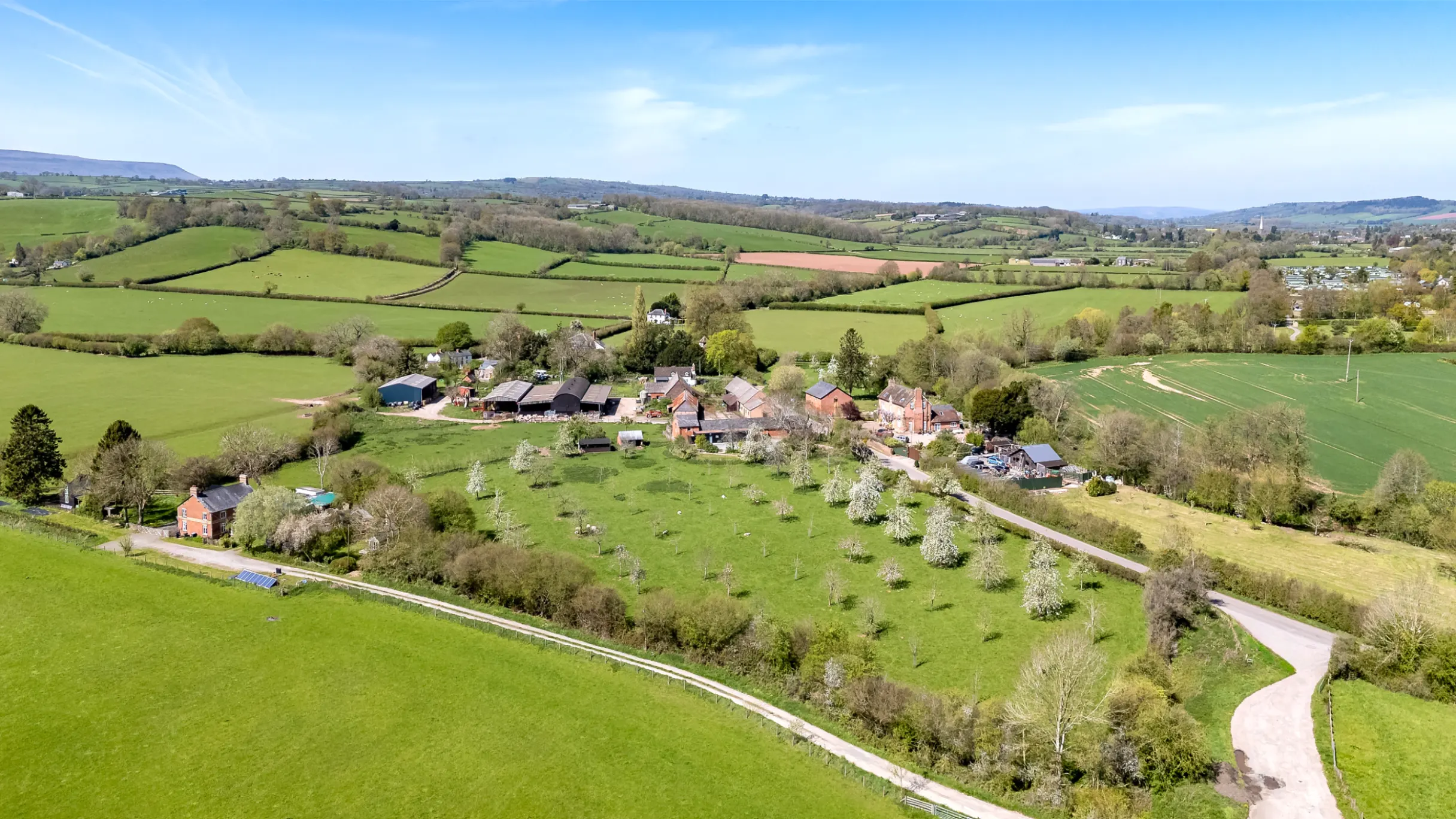
Knight Frank’s West Midlands specialist Kevin Boulton is selling Turnastone Court Farm, near Vowchurch, on behalf of the Countryside Regeneration Trust. Most of the 238-acre, wildlife-rich livestock farm with water meadows running to the River Dore hasn’t been ploughed for 400 years. There is a Grade II listed cottage, listed traditional barns and a range of more modern buildings. The property is for sale by informal tender in three lots with a guide price of £2.7 million. Tenders are due by midday on 1 July. Please contact Kevin for more information.
Discover more of the farms and estates on the market with Knight Frank
Property markets Q1 2026
Development land – Green fields flat
The average value of urban brownfield and prime central London development land fell by 2.5% in the first quarter of the year, according to the Knight Frank Residential Development Land Index. Geopolitical instability, higher borrowing costs and an easing, yet still onerous planning and regulatory environment, weighed on demand, says our head of Res Dev research, Oliver Knight. Greenfield values, however, remained flat, reflecting more resilient conditions for volume housebuilders in suburban markets, where lower-density schemes, simpler build requirements and steadier underlying demand have supported viability, adds Oliver. Download the full report for more data and insight.
Farmland – market treads water
The average value of farmland remained relatively unchanged in the first three months of the year, according to the Knight Frank Farmland Index. Continued political and economic uncertainty, exacerbated by the current conflict in the Middle East, which has seen input costs like fuel and fertiliser spiral, and poor weather, mean few new farms, blocks of land or estates were put up for sale during the traditional spring selling season. But despite a perception by vendors that now is not a good time to sell, demand remains firm from a range of buyers. If you are thinking of selling, please contact Will Matthews.
Country houses – values stabilising
The average price of houses in the countryside fell 5.5% in the 12 months to the end of the first quarter of 2026, which was a modest improvement on the 5.7% decline recorded in December, despite the uncertainty caused by the Middle East crisis, according to the Knight Frank Country House Index. The annual price decline for flats (-3.8%) and townhouses (-5.1%) was lower than for farmhouses (-7.1%), underlining how demand has been stronger in needs-driven markets. Prices are now 13% lower than their pandemic-era peak in Q2 2022, when demand increased for more space and greenery. Contact Tom Bill for more insight and data.
