
The Rural Update: Don’t get distracted by EU reset
Your weekly dose of news, views and insight from Knight Frank on the world of farming, food and land ownership.
23 November 2026

Viewpoint
It ended badly for David Cameron, the last British Prime Minister to tie his fortunes to Britain’s membership of the EU. Whether things will work out better for the current incumbent Andy Burnham, who is taking an increasingly bullish view on potentially rejoining the bloc, remains to be seen. Some have welcomed the agreement struck last week that reduces restrictions on the trade in agricultural goods between the UK and the EU. Others claim that being forced to align with EU rules on things like agrochemicals is too high a price to pay. The danger is that reigniting the toxic debate around EU membership will distract from the real rural challenges the government needs to address. New survey results revealed at last week’s CLA Rural Business Conference, sponsored by Knight Frank, highlight a disturbing disconnect between the public and the rural economy, as well as the impact of government policies on rural employment opportunities. In her speech to the conference, Defra Minister Angela Eagle reiterated Burnham’s promise to deliver “growth in every postcode”. The inevitable discussions around Europe that now look set to dominate the run-up to the next General Election mustn’t distract from that pledge.
Sign up to receive this newsletter and other Knight Frank research directly to your inbox
In this week's update
- Pork problems
- Mixed fuel fortunes
- EU agri deal agreed
- Countryside not a playground
- Rural employment hampered
- Water management grant
- More innovation cash
- Bird protection failure
- Natural England cull?
- Biodiversity indicators fall
- Welsh bird flu restrictions
- Fertiliser plan progress
- Moorland payments increased
- COP31 failure
- Property of the week
- Property markets Q3 2026
Pork problems
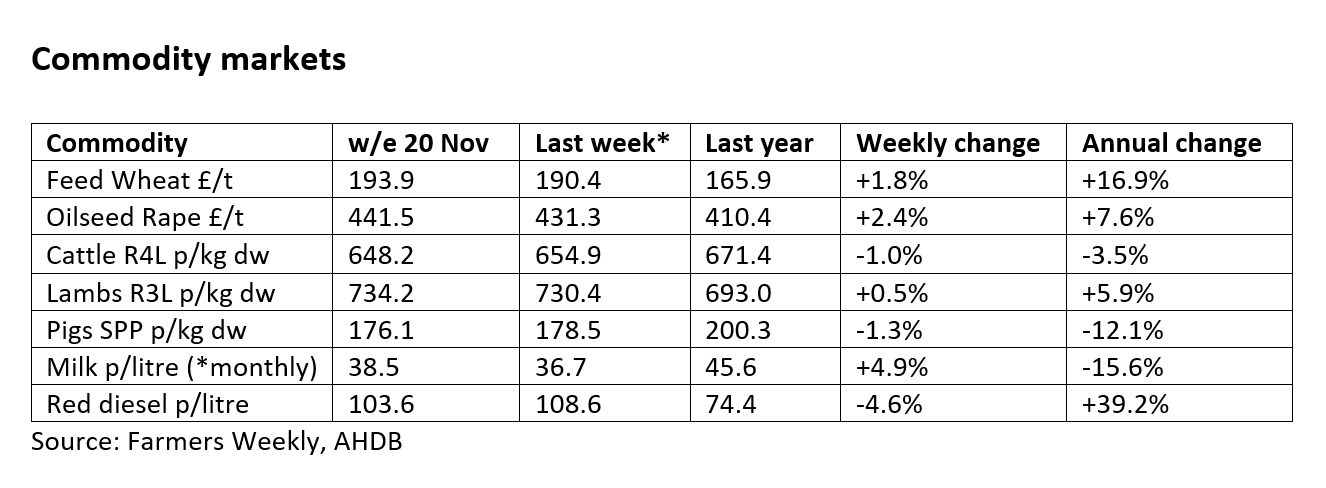
Pig prices have fallen to their lowest point this year, piling further pressure on beleaguered producers. To make matters worse, says the AHDB in its latest market update, oversupply means the drop in prices for EU-based farmers has been even more drastic, widening the gap between continental and British pork to almost 60p/kg. The pressure could continue in the run-up to Christmas, with an estimated 15,000 finished pigs per week across the country potentially without a buyer as a slew of fixed-term producer contracts come to an end.
Mixed fuel fortunes
Oil prices remain under pressure with the International Energy Agency forecasting a global surplus of around two million barrels per day for the final quarter of the year. This has led to a sharp drop in petrol prices at UK pumps, with the RAC suggesting they could fall below 150p/litre based on market fundamentals. Unfortunately for farmers, the drop in diesel costs has been more limited due to a lack of UK refining capacity.
The headline
EU agri deal agreed
Last Friday (20 November), the UK agreed a controversial new Sanitary and Phytosanitary (SPS) deal with the EU.
As part of the wide-ranging deal, which takes effect from 1 March 2028, restrictions on agricultural trade between the two blocs will be slashed. The government reckons this could boost the UK economy by over £5 billion each year.
GB Potatoes CEO, Scott Walker, said: “We are particularly pleased that the seed potato trade with the EU will resume. Before it stopped, that trade was worth around £11 million per annum. We hope to see it recover quickly and grow to at least that level again.”
Alex Freudmann, M&S Managing Director of Food, said: “We’ve long championed a UK-EU food trade deal, and today’s announcement is a major step forward.
“Getting our Spaghetti Bolognese from Lincolnshire onto a shelf in Dublin takes hundreds of extra miles, mountains of paperwork, a vet’s signature and even the Latin name of a cow. When this deal comes into force, it will remove this bureaucracy.”
However, in return, British businesses will have to align with numerous EU regulations, including the use of crop chemicals, gene editing regulations and food labelling, even if they do not trade with Europe.
Not all of these will necessarily be detrimental to the agricultural sector. Meat industry lobby group AIMS, for example, welcomed the EU legislation that restricts the use of certain meat-based terms to describe plant-based meat substitutes.
Foie gras lovers will also be relieved that the Labour government is having to step back from its pledge to ban imports of the delicacy, whose production is considered cruel by animal welfare campaigners.
But there are serious concerns around the implications of the EU’s more restrictive approach to crop protection chemicals. Growers worry that the potential banning of certain products could severely affect their ability to control some pests.
There won’t, however, be any cliff-edge product removals. Active substances approved in Great Britain but not approved in the EU can continue to be sold until 1 June 2028, and used, stored and disposed of until 1 December 2028.
CLA President Gavin Lane said: “In the short term, there will be significant benefits to exporters, but it's naive to think that there won't be challenges in the long term.
“When the EU comes up with a new regulation that may damage British farmers or producers, we will have no recourse. This doesn't bode well for democracy.
“The political instability this will cause risks overshadowing many of the benefits the deal will bring.”
NFU President Tom Bradshaw added: “Reaching this agreement is only the beginning. Its success will ultimately depend on how it is implemented and the UK government's ability to influence future EU rules that work for British farmers.”
Read a summary of the SPS agreement.
News in brief
Countryside not a playground
A new survey commissioned by the CLA and Knight Frank, released to coincide with the CLA’s annual Rural Business Conference in London last week, reveals that just 9% of the British public sees the countryside as a place of business and economic activity, while almost 70% view it primarily as a place for nature and wildlife. A majority of respondents also believe rural communities should focus on preserving the character of their area, even if it gets in the way of economic growth.
Rural employment hampered
The latest instalment of Knight Frank’s biennial Estate Staff Salary Survey further highlights the challenges for rural employers. Over 70% of respondents said current government policy, including Inheritance Tax reforms, new employment legislation, and National Insurance hikes, would reduce rural employment opportunities. Please get in touch with Alastair Paul for further details of the survey, which now tracks salaries for 40 staff positions.
Water management grant
Defra has published further details of the third round of its competitive £15 million Water Management grant that opens for applications on 30 November and covers 40% of eligible project costs. Grants of between £35,000 and £300,000 are available for irrigation reservoirs and underground water distribution mains. To support smaller growers, a minimum grant of £15,000 applies to projects involving just water storage tanks. The application window closes on 23 February, but applications are not prioritised based on when they are submitted. Please contact Mark Topliff for advice on grant applications.
More innovation cash
A further £28 million is also being made available for projects costing between £1 million and £5 million that support innovation to improve soil health, water quality and environmental management in livestock and cropping systems on farms in England. Applications for the Healthy Soils and Water for a Sustainable Environment competition, which must include a farming or forestry business and at least one other business or research organisation, opened last week.
Bird protection failure
Defra and Natural England are failing in their legal duties to protect wild birds, according to a statement from the Office for Environmental Protection (OEP). As part of an ongoing investigation, the OEP has now issued the two organisations with decision notices setting out its findings, detailing where it has identified failures to comply with environmental law. The notices also set out the actions they need to take to meet their legal obligations.
Natural England cull?
Meanwhile, time may be running out for Natural England. Louise Haigh, the First Secretary of State, set out plans to slash the number of government quangos in a speech to the CBI yesterday (23 November). Haigh said “outsourcing responsibility to a sprawling web of regulators and arm’s-length bodies” by previous governments had created planning delays, more pollution and higher energy costs.
Biodiversity indicators fall
Environmental groups, however, have warned against weakening environmental protections following the publication of the government’s latest biodiversity relative abundance index, which tracks the health of 1,185 species. Between 2019 and 2024, the index (which started at 100 in 1970) continued to decline, dropping from 68 in 2019 to 60 in 2024. Over this period, 38% of species showed a strong or weak increase and 47% showed a strong or weak decline.
Welsh bird flu restrictions
The Welsh government has followed England and Scotland by introducing restrictions on poultry flocks. An all-Wales Avian Influenza Prevention Zone (AIPZ) came into effect last week. The AIPZ requires all keepers of poultry and other captive birds, irrespective of the size of the flock or how the birds are kept, to take appropriate and practicable steps to mitigate the spread of the disease.
Fertiliser progress published
Defra is requesting help to inform the next stage of its Fertiliser Sustainability and Resilience Plan for England. The plan focuses on three areas: Improving nutrient management and on-farm nutrient use efficiency (NUE); optimising use of available organic and recycled nutrients; and reducing reliance on nutrient inputs through land management practices. The next phase of engagement will focus on developing and testing potential interventions. Those wishing to share their insights as part of the process should email Defra.
Moorland payments increased
Increased payment levels for several ‘moorland’ actions under the Countryside Stewardship Higher-Tier Scheme have now kicked in. The new rates, which include a jump from £48/ha to £102/ha for removing stock for at least eight months, will be backdated to the start of agreements and applied automatically.
COP31 failure
The United Nations’ latest climate change conference ended in acrimony on Sunday evening, with delegates in Turkey unable to agree on a final overarching pact despite the talks being extended by two days. The EU and smaller nations, including Pacific islands at threat from rising sea levels, refused to back a text that made no mention of fossil fuels. The last COP to end with no agreement was in 2009 in Copenhagen.
Property of the week
Rare Welsh estate
The 704-acre Penbedw Uchaf Estate at Nannerch, in the picturesque Dee Valley National Landscape near Mold in Flintshire, includes an attractive stone farmstead, full of period features, that is believed to date back to Cromwellian times. A range of traditional and modern buildings offers extensive potential for equestrian, agricultural, storage and diversification uses, subject to any necessary consents. The estate’s traditional grassland is still framed by ancient field patterns and blocks of woodland that provide a strong sense of character and heritage. Ty Uchaf is an off-lying 188-acre block of land with a large modern livestock building. The guide price is £6.7 million. Please contact Christopher Dewe for more information.
Discover more of the farms and estates on the market with Knight Frank

Property markets Q3 2026
Farmland
The fall in the average value of farmland across England and Wales slowed to just 0.6% in the third quarter of 2026, according to the latest instalment of the Knight Frank Farmland Index. On an annual basis, prices have dropped by 3% to £8,442/acre. The amount of land launched publicly has dipped by 17%, helping to offset limited demand.
Country houses
The average value of residential property in rural areas continues to decline, according to the Knight Frank Prime Country House Index. Tom Bill, Head of UK Residential Research, said: “The impact of rising mortgage rates and political uncertainty is being felt in the country market.” Average prices fell 1.4% in Q3 2026 and 4.2% in the year to September. Property exchanges were 2% lower in the third quarter compared with last year, while the number of offers made was 10% lower. Read more of Tom’s insight.
Residential development land
Residential development land values edged lower in the third quarter of 2026, according to the Knight Frank Residential Land Index, as rising mortgage rates weighed on sales, while elevated build costs and continued uncertainty over scheme viability put further pressure on housebuilders. However, the pace of decline has slowed, suggesting the UK land market may be approaching its nadir, according to researcher Oliver Knight. Greenfield land values fell 3% annually, and brownfield values declined 5%.
