

The Rural Update: Local food a win-win
Your weekly dose of news, views and insight from Knight Frank on the world of farming, food and landownership.
15 September 2025

Viewpoint
A new report discussed below highlights the significant benefits that providing more free school lunches could have for farmers, as well as the opportunity for local authorities to deliver on the government’s commitment to source more home-grown food. The numbers around the extra value of fresh produce, such as carrots and potatoes, that will be required look tantalising, but the reality is that market pressures mean the UK’s horticultural output has been condensed into the hands of an ever-smaller number of specialist fruit and vegetable growers. Reversing that trend could be difficult, but unprofitable arable commodity prices and declining farm support payments could tempt some farmers to diversify if the government is prepared to provide sufficient encouragement. More locally grown, nutrient-dense food would be a win-win for farmers and school children.
Sign up to receive this newsletter and other Knight Frank research directly to your inbox
Arable price pressures
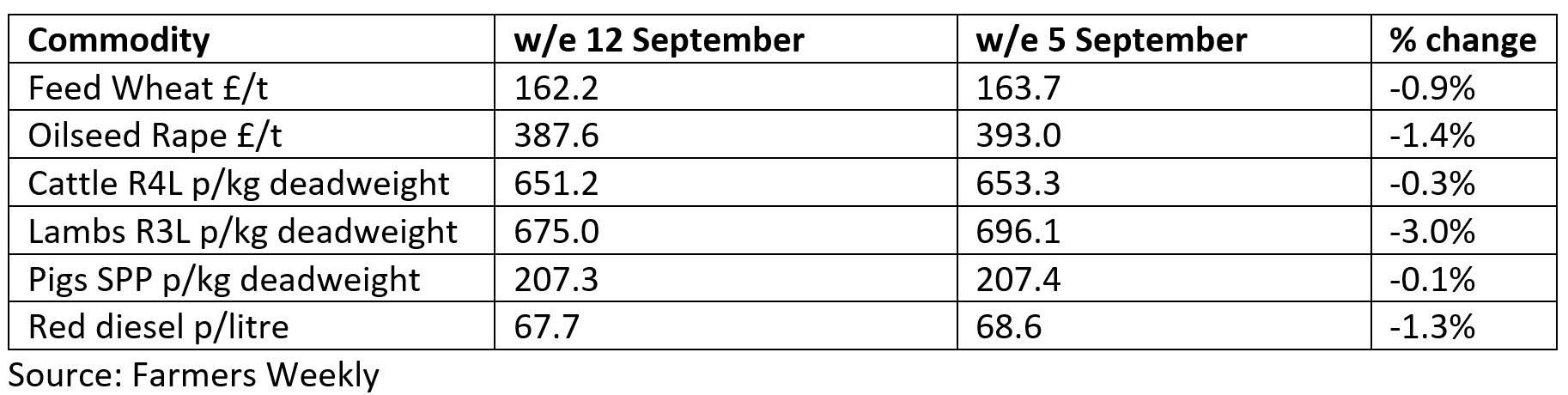
Much-needed rain has gifted some arable farmers an earlier start than normal to their autumn drilling schedules, but the news regarding their recently harvested 2025 crops remains bearish. Increased estimates for Russian wheat production this year continue to apply downwards pressure on markets, while Canadian oilseed rape is looking for discounted new homes to avoid Chinese tariffs. Meanwhile, malting barley values continue to slide towards parity with feed barley as maltsters sit on ample stocks. Potato growers are also under pressure as a big EU harvest pulls down prices.
The headlines
Tenancy review announced
The Law Commission, which reviews legislation on behalf of the government, has just announced it will examine the law governing tenancies of agricultural land in England and Wales.
Tenancies either fall under the Agricultural Holdings Act (AHA) 1986, which generally provides lifetime security of tenure, rent control, and often succession rights, or the Agricultural Tenancies Act 1995, which created Farm Business Tenancies (FBTs) that do not offer any fixed statutory period, succession rights or rent control.
A statement from the commission explained: “We have heard that these regimes may not correctly balance the interests of landowners and tenants and that the lack of security of tenure and often short-term nature of many tenancies is a barrier to investment and the viability of some tenanted farm businesses.
“We have also been told that the current law may restrict tenant farmers from diversifying and adapting their businesses and benefiting from new opportunities. The current law may therefore hinder economic growth and opportunity for tenant farmers.”
The review will consider “whether the existing law properly balances giving tenant farmers sufficient security to encourage investment and maintain viable farm businesses, opportunities for new entrants to access farming opportunities, and the interests and confidence of landlords to let land”.
It will also examine whether “the law impedes tenant farmers from diversifying their businesses, including to farm in more sustainable ways; whether the law supports a collaborative approach between landlords and tenants; and whether there are technical issues which cause problems in practice”.
Commenting on the review, Alastair Paul of Knight Frank’s Rural Consultancy team says: “There’s no doubt that AHA tenancies don’t really work for many landlords, and FBTs are too short-term and restrictive for many tenants, so it makes sense for a review of how land is let.
“However, the industry has already had one big shock regarding the changes to Inheritance Tax and will not want the same again. Any tenancy law change needs to be consulted on and balanced between the interests of both parties.”
Peat burning ban extended
The government has controversially extended the ban on burning vegetation on deep peat in England.
By extending the definition of deep peat from 40cm to 30cm, the burning ban now covers 676,628 hectares, up from the current 222,000 hectares. The extension comes into force from 30 September.
Environment Minister Mary Creagh said: “Restricting burning will help us restore and rewet peatlands. These new measures will create resilient peatlands that are naturally protected from wildfires.”
However, landowner groups have criticised the extension, saying controlled burning can benefit peatland ecosystems and mitigate the risk of wildfires.
Health and hygiene warning
A new report published yesterday (15 September) by Parliament’s Environment, Food and Rural Affairs Committee paints a worrying picture of the UK’s post-Brexit border strategy with the EU.
UK-EU trade: towards a resilient border strategy highlights the long delays and extra costs associated with the government’s Border Target Operating Model (BTOM), which presently serves as the operational framework for maintaining biosecurity in the UK’s external trade in animal and plant products.
However, its biggest concerns highlight the disease risks presented by BTOM’s failure to adequately police the import of illegal meat and plant products.
For example, the committee found that meat and dairy products from Germany, which were prohibited following an outbreak of foot and mouth, were being automatically cleared through the UK border for six days until digital systems were updated.
“We are not confident that Defra has effective oversight of border controls, particularly at the Short Straits (Dover to Calais), where enforcement is weakened by flawed IT systems, data gaps and limited support for inland authorities,” states the report.
News in brief
Call for more nature access
The All-Party Parliamentary Group on Outdoor Recreation and Access to Nature has just published Outdoors For All: Recommendations for Government on Access to Nature, a 40-point report whose key recommendation is to: “establish statutory rights to responsible access across a broader range of landscapes, including but not limited to inland waters, woodlands and other suitable natural environments, and for a broader range of recreational activities, including wild camping, paddling, swimming, cycling, caving and horse riding.”
School meal farm bonus
Follow the Carrot: Can free school meal expansion boost the UK food and farming economy?, a new report from campaign group Sustain, says that government plans to offer free school meals to all children in households receiving universal credit is a £600 million opportunity for farmers. An extra 540 million plates of school lunch would significantly boost demand for fresh produce, including over £25 million of broccoli alone, it claims.
Farm tech grant rush
Around 9,500 farmers applied to the latest round of the Farming Equipment and Technology Fund (FETF), the highest number to date. The competitive fund helps producers invest in three themes: improving productivity, managing slurry, and animal health and welfare. Successful applicants to the productivity and slurry funds will be notified shortly. Responses for the animal health and welfare theme will take longer to process due to the high volume of applications, says Defra.
Higher-level CS details
Meanwhile, details of the new round of Countryside Stewardship Higher Tier (CSHT) agri-environment funding, including how and when to apply, have just been published by Defra. Farmers and land managers will be invited to join on a rolling monthly basis. Those with existing CSHT agreements will be given priority, but they will not be allowed to apply until their current agreement has expired. This will mean a funding gap as the start date for new applications will not be backdated. For advice on applications, please contact Mark Topliff.
Nature loss risks
A new report from the sustainability advocacy group Ceres is the latest to quantify the cost of environmental degradation to businesses and their shareholders. Nature’s price tag – The economic cost of nature loss, estimates that eight industrial sectors, including food production, will suffer combined direct losses of US$2.15 trillion over the next five years due to land and sea use change, over-exploitation of natural resources, climate change, pollution and spread of invasive alien species. Climate change, alone, will cause annual losses of over US$302 billion.
Sunshine boosts renewables
Solar farms are becoming increasingly controversial, but new data shows why they are popular with policymakers. A report produced by Imperial College London reveals that the carbon intensity of Britain’s electricity fell below 100 grams of CO2 per kilowatt-hour for the first time between April and June. A decade ago, that figure was over 450g CO2/kWh. Over 3GW of new solar capacity has been added in the past two years, taking the UK’s total to almost 20GW. Combined with the sunniest spring on record, this saw solar supply over 40% of Britain’s electricity at peak for the first time in May.
Government pesticide plan
Gaining emergency permission to use restricted agricultural chemicals such as neonicotinoids has just got harder following new guidance from the Health and Safety Executive published last week. The changes clarify and strengthen the existing guidance to ensure that anyone applying for an emergency authorisation to use a pesticide must take full account of the risks it poses to pollinators in their application. Neonicotinoids are widely claimed to harm pollinators such as bees.
Lords’ hedgehog amendment
Members of the House of Lords have tabled a number of amendments to the Planning and Infrastructure Bill, which has been criticised for not doing enough to protect nature. The amendments, which enjoy crossbench support, include making it compulsory to integrate swift bricks and bird nesting boxes into new developments, bird-safe glazing and the requirement to provide hedgehog highways and bat boxes where needed.
The Rural Report SS 25 – Out now
The Spring Summer 2025 edition of The Rural Report, Knight Frank’s flagship publication for rural businesses, which looks in more detail at many of the issues discussed in The Rural Update, is out now. The new report includes the latest news, research and insights from Knight Frank’s rural property experts, as well as thought-provoking contributions from some of Britain’s most iconic estates. Available online and in print, you can click here to access the full report.
Properties of the week
Private Herts zoo
This week’s property is something out of the ordinary that could appeal to animal lovers looking for a diversified income stream. Cassiobury Farm at Croxley Green, near Rickmansworth, is a 10-acre site that currently includes a private zoo with Galapagos tortoises, red pandas, flamingos and over 70 other species, plus a collection of rare-breed farm animals, in residence. There are also fishing lakes, a fishing lodge, a café, a farm shop, canal moorings and a three-bed house with a yoga studio. The guide price is £2.75 million. The animals are available separately. For more information, please contact Freddie Sandercock.
Historic Kent estate home to rent
If you need a place to stay while you get started with your new vineyard, Knight Frank’s Rural Consultancy team in Kent has an intriguing option on offer. Newhouse at Mersham, near Ashford, which was once home to Countess Mountbatten of Burma and Lord Brabourne, is part of the idyllic 2,700-acre Hatch Park Estate. Now available to rent, the nine-bed period property costs £7,995 a month. For more information, please contact Katie Bundle.
Discover more of the farms and estates on the market with Knight Frank
Property markets Q2 2025
Development land – Market weakens
The value of development land continues to fall, despite the government’s pledge to build 1.5 million new homes during this parliamentary term. According to the newly published Q2 2025 instalment of the Knight Frank Residential Land Index, prices for green and brownfield sites have dropped by 5% over the past 12 months. Lower levels of supply mean values in London slid by just 2.5%. Housebuilders are grappling with planning delays, viability challenges, skills shortages and weak demand, explains Oliver Knight.
Farmland – Uncertainty dominates
Despite cuts to support payments and lacklustre grain prices, the average price of bare agricultural land fell just 2.3% in the second quarter of the year, according to the latest edition of the Knight Frank Farmland Index. “It’s really difficult to discern any clear value trends at the moment because of reduced transaction levels,” says Will Matthews, Head of Farms & Estate Sales. Download the full report for more data and insight.
Country houses – buyers’ market
It’s a buyers’ market when it comes to rural homes, according to the latest research from Tom Bill, Knight Frank’s Head of UK Residential Research. The Knight Frank Prime Country House Index slipped by 2.5% in Q2, the second-largest quarterly decline since Q1 2009. At the same time, the number of properties for sale is up 9% compared with this time last year. On average, there are six prospective buyers for each new instruction, compared with 19 at the height of the Covid-19 pandemic, while sales are achieving 94% of the asking price. Read more of Tom’s numbers and insight.
