
Tax speculation takes its toll
Making sense of the latest trends in property and economics from around the globe
14 August 2026

“This tax-raising budget may be ¬almost as big as the last, but with the balance tilted away from hikes on businesses seen in recent years towards tax hikes on capital, wealth and income,” Ruth Gregory, deputy chief UK economist at Capital Economics, said in a much-covered research note this week. Prime Minister Andy Burnham must find £25 billion in the October Budget to fund his pledges, the economics consultancy reckons.
Lavish pledges with little information as to how they will be paid for weighs on investment across the board. Speculation ahead of this year's Budget hasn't yet been as rife as last year (see the update on prime central London below), but uncertainty is already weighing on the property market. Every RICS Residential Market Survey ends with pages of commentary from estate agents across the country, and the July edition is packed with participants lamenting the uncertain tax landscape: "There appears to be limited understanding of the impact that tax speculation has on the market," says Knight Frank's Edward Rook in Sevenoaks. "Uncertainty stagnates markets and recent policy signals have compounded this."
The new buyer enquiries series posted a net balance of -28% for the second consecutive month, though the monthly rate of contraction has slowed from the market's nadir in March. The agreed sales metric languished at -30% for the second month.
The outlook for inflation and interest rates has become more benign since the spring, which is cutting into levels of pessimism over the months ahead – or perhaps there's a sense that speculation ahead of the Budget might be more damaging than its contents. Near-term sales expectations have improved over the past four surveys, rising to a net balance of -14% in July. Sales expectations over the twelve month time horizon remain broadly neutral, although the latest reading is the most positive recorded since February.
Renters' rights
Tenant demand in the rental market has cooled, but landlords are selling up and rents are rising steadily. The metric for landlord instructions hit -27%, meanwhile rental price growth expectations posted a net balance of +28%.
Respondents to the survey say landlords are selling properties as a result of the Renters' Rights Act. Other impacts cited include landlords setting asking prices at their highest conceivable point "because offers over asking can no longer be accepted," landlords insisting on better quality references, or "being more discerning and only picking the best applicants with guarantors making it harder for struggling applicants to secure homes."
Tom Bill covered the impact of the Renters' Rights Act in prime London markets this week. There is now a shortage of supply as more landlords have sold due to the prospect of tighter margins and increased red tape. The number of new rental listings in prime central and prime outer London was 14% below the five-year average in the first six months of this year, Rightmove data shows.
Average rents in prime outer London (POL) rose 3.2% in the year to July, Knight Frank data shows. That followed an increase of 1.2% over the previous three months. Average rents in PCL increased by 1.1% in the year to July. PCL have increased on an annual basis for five years and are currently 37% higher than before the pandemic.
Milan rising
Fresh updates from our team shine a spotlight on the divergent paths of prime residential markets in the UK and Italy.
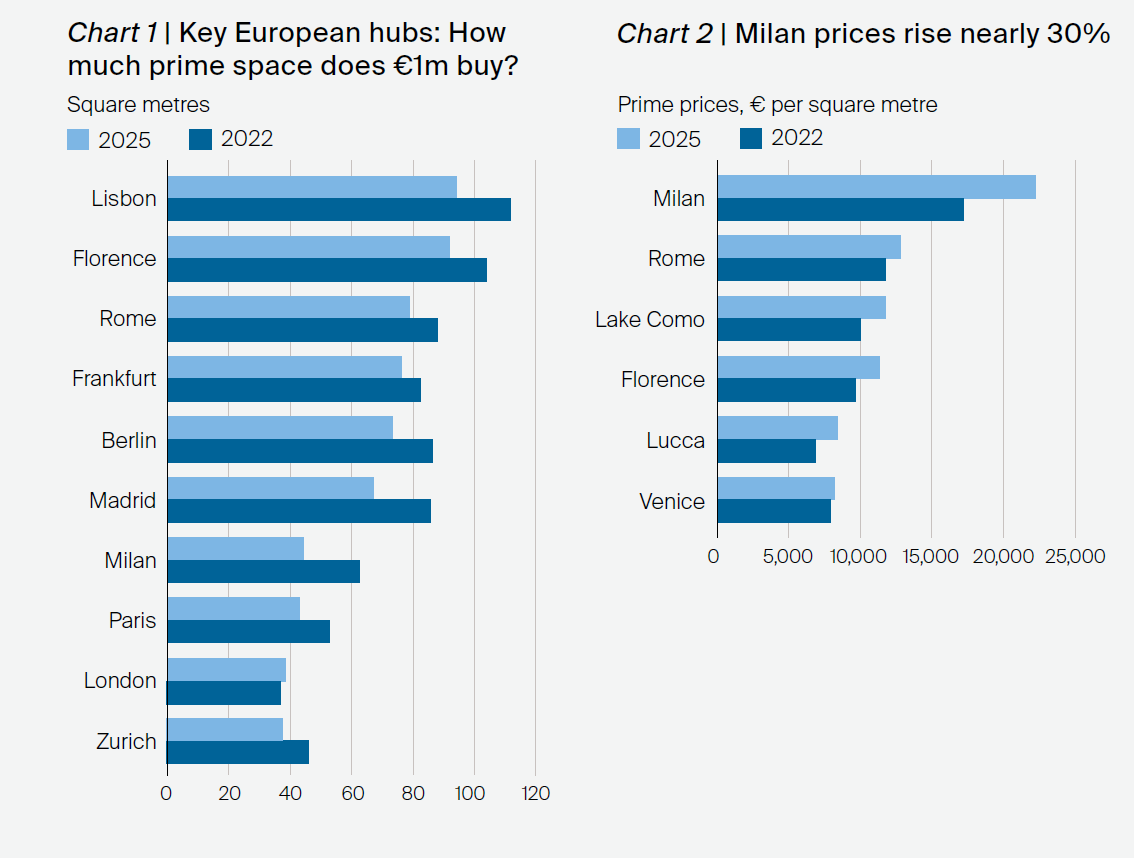
Italy’s prime residential markets continue to strengthen, underpinned by growing international demand, favourable tax positioning and a relative pricing advantage over other European hubs. In cities such as Rome and Florence, €1 million buys you around 79–89 square metres, significantly more than in key European locations such as Frankfurt, Paris, Madrid and London (see chart 1). Value becomes even more pronounced in lifestyle-led areas including Venice and Lucca, where the same budget stretches to roughly 126–130 square metres.
Milan has emerged as the country’s standout performer, driven by its role as a financial and business hub. Unlike other Italian markets, budgets here are increasingly stretched, with prime values rising nearly 30% from €17,270 per square metre in 2022 to just over €22,000 in 2025, reducing the amount of space buyers can secure for €1 million by 27% over five years. Average asking prices for homes in Milan have jumped 50% since 2017, when Italy first introduced its flat tax regime which originally allowed new residents to pay a fixed €100,000 annual tax on all foreign income, regardless of how much they earned.
Low bars
Average prices in PCL fell 3.3% in the year to July, marking the 39th consecutive month of annual declines, according to Knight Frank's Prime Central London Sales Index.
That said, the market is having a better summer than it did in 2025, but that’s not a particularly high bar. The number of transactions was 14% higher across the capital in the three months to July, while the rise was 3% in prime central London (PCL).
Activity was subdued last year after the introduction of Donald Trump’s trade tariffs, the ending of non dom status and speculation around property taxation in the autumn Budget. The latter has been more muted this year, particularly after Burnham ruled out a land value tax, but speculation over how the government will fund its £25 billion of extra pledges will only grow from here.
In other news...
Manhattan Rents Hit $5,000 Record While Listings All But Vanish (Bloomberg).
Sign up to Knight Frank Research.
