

Prime London Market Activity Improves as Backdrop Stabilises
July 2026 PCL Sales Index: 4,976.2 July 2026 POL Sales Index: 274.5
10 August 2026

The prime London property market is having a better summer than it did in 2025, but that’s not a particularly high bar.
The number of transactions was 14% higher across the capital in the three months to July, while the rise was 3% in prime central London (PCL), Knight Frank data shows.
Activity was subdued last year after the introduction of Donald Trump’s trade tariffs, the ending of non dom status and speculation around property taxation in the autumn Budget.
This year the backdrop has been quieter.
New rates of high-value council tax announced in November look like the thin end of the wedge for a government with limited capacity to fund its spending plans, but they weren’t as bad as feared.
It enabled buyers to make plans after the Christmas break and by March the number of offers made in prime central and prime outer London was 8% higher than last year, which has translated into more activity this summer.
There is still speculation ahead of October’s Budget, but it has been more muted this year, particularly after new Prime Minister Andy Burnham ruled out a land value tax. The CEO of the CBI became the latest person to warn about the damaging effects of speculation last month.
Buyers and sellers have also become hardened to the volatility to some extent, as I discussed on a recent episode of Housing Unpacked with Alex Webster, the head of lending at Coutts.
Same Financial Challenges
Burnham replaced Keir Starmer as Prime Minister last month but faces the same financial challenges as his predecessor, as I explored on the latest episode of Housing Unpacked with market analyst Michael Brown. The new government is still caught between a bond market that won’t permit a spending spree, Labour backbenchers who won’t sanction meaningful spending cuts, and a Labour manifesto that has ruled out income tax, VAT or national insurance rises.
Compared to the same period two years ago, when the country was contemplating the relatively blank canvas of a new Labour government, the picture is not quite so positive. Exchanges are 7% lower in both London and PCL over the last three months.
And compared to the five-year average, exchanges are down 6% in London and 15% in PCL. However, that comparison is distorted by a series of stamp duty cliff edges during and after the pandemic as well as the sharp re-pricing of mortgage rates that began in 2022.
It means accurately gauging the current strength of the market is not totally straightforward, though the absence of bad news means demand is gradually strengthening.
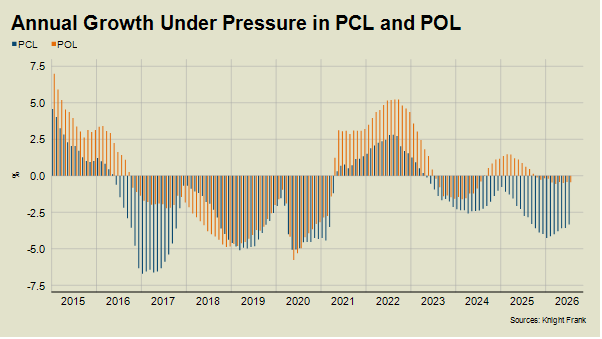
Underpinning that is the fact average prices in PCL have fallen by 23% since their last peak in mid-2015 due to a succession of tax increases and political uncertainty.
Average prices in PCL fell 3.3% in the year to July, which marked the 39th consecutive month of annual declines. Prices rose modestly over the two years to April 2023, but that followed a 59-month period of declines that ran from June 2016. Prices have been steadier in POL, as the chart shows.
Refurbs on Radar
As well as becoming tentatively more confident, buyers are also adjusting their priorities, said Stuart Bailey, head of prime central London sales at Knight Frank.
“Exceptional properties are in short supply which means buyers who were previously unwilling to consider refurbishment projects are doing so to ensure they get what they want,” he said. “Many buyers at the top end of the market can spend one or two years looking for their ideal home, so even if doesn’t exist right now, the opportunity to create it does.”
The development pipeline in PCL had contracted by 70% over ten years, a 2024 Knight Frank report found.
As well as a tougher planning environment and higher build costs, viability pressures for developers have arisen from the price declines over the last decade. It’s more evidence that when a government makes tax changes, the repercussions can be felt in unexpected ways for many years.
Sign up to Knight Frank Research.
