

No News Has Been Good News for the Prime London Market
September 2026 PCL Sales Index: 5,004.4 September 2026 POL Sales Index: 273.7
02 October 2026

This year has proved the theory that the mere absence of bad news fuels demand in the residential property market.
A mood of hope began to emerge in the first two months of 2026, as the uncertainty of last November’s Budget faded and mortgage rates fell towards 3.5%.
In March, the outbreak of the Middle East conflict pushed mortgage rates closer to 4.5% and activity stuttered. However, demand strengthened as the war faded from the front pages, supported by mortgage offers that pre-dated the conflict and a desire to act before they lapsed.
In September, stronger demand helped deliver the first period of quarterly price growth (+0.3%) in prime central London for four years. Prices fell 2% over the year, which was the smallest annual decline in 18 months.
Renewed tensions in the Middle East meant mortgage costs rose again in mid-September, as we analysed here. The Budget also moved closer into view following a front-page story in The Times two weeks ago about a possible reduction to the high-value council tax threshold, as we explored last week.
The negative headlines are back, but for how long?
Prices in prime outer London, where demand has been more consistent and needs-driven, fell 0.6% in the year to September. Values haven’t moved by more than 1% in either direction since May 2025.
More Resilient
Transaction numbers also stabilised as the backdrop became more favourable. Exchanges in prime central London (PCL) and prime outer London (POL) in the year to September were 2.5% down on the previous 12 months, Knight Frank data shows. That compares to an equivalent drop of 14% in March.
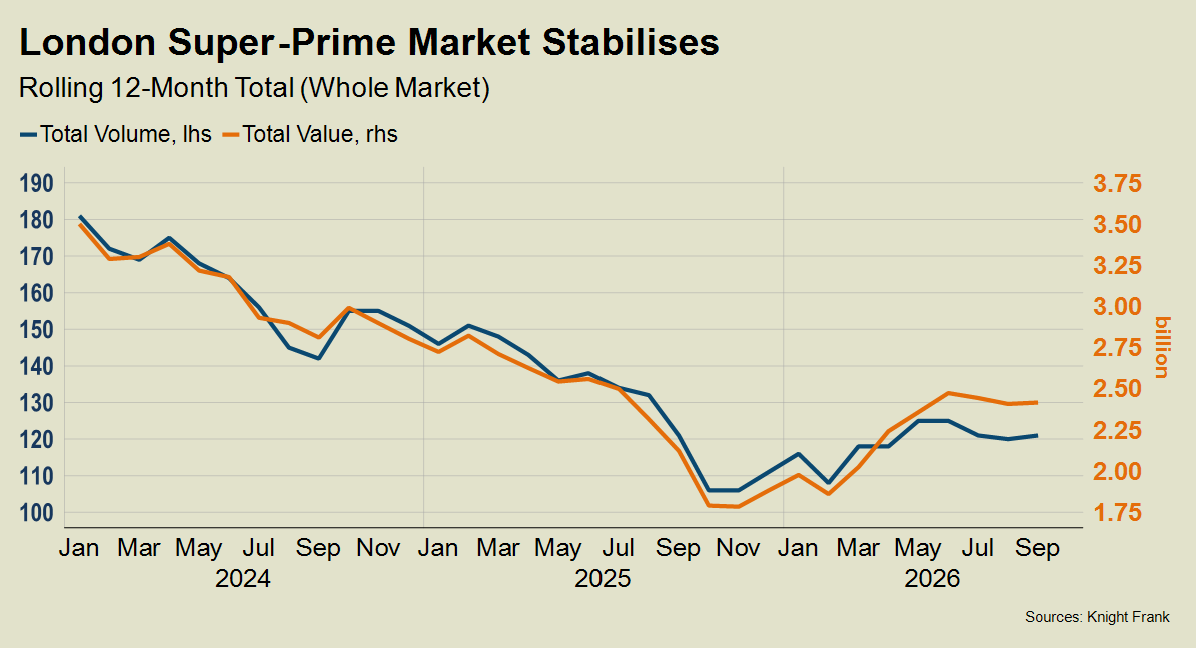
The super-prime market above £10 million followed a similar pattern, having come under particular pressure following the scrapping of non-dom status in April 2025, as discussed on a recent episode of Housing Unpacked.
There were 121 transactions above £10 million in the year to September, which equalled the previous year, whole-market data shows. Meanwhile, total spend above £10 million was 14% higher, reaching £2.4 billion in the year to September.
It followed a period of declining activity, which bottomed out last November when 106 transactions were recorded over the previous year. That was down from 155 in 12 months to November 2024.
While the super-prime market hasn't rebounded to 2024 levels, it has stabilised.
Outlook Change
A change in outlook from both buyers and sellers has helped support activity in the super-prime market, said Liza-Jane Kelly, head of London sales at Knight Frank.
“We are starting to see sellers become more realistic with their price,” she said. “Some have been on the market for several years and want to get on with their lives. They have accepted the more difficult mortgage landscape facing buyers and the fact that the political reality won’t change in the short-term.”
“Meanwhile buyers, some of whom have been renting, are sensing value after the price declines of the last decade. What this year has clearly shown is that underlying demand strengthens quickly when the negative news fades.”
Average prices in prime central London have fallen by 22% since their last peak in August 2015.
Two dates will be key in determining whether the negative headlines recede or multiply in the final three months of the year.
First, the Budget on 28 October, which will provide clarity around taxation.
Second, the US mid-term elections on 3 November, after which the political pressures shaping the Middle East conflict may shift, potentially lifting the fog around the outlook for mortgage rates.
Sign up to Knight Frank Research.
