
The Rural Update: Prepare for food supply chain shocks
Your weekly dose of news, views and insight from Knight Frank on the world of farming, food and landownership.
08 September 2026

Viewpoint
Another summer, another record broken. It’s a sobering thought that some believe 2026 could be the coolest summer our children ever experience. If the only way is hotter, we need to take a much more serious look at how we manage not only our land, but also our water and to ask ourselves what infrastructure is needed to be fit for the future, particularly when it comes to drought as well as flooding. Landowners are well placed to be at the heart of water management and security, investing in the infrastructure needed to protect food production, provide flood protection through nature-based solutions and withstand increasingly extreme conditions. But this requires significant long-term investment, and a government that presides over a pragmatic and strategic set of policies that give landowners and investors the confidence to act. As a new report from the National Audit Office makes clear, Defra has much to do to prepare the country for shocks to the food chain, including from an increasingly volatile climate.
Sign up to receive this newsletter and other Knight Frank research directly to your inbox
In this week's update
- Grains head higher
- Red diesel surges
- Think about fertiliser
- Defra food shock worry
- IHT U-turn in balance
- Hottest summer
- Gamebird consultation
- Nature restoration fund
- Windpower savings
- Seasonal worker cap
- Capital grants closed
- Electricity infrastructure access
- Property of the week
- Property markets Q2 26
Grains head higher
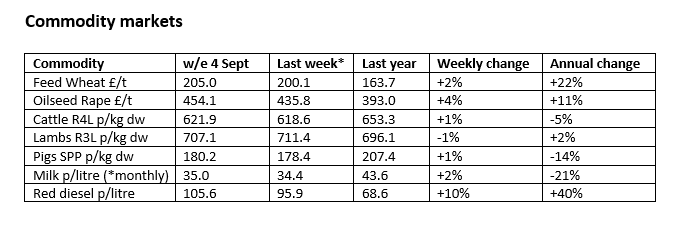
Ukraine’s capacity to export grain via the Black Sea has fallen by 50% as the country continues to trade blows with Russia, despite attempts by Turkey to establish safe navigation routes. During the first three weeks of August, Ukraine managed to export just 61,000 tonnes of barley, compared to 247,000 tonnes for the same period last year, according to trader Frontier. As a result, UK farmgate prices for feed wheat, barley and oilseed rape continue to move higher.
Red diesel surges
Brent crude was knocking on the door of US$100/barrel in early morning trading on Monday (7 September) as the US targeted three Iranian tankers over the weekend in retaliation for Iran’s recent strikes on US forces. The average cost of red diesel in the UK also jumped sharply last week, rising to over 105p/litre. However, in an interview, US Treasury Secretary Scott Bessent predicted that crude oil could quickly fall back to under US$50/barrel once the conflict is resolved.
Think about fertiliser
Traders are urging farmers not to delay purchasing their spring fertiliser requirements until the last minute. Although orders have increased following the recent rain, many businesses have yet to secure supplies. The Middle East conflict, limited storage capacity and the imminent introduction of the Carbon Border Adjustment Mechanism (CBAM) could all lead to supply-chain bottlenecks at the beginning of 2027.
The headline
Defra food shock worry
A new report from the National Audit Office (NAO) highlights the government’s lack of readiness for shocks to the food supply chain and its overreliance on the private sector to help weather future events.
“During recent disruptions, including the Covid-19 pandemic and the war in Ukraine, private sector businesses have succeeded in keeping the food supply chain running, in most cases without the need for significant government assistance,” the report says.
“But short and long-term risks that could significantly affect the food supply chain are becoming more likely and potentially more severe. For example, climate change is increasing the likelihood of extreme weather events.
“As a result, Defra is less confident about the private sector’s ability to withstand such shocks without greater government intervention,” it adds.
The report concedes Defra has taken some positive steps to improve its preparedness for food supply disruptions, such as expanding its Food Supply Chain Resilience team and increasing its focus on planning for catastrophic events where food supply would be seriously affected.
However, it reckons the department has done too little to encourage businesses, households and communities to strengthen resilience and prepare for potential food shortages caused by disruption to the food supply chain.
UK households are less prepared for emergencies compared with several other countries, according to government research, it notes.
Measures recommended by the NAO include Defra refreshing its approach to engaging with food supply chain businesses and reviewing the current legal powers it could use to respond to a catastrophic event that causes a severe food supply disruption.
News in brief
IHT U-turn in balance
There is a 50% chance that Andy Burnham will scrap the hated Inheritance Tax rules on agricultural and business property reliefs introduced by his predecessor at his first Autumn Budget, according to Jonathan Roberts, the CLA’s Director of External Affairs. “I wouldn’t say I’m optimistic, but I think there is a chance they might do that,” Roberts told Farmers Weekly.
Hottest summer
This summer was the UK’s hottest since records began in 1884, according to provisional figures from the Met Office. The average mean temperature of 16.5°C overtook last year’s previous record of 16.1°C. Met Office scientists reckon the record-breaking summer was made around 130 times more likely because of human-induced climate change.
Gamebird consultation
Anybody with an interest in shooting may want to respond to a new government consultation on the environmental, animal health and welfare impact of gamebird rearing, release and shooting in England. Defra says the call for evidence aims to improve its evi dence base by gathering information on both the positi ve and negative impacts.
Nature restoration fund
Preliminary guidance on t he government’s controversial new Nature Restoration Fund (NRF) has just been issued. The NRF is a way for housing and infrastructure developers to discharge specific environmental obligations (although it is unrelated to Biodiversity Net Gain). Rather than carrying out project-level assessments and site-specific mitigation measures, developers may have the option to pay a nature restoration levy, which is used to deliver environmental conservation measures on a more strategic scale.
Windpower savings
UK billpayers could save £3 billion a year if the country hits its target of delivering 29 gigawatts of energy generated from onshore wind by 2030, according to research from RenewableUK. One of the fastest ways to unlock more cheap power is to replace older turbines on existing wind farm sites with newer, more efficient models, the lobby&nb sp;group claims.
Seasonal worker cap
The Home Office has announced that 41,000 visas will be available for seasonal workers in the horticultural sector next year, with 1,900 offered to those in the poultry sector. Meanwhile, the latest government survey of seasonal workers reveals that workers from Kyrgyzstan accounte d for the largest proportion – < span>33% – < span>of the 38,805 seasonal visas issued last year.
Capital grants closed
The 2026 round of Defra’s Capital Grants programme closed last week after £225 million of funding was allocated within just one month. There were about 17,000 applications. The most popular item was sheep netting with grant requests totalling 20,000 km. Applications to fund hedgerow planting were equivalent to 2,500 km of new hedges.
Electricity infrastructure access
The CAAV, RICS and Energy Networks Association (ENA) have just published an updated code of practice for professionals working in respect of rights over land for electricity infrastructure, whether they are actin g for an electricity undertaker, a farmer or a landowner. The new code took effect from 1 September.
Property of the week
Leicestershire organic dairy
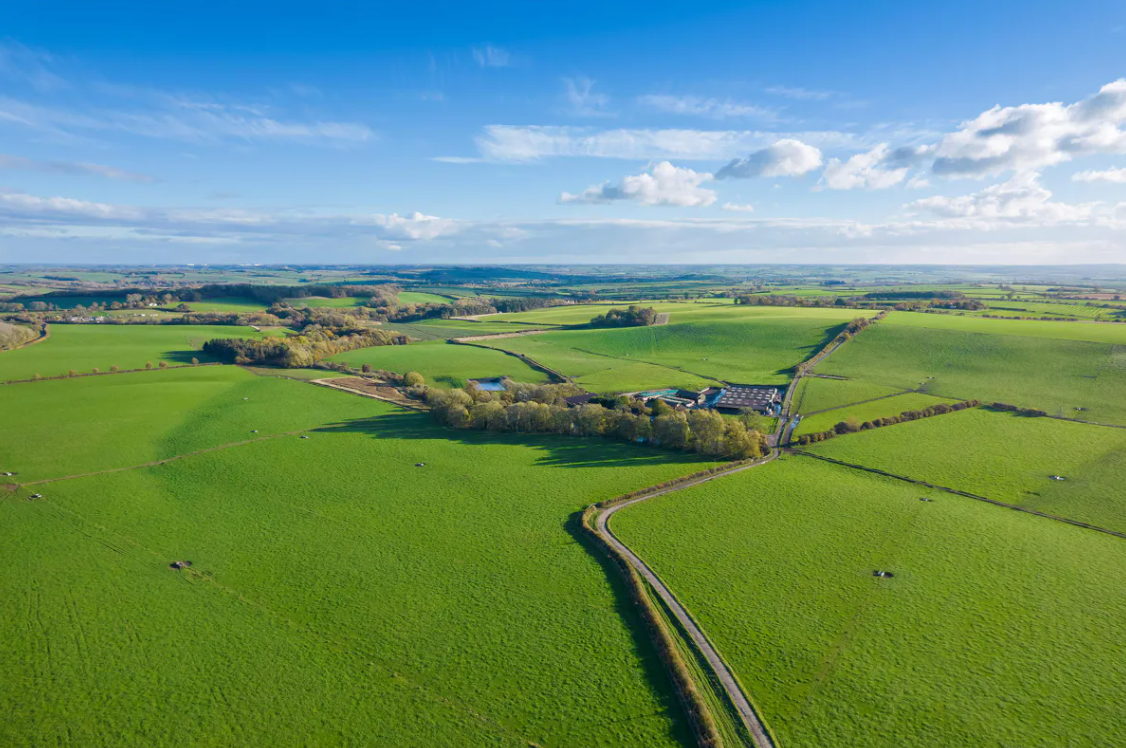
A rare commercial organic dairy opportunity is set to spice up the early autumn farmland market. Extending to almost 900 acres at Tugby, near Leicester, the operation is split across two complementary units. Keythorpe Lakes Farm runs to 654 acres and includes a 24:48 milking parlour and the capacity to house 350 cows. There is also a house and cottage, both with agricultural occupancy conditions (AOCs). Keythorpe Hall Farm is 224 acres and includes two properties with an AOC, a large grain store and a range of equestrian facilities. The total guide price is £11 million. For more details, please contact Patrick Beddows or Will Matthews.
Discover more of the farms and estates on the market with Knight Frank
Property markets Q2 2026
Farmland
The farmland market remains in a state of inertia, according to the Q2 2026 edition of the Knight Frank Farmland Index, which tracks the value of bare land in England and Wales. Average values fell by just 1.5% over the quarter to just under £8,500/acre. Download the full report for more farmland insight and data.
Development land
The value of greenfield development sites fell 5.5% in the second quarter of the year, according to the Knight Frank Residential Land Index. Weak sales, elevated build costs driven by the Middle East conflict and uncertainty around scheme viability have all contributed to the drop, notes the report’s author Oliver Knight. There is, however, still demand for ‘shovel-ready’ sites, he points out. Download the full report for more numbers and analysis.
Country houses
The average price of rural properties fell 5% in the year to June, according to the Knight Frank Prime Country House Index, which tracks the value of homes worth over £750,000. The drop was slightly narrower than the decline of 5.5% recorded in March.
