
The Rural Update: Diversify strategically to build resilience
Your weekly dose of news, views and insight from Knight Frank on the world of farming, food and landownership.
14 September 2026

Viewpoint
A new data series released by Defra reveals how little net farm incomes have increased over the past eight decades or so when taking inflation into account. Meanwhile, a new report from the NFU highlights how many businesses are losing money growing food. Diversifying into something new could be the logical answer; the English whisky sector certainly seems to be performing well.
However, as a new article on our website individual project: a café, a wedding venue, a converted building, a change of land use. A better lens is usually wider. Does the opportunity align with the farm or estate’s identity and geography? Does it make sensible use of existing assets? Does it create reliable income, spread risk or unlock value that was previously dormant? Does it complement the way the estate is managed, and how it wants to be understood by family, tenants, visitors and the local community? The difference between resilient diversification and expensive distraction is rarely the idea itself; it is the discipline behind it.
Sign up to receive this newsletter and other Knight Frank research directly to your inbox.
In this week's update
- Oil woes mount
- NFU food security warning
- Trail hunting ban
- Overnight levy confirmed
- English whisky win
- Scottish bluetongue move
- Farm income data
- Gen Z opportunity
- Roundup resolution?
- Property of the week
- Property markets Q2 2026
Oil woes mount
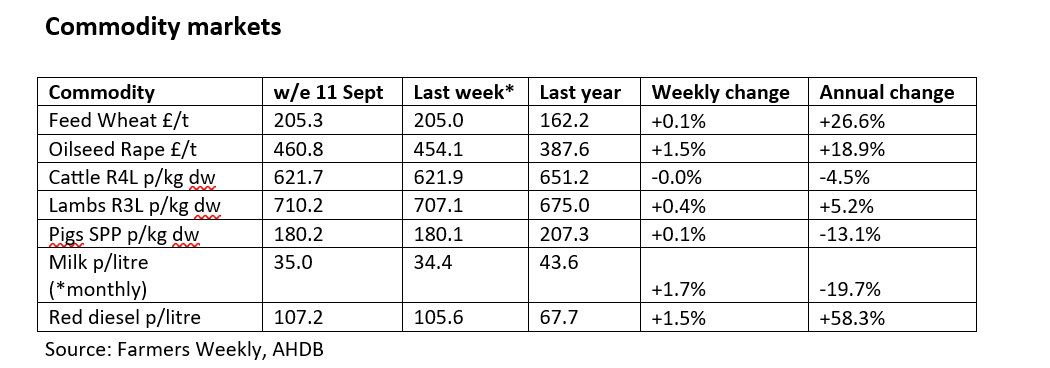
Brent crude prices almost touched US$110/barrel in early-week trading after a meeting set for Monday (14 September) between Iran and other Gulf states to discuss shipping movements through the Strait of Hormuz was cancelled. The move followed a drone attack on a Saudi pipeline that had been used to bypass the Strait. Iranian-backed Houthi rebels in Yemen also strengthened their positions along crucial Red Sea shipping lanes and launched more attacks on Saudi Arabia. Petrol and red diesel prices in the UK followed crude prices upwards.
The headline
NFU food security warning
A report released by the NFU last week to coincide with Back British Farming Day further highlights the vulnerability of Britain’s food chain.
According to Ready to Grow, 65% of wheat and barley grown on cereal farms last year came from farm businesses operating at a loss. On lowland livestock farms, only 26% of some sheep products came from profitable farms.
At the same time, the country is becoming less able to feed itself, says the report. Over the past 30 years, the UK’s self-sufficiency in 10 out of 11 everyday foods, such as wheat, vegetables, beef, poultry meat and eggs has fallen.
Food import volumes have climbed 70% over the period, while exports have dropped by 50%.
The NFU is calling on the government to implement a number of measures to help prevent even more damage being done to the farming sector.
In the immediate term, it is asking for a government-backed, interest-free ‘Keep Britain Growing’ loan, linked to losses caused by drought, to give farm businesses the working capital to produce next year’s food, as well as more support to help livestock farmers affected by bluetongue disease.
Longer term, it wants defined government targets for domestic food production and a set of core production standards that apply to both domestically produced and imported food sold in the UK.
The union is also calling for an increase in the Annual Investment Allowance to at least £5 million and for it to include assets qualifying for Structures and Buildings Allowance to support longer-term investments in efficiency and productivity improvements, including energy and water usage.
News in brief
Trail hunting ban
The government has been forced to delay the response to its consultation on banning trail hunting in England and Wales due to the volume of feedback it received. Defra said it had received 184,000 responses to the consultation, which closed in June, and covered how to define trail hunting as well as the social, economic and environmental impacts of a ban.
Overnight levy confirmed
Local government minister Angela Rayner has confirmed that mayors and leaders of Foundation Strategic Authorities are to be given the power to levy a tax on overnight visitors to their regions. The Overnight Visitor Levy will be set as a proportion of the value of a stay and will be collected by the accommodation owner.
English whisky win
Whisky produced in England can now claim to be a distinct category of the popular spirit after English Whisky was granted protected geographical indication status last week. There are now 70 English distilleries, up from 46 just three years ago, with an estimated £1 billion of liquid maturing in casks across the country.
Scottish bluetongue move
The Scottish government has just changed the status of the bluetongue Temporary Control Zone in the south-west of the country to a Restricted Zone. This means any farmers wanting to move livestock from the zone to the rest of Scotland will have to follow specific licensing conditions.
Farm income data
Defra has just released a new net farm income data series for England and Wales to “commemorate 90 years of farm income data”. Although variations in the way the data has been collected mean any comparisons need to be treated with caution, the results are fascinating. In cash terms, net farm income has jumped from £900 in 1940/41 to £60,300 in 2024/25, a rise of 6,600%. However, adjusted for inflation, the increase falls to just 13%. Net farm income has also been highly volatile in real terms, slumping to £16,000 in 1999/00 and peaking at £100,400 in 1972/73.
Gen Z opportunity
Food producers have an opportunity to better engage Gen Z consumers, according to a new report from the AHDB. The research reveals that almost 70% of consumers born between 1997 and 2012 have a positive view of British agriculture, but lack the understanding or confidence to form balanced views on issues such as animal welfare. The report also found that Gen Z’s views on the environmental impact of British farming were less critical than many farmers assumed.
Roundup resolution?
Ag-chemical company Bayer, which owns the controversial Roundup weedkiller brand, will find out this week whether a US court agrees to its US$7.5 billion plan to finalise any outstanding compensation cases against it. The firm has already paid out US$11 billion to settle around 100,000 claims from those who say exposure to the glyphosate-based herbicide caused them to develop non-Hodgkin lymphoma. Up to 65,000 cases are still pending.
Property of the week
Leicestershire organic dairy
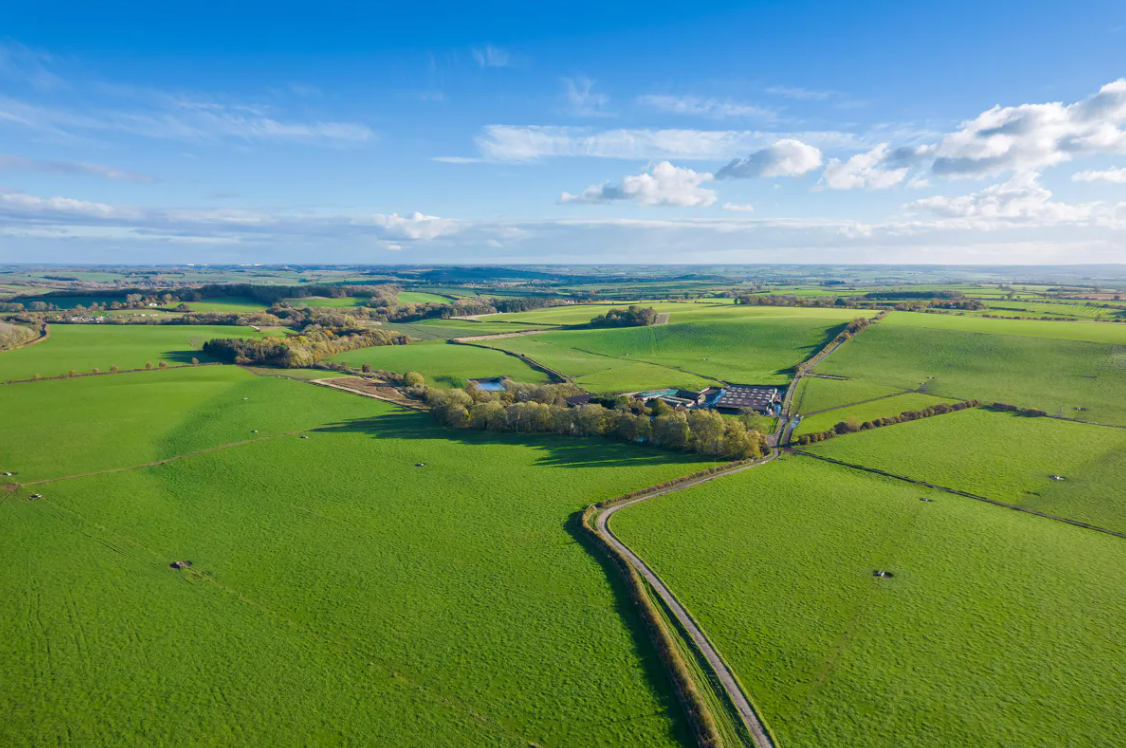
A rare commercial organic dairy opportunity is set to spice up the early autumn farmland market. Extending to almost 900 acres at Tugby, near Leicester, the operation is split across two complementary units. Keythorpe Lakes Farm runs to 654 acres and includes a 24:48 milking parlour and the capacity to house 350 cows. There is also a house and cottage, both with agricultural occupancy conditions (AOCs). Keythorpe Hall Farm is 224 acres and includes two properties with an AOC, a large grain store and a range of equestrian facilities. The total guide price is £11 million. For more details, please contact Patrick Beddows or Will Matthews.
Discover more of the farms and estates on the market with Knight Frank
Property markets Q2 2026
Farmland
The farmland market remains in a state of inertia, according to the Q2 2026 edition of the Knight Frank Farmland Index, which tracks the value of bare land in England and Wales. Average values fell by just 1.5% over the quarter to just under £8,500/acre. Download the full report for more farmland insight and data.
Development land
The value of greenfield development sites fell 5.5% in the second quarter of the year, according to the Knight Frank Residential Land Index. Weak sales, elevated build costs driven by the Middle East conflict and uncertainty around scheme viability have all contributed to the drop, notes the report’s author Oliver Knight. There is, however, still demand for ‘shovel-ready’ sites. Download the full report for more numbers and analysis.
Country houses
The average price of rural properties fell 5% in the year to June, according to the Knight Frank Prime Country House Index, which tracks the value of homes worth over £750,000. The drop was slightly narrower than the decline of 5.5% recorded in March.
