
The Rural Report: Farming needs long-term policy support
Your weekly dose of news, views and insight from Knight Frank on the world of farming, food and landownership.
05 May 2026

Viewpoint
Farmers in the UK might be casting an envious eye across the English Channel to continental Europe, where the EU has just approved an emergency plan to give farmers up to €50,000 to cover the cost of increased fuel and fertiliser bills. A similar move would be extremely welcome here, but short-term measures can’t disguise the need for far-reaching structural changes and policy incentives that will help the food and farming industry cope with the increasingly volatile state of global geopolitics, not to mention the need to adapt to climate change and reverse biodiversity decline.
Net zero is often seen as a hindrance to farmers, but moves by one of Europe’s largest poultry producers to cut its own carbon emissions by swapping South American soy for UK-grown pulses and oilseeds is a win-win that could be copied elsewhere. Likewise, a proposal by Clive Bailey, one of the architects of the ‘family farm tax’ protests, to increase the inclusion of bioethanol in fuel to 15% would support UK feed wheat prices, cut emissions and reduce our reliance on fuel imports.
The Duchy of Cornwall’s new 25-year regenerative Farm Business Tenancy is another example of long-term thinking from the private sector that politicians should dwell on. As the Rothamsted Research report discussed below makes clear, change is possible, but it requires a clarity of thought that policymakers don’t always seem willing to deploy.
Sign up to receive this newsletter and other Knight Frank research directly to your inbox
Commodity markets
Milk price respite?
Average UK farm-gate milk prices fell by a further 2.4% in March to 35.05p/litre, according to the latest Defra statistics. The drop takes the total annual decline in value to 22%. But there could be light at the end of the tunnel with Arla, the UK’s largest milk processor, announcing a 1.76p/litre rise in May, taking its conventional milk price to 35.83p/litre. However, other major processors are yet to follow suit.
Grain boost
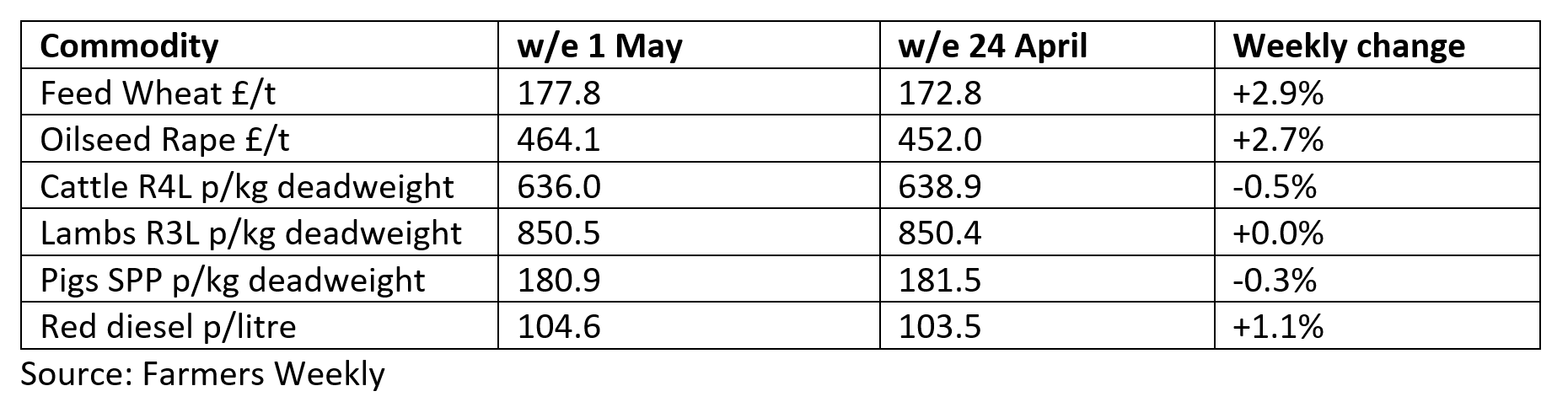
A mixture of poor weather in key growing areas and the knock-on effect of spiralling energy and fertiliser prices is lending some support to global cereal and oilseed prices. Australia’s rapeseed harvest is predicted to fall by almost 20% this season, adding to the upward pressure of higher crude oil values. Severe drought in the US winter-wheat belt means just 30% of plantings are classified as in good or excellent condition by the USDA. However, easy access to cheap Black Sea grain and the strength of sterling against the euro are limiting the upside for UK growers.
The headlines
Farm eco footprint falls
Emissions from farms in England have dropped significantly over the past decade, according to newly published findings from Rothamsted Research.
The study, which assessed intensive farming systems covering almost 18 million acres between 2010 and 2021, revealed an 18% reduction in both short and long-term global warming potential.
There was also a 21% drop in acidification potential and a 13% fall in eutrophication potential, which represents the nutrient run-off that can pollute rivers and lakes.
However, although some of the changes were driven by changes in agricultural practice, a drop in the size of the country’s beef herd and sheep flock, as well as the area of land used for dairy farming, also played a significant role.
Study co-author Professor Adie Collins said: “The findings clearly demonstrate, in the context of the recently released Land Use Framework for England, how structural change in land use and management can drive improvements in environmental performance while delivering food production.”
Soil data download
Farmers and landowners in England and Wales now have open access to detailed soil data collected over the past two decades by Cranfield University.
The creation of the National Soil Data Portal for England and Wales was one of the commitments in the government’s recently published Land Use Strategy, which aims to improve access to high-quality data to support food production and sustainable land management.
“Opening up access to this data will help monitor soil health and the wider ecosystems at both local and national levels,” said Ron Corstanje, Professor of Environmental Data Science and Head of Cranfield Environment Centre. “This is crucial to protecting and safeguarding our future.”
If you need help interpreting what the numbers mean for your farm or estate, please contact Patrick Dillon, a rural data specialist in our Research Analytics team.
News in brief
Tech grant extension
Defra has extended the deadline for applications to its Farming Equipment and Technology Fund (FETF) until 12 May. The FETF supports farmers, growers, foresters and contractors to invest in equipment and technology that can improve productivity, animal health and welfare, and slurry management. Please contact Mark Topliff for help with any grant and environmental payment issues.
EU farmer fuel boost
Farmers, fishing businesses and hauliers in the EU will now be able to apply for emergency payments of €50,000 to help cover their fuel and fertiliser bills, which have spiralled in the wake of the war between Iran, the US and Israel. The measure, announced last week, allows member states to cover the cost of up to 70% of a beneficiary's extra costs. Previously, state-aid rules capped compensation at 50%.
Soy cut boost for farmers
Arable farmers in the UK could benefit from a move by one of Europe’s largest poultry producers to reduce its carbon footprint. Last week, the 2 Sisters Food Group announced it had redeveloped its chicken feed to replace nearly one quarter of imported soya meal with 150,000 tonnes of British-grown oilseed rape and beans worth £50 million to the farming economy. By the end of 2027, the firm says it will have entirely replaced soya meal at its Scottish plant with home-grown peas, seeds and beans.
Red squirrel action plan
The red squirrel could be extinct in England within the next 25 years if insufficient action is taken to control the population of its nemesis, the disease-spreading and tree-destroying grey squirrel, according to research by the Zoological Society of London. The study, which forms the basis of the government’s recently released England Red Squirrel Strategy, proposes using a contraceptive liquid to drastically reduce the number of non-native greys. King Charles has just made a “very generous” donation to the Red Squirrel Survival Trust to help with its work developing the birth-control drug.
Vineyard values revealed
The 20th edition of our flagship publication, The Wealth Report, is out now. The report includes a detailed analysis of the forces, including climate change and shifting cultural tastes, that are reshaping the global vineyard map. Despite several challenges affecting the wine industry overall, average vineyard values in the UK’s key grape-growing regions remained steady in 2025, reports Will Banham, Partner in our Viticulture team. “The UK is innovating beyond traditional sparkling wines,” he explains. Download your copy of The Wealth Report.
Next Gen Dales' discussion
Our Northern Rural team is helping to host a CLA Next Generation event at the stunning Ingleborough Estate in the Yorkshire Dales on 5 June. The day will help equip those managing a diversified rural business or planning for the next generation. Attendees will also hear how the Farrer family has strengthened Ingleborough’s financial resilience, from a café renovation to land-use planning, offering an honest insight into the estate’s development so far. Sign up for the event.
Property of the week
Surrey equine stunner
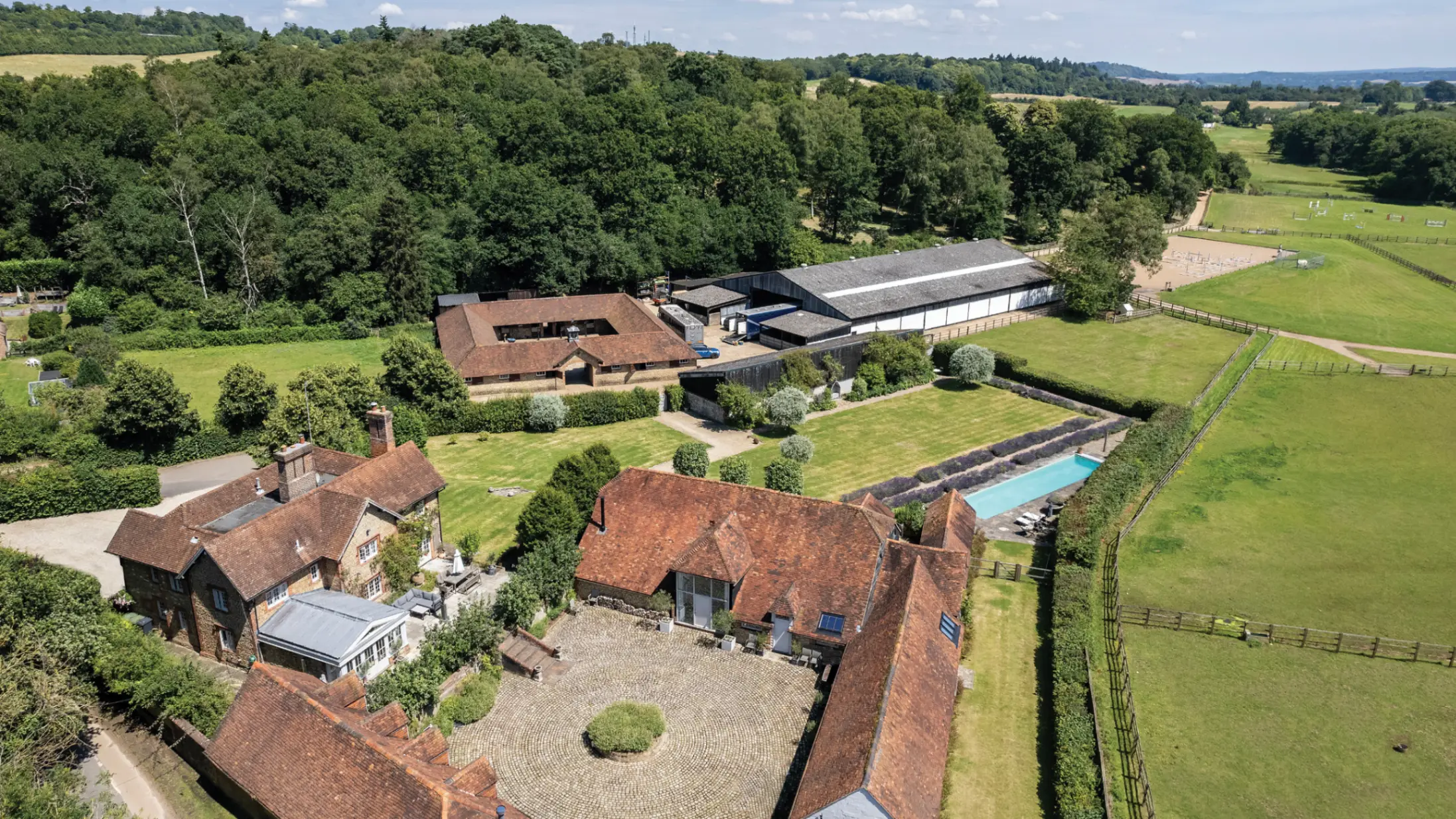
We’re heading to the Home Counties for this week’s property. Coneycroft, nestling in the Surrey Hills AONB, but just a short drive from Guildford, is a 33-acre horse enthusiast’s dream. The equestrian facilities, currently rented by an Olympian eventer, include 27 stables, indoor and outdoor arenas, and a cross-country training field. There is a five-bed main house, a five-bed barn conversion and a two-bed cottage. The guide price is £4.75 million. Please contact Julia Meadowcroft for more information.
Discover more of the farms and estates on the market with Knight Frank
Property markets Q1 2026
Development land – Green fields flat
The average value of urban brownfield and prime central London development land fell by 2.5% in the first quarter of the year, according to the Knight Frank Residential Development Index. Geopolitical instability, higher borrowing costs and an easing yet still onerous planning and regulatory environment weighed on demand, says our head of Res Dev research, Oliver Knight. Greenfield values, however, remained flat, reflecting more resilient conditions for volume housebuilders in suburban markets, where lower-density schemes, simpler build requirements and steadier underlying demand have supported viability, adds Oliver. Download the full report for more data and insight.
Farmland - market treads water
The average value of farmland remained relatively unchanged in the first three months of the year, according to the Knight Frank Farmland Index. Continued political and economic uncertainty, exacerbated by the current conflict in the Middle East, which has seen input costs like fuel and fertiliser spiral, and poor weather, means few new farms, blocks of land or estates were put up for sale during the traditional spring selling season. But despite a perception by vendors that now is not a good time to sell, demand remains firm from a range of buyers. If you are thinking of selling, please contact Will Matthews.
Country houses - values stabilising
The average price of houses in the countryside fell 5.5% in the 12 months to the end of the first quarter of 2026, which was a modest improvement on the 5.7% decline recorded in December, despite the uncertainty caused by the Middle East crisis, according to the Knight Frank Country House Index. The annual price decline for flats (-3.8%) and townhouses (-5.1%) was lower than for farmhouses (-7.1%), underlining how demand has been stronger in needs-driven markets. Prices are now 13% lower than their pandemic-era peak in Q2 2022, when demand increased for more space and greenery. Contact Tom Bill for more insight and data.
