
The Rural Update: Food production is a critical industry
Your weekly dose of news, views and insight from Knight Frank on the world of farming, food and landownership.
21 April 2026

Viewpoint
The Scottish National Party, as discussed below, is promising to cap food prices to protect struggling consumers, yet the Westminster government refuses to include agriculture in a scheme to protect critical industrial sectors from the ravages of the latest energy crisis.
There is no doubt that the rising cost of food is hurting the worst-off in society, but there should also be no doubt that producing the food that sustains the country is also a critically important business.
Policymakers may not see it, but energy is a key cost for the farming and horticultural sector. The glasshouses that produce the salad vegetables that the UK is least self-sufficient in are particularly vulnerable to surging gas and electricity costs.
Experts have repeatedly warned that the UK’s food supply chain is increasingly fragile; capping the cost of food and failing to grasp the importance of energy to farming will only make the situation worse.
Sign up to receive this newsletter and other Knight Frank research directly to your inbox
Commodity markets
Oil bouncing
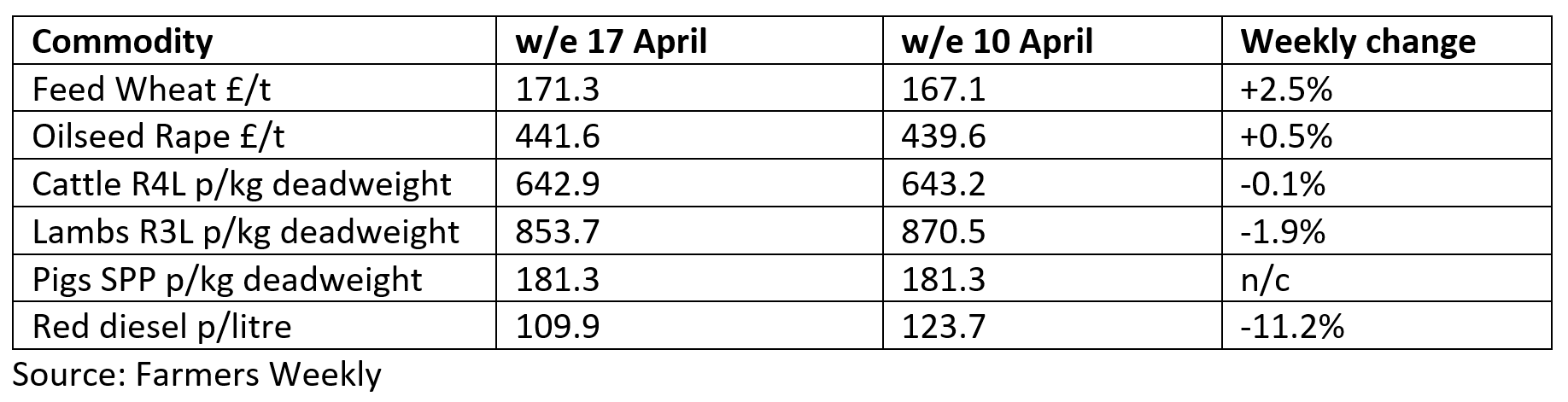
Last week’s welcome drop in red diesel prices could soon be reversed as the fragile ceasefire between the US, Iran and Israel falls apart. After falling 9% on Friday when Iran declared the Strait of Hormuz open again, crude oil prices jumped more than 6% in early Monday trading after Iran opened fire on ships and the US seized an Iranian cargo ship. Brent crude was trading at almost US$96/barrel.
The headline
BNG reforms revealed
Smaller developments will no longer have to worry about Biodiversity Net Gain (BNG) after the government published its responses to a public consultation on reforming the scheme.
From the end of July, sites under 0.2 hectares, which are estimated to account for around 50% of planning applications, will be exempt from mandatory BNG unless they include priority habitat. The government predicts the change could lead to a reduction of around 10% in demand for off-site biodiversity units.
Exemptions are also being introduced for habitat creation schemes where the primary purpose is to conserve or enhance biodiversity, park and public space enhancements, and temporary permissions of up to five years. However, the exemption for self-build projects is being scrapped, with smaller one-off homes having to rely on the 0.2-hectare exemption.
The government also plans to make it easier for ‘minor’ developments to achieve their BNG targets by removing the multiplier currently applied to the use of off-site credits. The BNG metrics tool will also be digitised, making it easier to use.
“The changes appear to be a sensible compromise that will make life easier for smaller developers while maintaining the integrity of the overall BNG market,” comments Mark Topliff, a natural capital specialist in our Rural Consultancy team.
Responding to a separate consultation, the government said BNG will start to apply to nationally significant infrastructure projects (NSIPs) from November this year.
A new consultation on whether to exempt brownfield sites from BNG under certain circumstances has also just been launched. A review of the de minimis exemption, which covers larger developments, such as the upward extension of a building, that have minimal environmental impact, will be considered alongside this consultation.
News in brief
KF BNG partnership
Meanwhile, we are pleased to launch our partnership with BNGx, the market-leading BNG advisory and trading platform. “As the BNG market continues to mature, the focus is increasingly on how transactions are delivered in practice. Working with BNGx allows us to bring together pricing, documentation and execution in a single, consistent workflow,” explains Mark Topliff.
SNP food cap proposal
As part of its manifesto (page 28) for the forthcoming Scottish parliamentary elections, the SNP is proposing a statutory price cap on a basket of 20 to 50 ‘essential’ foods, including milk, bread and eggs. Retailers will only need to ensure one item within each category is capped, while the SNP says measures will be put in place to ensure farmers are not affected.
Farming energy snub
Lobby groups have slammed the government for not including agriculture in its British Industrial Competitiveness Scheme, which will see electricity bills cut by up to 25% for more than 10,000 manufacturers, including those in the automotive, pharmaceutical and recycling sectors. NFU President Tom Bradshaw said: “It is deeply frustrating that food has been forgotten again by the government despite acknowledging the crippling impact of high energy costs on other industries.”
Tech grant deadline
Farms and rural estates wanting to take advantage of the 2026 round of the £50 million Farming Equipment and Technology Fund have until midday next Tuesday (28 April) to get their applications in. The scheme provides funding for three themes: productivity, animal health and welfare, and slurry management. Applicants can apply for up to £25,000 of funding under each theme.
M&S red meat commitment
Retailer M&S has signalled its long-term commitment to the red meat sector with two new decade-long supplier contracts with ABP and Dunbia. The firms process beef and lamb reared by 3,500 M&S Select Farmers. M&S said the deal secures long-term, all-year-round British supply for M&S and protects exclusivity across its Wagyu Gold, Aberdeen Angus Gold, and organic ranges.
Butterfly decline data
The latest results from the UK Butterfly Monitoring Scheme show that 33 of the country's 56 monitored species have fallen since 1976. Most affected are species reliant on specific habitats such as chalk grassland. The Pearl-bordered Fritillary, for example, has declined by 70% since records began. However, more adaptable species such as the red admiral are prospering as warmer temperatures allow them to survive throughout the year.
Cow gets waste licence
Government efforts to clamp down on illegal fly-tipping have been questioned after the CLA successfully applied for an upper-tier waste carrier licence in the name of a cow. The licensing scheme is supposed to ensure only legitimate businesses can collect waste, but Beau Vine, a Charolais-cross cow, was approved in under three seconds with no checks or questions. “Criminal gangs are now milking the system, using permits to appear legitimate before illegally dumping people’s waste,” says the CLA.
Property of the week
Suffolk splendour
Georgie Veale, of Knight Frank’s Woodbridge office, has just launched a cracking 240-acre East Anglian estate with diversified income streams. Haughley Park, near Stowmarket, includes a converted 16th century stable block that can host evening events for up to 240 guests and wedding breakfasts for 120 people. The main house is a Jacobean Grade I listed, seven-bedroom manor house, which is surrounded by 100 acres of woodland and 119 acres of park and pasture. The guide price is £4.25m. Please contact Georgie for more information.
Discover more of the farms and estates on the market with Knight Frank
Property markets Q1 2026
Country house - prices stable
The average price of houses in the countryside fell 5.5% in the first quarter of 2026, which was a modest improvement on the 5.7% decline recorded in December, despite the uncertainty caused by the Middle East crisis, according to the Knight Frank Country House Index. The annual price decline for flats (-3.8%) and townhouses (-5.1%) was lower than for farmhouses (-7.1%), underlining how demand has been stronger in needs-driven markets. Prices are now 13% lower than their pandemic-era peak in Q2 2022, when demand increased for more space and greenery. Contact Tom Bill for more insight and data.
