

The Rural Update: Don’t become reliant on environmental cash
Your weekly dose of news, views and insight from Knight Frank on the world of farming, food and landownership.
02 March 2026

Viewpoint
Defra Secretary Emma Reynolds probably did enough at last week’s NFU conference to keep farmers from becoming even more fractious. She emphasised the importance of food production, while the latest version of the Sustainable Farming Incentive (SFI) didn’t raise too many complaints. However, the new £100,000 cap does pose some questions about the government’s attitude towards supporting farmers. As CLA President and Rural Report interviewee Gavin Lane points out in a thought-provoking post on LinkedIn, “the SFI is a contract with government to supply those goods for which there is no functioning market.
The government has yet, as far as I know, decided to cap those businesses which provide us with the roads, hospitals and schools for the nation, so I am unsure why the provision for nature should be different. I worry this muddies the water between subsidisation and contractual obligations, between partnership and patronage.” It’s also important to note that the new SFI contracts will be for three years, not five. That will take farmers to around the end of this parliament, assuming Labour lasts its full five-year term. Nobody knows what will come next, so it is important that rural businesses do not become over-reliant on payments that could all too easily disappear.
Sign up to receive this newsletter and other Knight Frank research directly to your inbox
Commodity markets
Oil hike
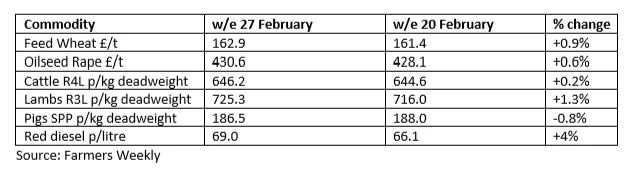
Donald Trump’s surprise assault on Iran has caused oil prices to jump as the impacts of the conflict reverberate around the Middle East. Iran has unleashed a barrage of retaliatory missile and drone strikes on targets across the region, including several oil tankers near the Strait of Hormuz. Brent Crude prices were up 10% to US$82/barrel at one point on Monday morning. Iran has warned shipping against using the Strait of Hormuz, through which around 20% of the world’s oil and gas passes.
Inflation worries
An extended conflict could create headaches for central bankers who seemed to be slowly winning the war on inflation. Any hike in oil and gas prices will have knock-on effects on other commodities, including fertiliser. Transport costs and delivery times will also rise if shipping firms opt to avoid the Suez Canal and Red Sea and take the much longer route around the Cape of Good Hope. Economists are already revisiting their expectations that the Bank of England will almost certainly cut interest rates again at its March meeting.
Meat export US boost
In more positive news, the first deliveries of tariff-free UK beef are arriving in the US after a trade deal, which included a reciprocal 13,000-tonne quota for beef, was struck between the two countries last May. If fully utilised, the quota could be worth up to £70 million a year for British farmers, claims Defra. Latest figures from HMRC reveal the total value of UK dairy exports in 2025 was £2.2 billion – up 17% on the year – while red meat exports, including offal, reached £2 billion – an increase of 12%.
The headline
New SFI details released
Speaking at last week’s NFU conference, Defra Secretary Emma Reynolds announced a new package of support measures for farmers, including details of the new Sustainable Farming Incentive (SFI).
As expected, the latest iteration of SFI will include fewer options for farmers to choose from, a change in payment rates for some options and a cap on the maximum amount that a single business can claim. However, at £100,000, this was higher than some were expecting. Agreements will last for three years rather than the current five, and the £50/ha management fee has been scrapped.
The number of options falls from 102 to 71. Those that will see higher payment rates include limited moorland grazing (£66/ha to £111/ha), while those dropping include the popular herbal leys (£382/ha to £224/ha) and winter bird food (£853/ha to £648/ha).
Smaller farms up to 50ha can apply in June, while the window for larger units will open in September.
Mark Topliff of our Rural Consultancy team comments: “This update represents a clear shift toward spreading the budget across more farms. While the £100,000 cap and the removal of management payments may hit some harder than others, the simplification – moving from 102 actions down to 71 – is a sensible reset.
“The real test now is whether lower rates on some of the most popular actions will maintain the environmental momentum we’ve seen so far.”
Reynolds also launched a £345 million package to boost productivity, innovation and animal welfare.
This includes £50 million for the Farming Equipment and Technology Fund, which provides grants to improve slurry management, and £70 million for the Farming Innovation Programme.
A new round of the Environmental Land Management Capital Grants offer will also open in July 2026. These help cover the cost of one-off investments such as tree planting, hedgerow restoration and improving water quality. Funding will increase from £150 million last year to £225 million in 2026.
For help with any grant schemes, please get in touch with Mark Topliff.
News in brief
Good food bill call
Over 100 UK supermarkets, food businesses, investors, NGOs and academics have signed a joint statement calling for the government to introduce a new ‘Good Food Bill’. The statement says a food strategy white paper committing to primary legislation that includes food system impact targets and long-term duties to support the cross-government action is needed to transform the food system for present and future generations. Farmers might claim that fairer treatment by some of the signatories would be a good start.
Welsh eco bill passes
The Environment (Principles, Governance and Biodiversity Targets) (Wales) Bill has just been passed by the country’s Senedd. The new legislation will create the Office of Environmental Governance Wales, an independent body responsible for holding public authorities to account on environmental law. It also requires ministers to set ambitious, legally binding targets to halt and reverse biodiversity decline by increasing native species, strengthening ecosystem resilience and addressing the drivers of biodiversity loss. Meanwhile, applications for the new Welsh Sustainable Farming Scheme opened on Monday (2 March).
Biodiversity indicator concern
The government’s latest review of English biodiversity shows little improvement in most of the indicators tracked. Only two indicators – the area of land under higher-level or targeted agri-environment schemes and the extent of protected areas at sea – are improving in both the long and short term. Of the 13 indicators that have been deteriorating in the long term, 10 are also deteriorating in the short term. These include relative abundance of breeding birds on farmland and relative abundance of farmland specialist butterflies.
April business cost crunch
The Federation of Small Businesses is warning of an impending cost crunch for firms next month as they are hit by a raft of rising bills. The extra costs include a 40% hike in the annual standing charges for electricity, a rise in the national living wage, higher statutory sick pay, a jump in dividend tax and, for many in England, higher business rate bills. For help with any of these issues, please contact Knight Frank’s Rural Consultancy team.
Fly tipping hits record levels
The number of fly-tipping incidents dealt with by local authorities in England rose 9% to 1.26 million during the 2024/25 reporting year, according to new data released last week. Lorry-sized incidents increased by 11% to 52,000. The CLA, however, points out that the figures represent the tip of the iceberg, as they do not include incidents dealt with independently by farms and estates. The organisation is calling for those affected to at least be allowed to dispose of dumped waste at council sites free of charge.
Unspent development levies
New analysis by the Home Builders Federation estimates that the total value of developer contributions held unspent by local authorities in England and Wales has increased to £9 billion, a rise of £800 million from mid-2024, despite declining housing delivery and reduced developer contribution receipts in recent years. The research estimates that there is £6.6 billion of unspent funds received via Section 106 agreements, alongside around £2.2 billion raised through the Community Infrastructure Levy (CIL).
Foot and mouth in Cyprus
Following recent outbreaks in mainland Europe, foot and mouth disease has been confirmed in sheep and cattle at Larnaca in Cyprus. Since 12 April 2025, travellers have been banned from bringing cattle, sheep, goat and pig meat, as well as dairy products, from EU countries into Great Britain for personal use.
Rural Report out now
The Autumn Winter 25/26 edition of The Rural Report, Knight Frank’s thought-leadership publication for rural property owners and their advisors, is available now. Full of insight from leading landed estates and our Rural Consultancy experts, it’s a must-read. To receive your copy, please sign up here.
Property of the week
NZ vineyard opportunity
While rain continues to delay the start of the UK’s spring farm-selling season, we thought we’d bring you some other opportunities from elsewhere within Knight Frank’s global network. Our New Zealand partner, Bayleys, has a number of vineyards for sale, including this scenic 50-acre property in the Awatere Valley in the heart of Marlborough’s winemaking heartland.
Since the first vines were planted in 1998, it has been carefully shaped into a thriving, premium vineyard with 32 acres of Sauvignon Blanc, Pinot Gris, Riesling and Chardonnay - varietals that capture the distinctive minerality and freshness of the Awatere terroir. A three-bedroomed house has dramatic views of the vines and mountains. The property is available by negotiation. Please contact Georgie Veale for more information.
Property markets Q4 2025
Farmland - prices stabilise
According to the Knight Frank Farmland Index, which tracks the value of bare agricultural land in England and Wales, the average price of land fell only marginally in the final quarter of 2025. However, diminishing farmer confidence and Inheritance Tax (IHT) worries saw prices slide by around 5% over the year. An acre is now worth just under £8,700. The government’s partial IHT U-turn just before Christmas should help stabilise prices during 2026.
Country houses - values slide
The Knight Frank Country House Index, which tracks the value of properties outside London above £750,000, lost 5.7% of its value in 2025 due to economic uncertainty and worries about what might be included in Labour’s second Autumn Budget. Properties classified as farmhouses were hit particularly hard, sliding by 7.3%. However, the market looks to be bottoming out with prices falling only marginally in the final quarter of the year and exchanges rising by 5%. Contact Tom Bill for more insight and data.
Development land - prices bottom
UK greenfield residential development land values fell 5% during 2025, but remained flat through the final quarter of the year, according to the latest instalment of the Knight Frank Residential Development Land Index. Uncertainty ahead of the Autumn Budget weighed on developers’ appetite for land, but positive signs are emerging. “The prevailing view is that Q4 2025 will mark the bottom of the market,” says Oliver Knight, Head of Res Dev Research.
