
The Rural Update: Does the Land Use Framework deliver?
Your weekly dose of news, views and insight from Knight Frank on the world of farming, food and landownership.
23 March 2026

Viewpoint
With so many people waiting for so long with such high levels of anticipation, it was always likely that the government’s Land Use Framework was going to struggle to meet expectations when it eventually arrived. Although the framework recognises the pressure on England’s finite land resource and the need to prioritise food security, it remains unclear what practical value it adds for farmers and landowners who already make informed, site-specific decisions about what works on their land. As a ‘national vision’, there is a real risk it removes choice and increases bureaucracy at a time when rural businesses need clarity and the ability to power up, not another layer of policy to navigate. Until we see whether it genuinely improves decision-making or unlocks investment on the ground, it is hard to judge whether this will support growth or simply add complexity to an already crowded system.
Sign up to receive this newsletter and other Knight Frank research directly to your inbox
Commodity markets
Oil ominous
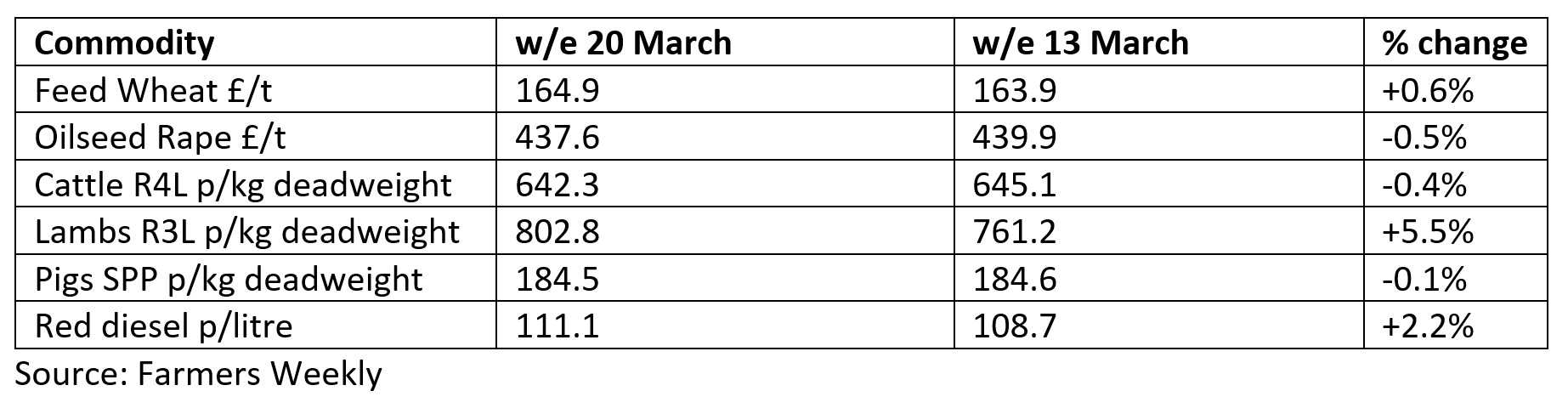
With the Middle East crisis entering its fourth week, crude oil prices hit their highest levels in almost four years on Monday as Brent crude futures for May rose to over US$112. Some commentators are starting to predict that the combined impact of the wars in Iran and Ukraine could lead to a more severe energy crisis than in the 1970s. For many farmers, the spiralling cost of fertiliser is the most immediate worry. Several ammonia plants in the Middle East have been forced to close, and urea values have surged by over US$200/t in 10 days, according to trader Frontier. Markets have become even edgier after Donald Trump issued Iran’s leaders with an ultimatum over the weekend to reopen the Strait of Hormuz within 48 hours or face bombing of their critical energy infrastructure. On Monday, he extended the deadline to five days.
Lamb leaps
Sheep prices continued their upward climb, breaking the 800p/kg barrier for the first time in almost two years. The peak coincided with Eid al-Fitr, the celebration that marks the end of the dawn-to-dusk fasting month of Ramadan, where lamb is a popular dish. Tight domestic supply and demand from the EU has also helped boost values.
Pigs stabilise
Pork producers will be hoping that the slide in prices, which have dropped 13p/kg since the beginning of the year, is about to bottom out. Values in some of the EU’s key markets, such as Spain and Germany, which had been badly hit by last year’s outbreak of African swine flu, have now started to recover, making UK pork more competitive.
The headline
Land strategy launched
The government has finally published its long-delayed Land Use Framework, which sets out how the English countryside can deliver on the many competing demands for land, such as food production, housing, nature recovery, flood mitigation and the provision of renewable energy.
Although the framework is not a mandatory guide on how land in different parts of the country should be used, Defra Secretary Emma Reynolds said it sets out “a coherent national vision for how we use our land, backed by the most advanced spatial analysis ever undertaken in this country”.
She added: “This Framework makes a clear, long-term commitment to maintain overall food production in England, to underpin our future food security and drive economic growth. It sets out how we will safeguard our most productive land and give every farmer, whether owner or tenant, the rights, data and certainty to invest with confidence.”
The framework says more efficient use of land and boosting agricultural productivity will safeguard food security, even though more space will be needed for nature.
Modelling by Defra suggests that the majority of England’s 22 million acres of Utilised Agricultural Area (UAA) will continue to produce food, albeit with more focus on soil management and climate resilience.
About 1.2 million acres will continue to be farmed but with a much greater emphasis on environmental measures, while almost 2 million acres of less productive land will be earmarked for more extensive habitat recovery measures such as peatland restoration.
Renewable energy will require about 380,000 acres by 2050 and new homes will take up 415,000 acres.
News in brief
Interest rate hike fear
The nine members of the Bank of England’s Monetary Policy Committee unanimously voted to hold the base rate at 3.75% at its meeting last week. Economists had been predicting a number of cuts during 2026 as inflation stabilised. The surge in oil prices, however, has turned that thinking on its head with some now saying rates might actually rise if the Strait of Hormuz remains closed for much longer. Bradley Smith, a rural lending specialist at Knight Frank Finance, said banks were increasing the cost of new loans, but few farmers were considering fixing their rates just yet. “About 90% of farmers are on variable rates.” Please contact Bradley for help with any borrowing requirements.
Sustainable farming boost
A newly published report from thinktank Demos, supported by chipmaker McCain, claims that adopting more sustainable farming methods could boost the profitability of UK farming by £1.6 billion each year. Growing Strong – The Sustainable Dividend for Economic and Food Security, says costs would be cut by over £900 million, including an almost £450 million drop in fertiliser imports.
Fertiliser consultation
Meanwhile, Defra and the parliaments of the home nations have just launched a new consultation on how to improve fertiliser supply resilience by boosting innovation and reducing environmental damage. Expanding the sector’s regulatory framework, which has not been significantly updated for over two decades and largely focuses on inorganic fertilisers, to cover alternatives such as digestates from recycling and biomass processes could deliver more options and flexibility for farmers. The consultation closes on 13 May.
Windpower planning boost
The government says farmers and other businesses wanting to install a wind turbine up to 30 metres high will no longer need to apply for planning permission. Energy Minister Michael Shanks said: “In the midst of uncertain global markets, the only way for households and businesses to have certainty is to invest in clean homegrown power such as onshore wind, one of the cheapest and quickest forms of energy to build.”
Landlord/tenant help
The Farm Tenancy Forum has just issued a guidance note to help landlords and tenants looking to set up a long-term tenancy agreement. The issues covered by the note include: agreeing approaches to rent reviews; clarifying responsibilities for repairs, maintenance and fixed equipment; and how to develop management plans for long-term farming and environmental objectives, while retaining flexibility to manage events. Alastair Paul, a keen advocate of better landlord/tenant relations, said: “Anything that leads to agreements that are more rewarding for both parties has to be welcomed.”
Dartmoor legal blow
The High Court ruled last week that the 89,000-acre Dartmoor commons, which cover over two thirds of Dartmoor National Park, have been mismanaged by the Dartmoor Commoners’ Council. The ruling said the council had failed in its legal duty under the Dartmoor Commons Act 1985 to assess the number of animals that should be allowed to graze on Dartmoor resulting in the deterioration of important wildlife areas. The claim was brought by environmental campaign group Wild Justice.
Commoners’ eco hit
Graziers on England’s upland common areas will not be able to apply to join the 2026 Sustainable Farming Incentive (SFI) or Countryside Stewardship Higher Tier agreements. Defra has confirmed that the Rural Payment Agency cannot process applications for common land or shared grazing and says there are no plans to upgrade its systems this year. For help with environmental scheme applications, please get in touch with Mark Topliff.
New towns revealed
The government announced yesterday (23 March) the preferred location of the seven new towns that it hopes will help deliver its ambitious target to build 1.5 million new homes by the end of this parliament. Each proposed location is expected to deliver at least 10,000 homes, with several delivering 40,000 or more over future decades. The proposed locations are: Tempsford, Bedfordshire; Crews Hill and Chase Park, Enfield; Leeds South Bank, West Yorkshire; Manchester Victoria North, Greater Manchester; Thamesmead, Greenwich;
Brabazon and the West Innovation Arc, South Gloucestershire; Milton Keynes, Buckinghamshire. If you need help with compulsory purchase or compensation issues please contact Tim Broomhead.
Cultured meat support
Farming Minister Angela Eagle expressed her support for the controversial cultured meat sector at a parliamentary debate last week. Responding to a question from Labour MP Will Stone, who is a champion of alternative protein start-up Hoxton Farms, Dame Angela said: “The government’s Good Food Cycle strategy sees alternative proteins as a major opportunity, and not just for the economy but for health, sustainability and food resilience.”
Abattoir charge U-turn
Following an outcry over a sharp increase in its inspection costs for abattoirs, the Food Standards Agency has launched a consultation on slashing the price for the smallest meat-processing businesses by 90%. The agency estimates that nearly a third of abattoirs – those processing up to 1,000 livestock units per year for red meat, or 150,000 poultry or small game birds annually – would receive the discount.
EU news – F&M and fur
A case of foot-and-mouth disease has been confirmed on a cattle farm in Greece. Meanwhile, despite a petition signed by over 1.5 million people demanding a ban, the European Commission has said it doesn’t plan to close down the bloc’s remaining fur farms. Instead, it plans to impose stricter animal welfare standards, according to an internal draft communication seen by Politico.
Rural Report out now
The Autumn Winter 25/26 edition of The Rural Report, Knight Frank’s thought-leadership publication for rural property owners and their advisers, is available now. Full of insight from leading landed estates and our Rural Consultancy experts, it’s a must-read.
Property of the week
Lambourn Valley land
With the rain clouds finally clearing, the spring farmland market is finally starting to move. This 217-acre parcel of Grade 3 land at Cranes Farm in East Garston, near Hungerford, Berkshire, will be an interesting early test of the market for bare land. Priced at £2.39 million, the sale includes 187 acres of arable soil, 27 acres of pasture and a 3.5-acre block of woodland. The land is entered into a mid-tier Countryside Stewardship Scheme and the Sustainable Farming Incentive, and is currently down to winter oats and wild bird seed mixture. Please contact Will Matthews for more information.
Property markets Q4 2025
Farmland - prices stabilise
According to the Knight Frank Farmland Index, which tracks the value of bare agricultural land in England and Wales, the average price of land fell only marginally in the final quarter of 2025. However, diminishing farmer confidence and Inheritance Tax (IHT) worries saw prices slide by around 5% over the year. An acre is now worth just under £8,700. The government’s partial IHT U-turn just before Christmas should help stabilise prices during 2026.
Country houses - values slide
The Knight Frank Country House Index, which tracks the value of properties outside London above £750,000, lost 5.7% of its value in 2025 due to economic uncertainty and worries about what might be included in Labour’s second Autumn Budget. Properties classified as farmhouses were hit particularly hard, sliding by 7.3%. However, the market looks to be bottoming out with prices falling only marginally in the final quarter of the year and exchanges rising by 5%. Contact Tom Bill for more insight and data.
Development land - prices bottom
UK greenfield residential development land values fell 5% during 2025, but remained flat through the final quarter of the year, according to the latest instalment of the Knight Frank Residential Development Land Index. Uncertainty ahead of the Autumn Budget weighed on developers’ appetite for land, but positive signs are emerging. “The prevailing view is that Q4 2025 will mark the bottom of the market,” says Oliver Knight, Head of Res Dev Research.
