

The Rural Update: Coherent energy policy vital
Your weekly dose of news, views and insight from Knight Frank on the world of farming, food and landownership.
16 March 2026

Viewpoint
Data centres are considered so critical to the UK economy that the government is apparently considering schemes that would deliver them discounted energy. Farmers, meanwhile, who supply real food for the nation rather than a digital diet of AI slop, are facing spiralling and potentially business-destroying energy costs in the form of more expensive red diesel and heating oil, higher electricity bills and fertiliser price hikes. The current crisis in the Middle East was a long time in the making, yet policymakers seem utterly unprepared. Natural gas from the North Sea, which could help our energy security, is erroneously labelled as irrelevant, while home-produced biogas that could help with the green transition is underutilised. Rural businesses, consumers and the environment need a coherent energy strategy that delivers for food security.
Sign up to receive this newsletter and other Knight Frank research directly to your inbox
Commodity markets
Heating oil help
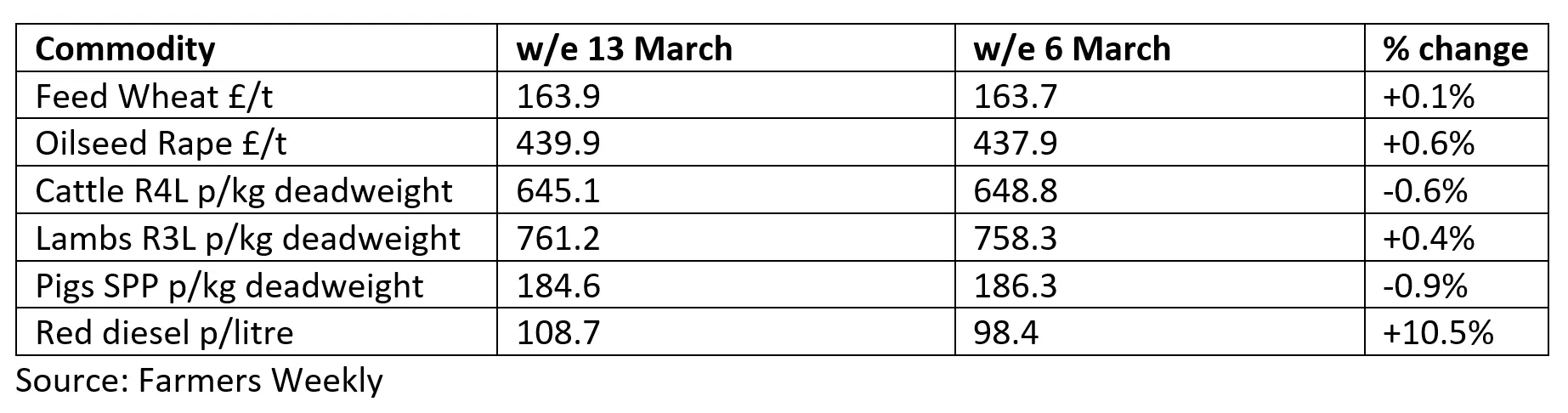
The government has just announced a £53 million package to help low-income households that rely on heating oil to keep their houses warm. Red diesel prices jumped by 10.5% last week as the Middle East crisis showed no signs of abating, but consumers are reporting that heating oil prices, which are not covered by the Ofgem energy price cap, have doubled. In England, £27 million will be distributed through local authorities via the Crisis and Resilience Fund, which launches on 1 April. Northern Ireland will receive £17 million, while Scotland will receive £4.6 million and Wales £3.8 million.
The headline
Plan for gas
The government could do much more to protect consumers, including farmers, from volatile energy markets caused by geopolitical events like the current Middle East crisis, according to industry experts.
Lifting restrictions on the use of bio-fertilisers and boosting bio-gas output would help mitigate the sharp rise in the costs of fertiliser and energy, says the Anaerobic Digestion and Bioresources Association (ADBA).
The organisation claims existing biomethane plants could increase production by almost a third “within months” if the government removes several regulatory barriers.
But ADBA says the UK has the resources to go even further. Studies suggest biomethane could eventually produce around 120 TWh of gas annually, potentially supplying between 20% and 50% of long-term UK gas demand.
Countries such as Denmark already meet around 40% of their gas demand from biomethane, while France has rapidly expanded production.
Meanwhile, claims that boosting fossil fuel output from the North Sea would do nothing to boost the UK’s energy security have been dismissed by one trade economist.
Writing on Substack, Catherine McBride points out that, unlike for oil, there is no global price for gas. She also notes that because gas pumped from the UK’s continental shelf can only currently be transported via pipelines to a few countries due to the lack of liquefaction facilities, our domestic market would benefit most from any extra supplies.
News in brief
UK climate transition
The UK’s Climate Change Commission (CCC) says that the cost of dealing with geopolitical energy shocks like Russia’s invasion of Ukraine is actually more expensive than delivering its long-term net-zero targets. The CCC calculates that the government has spent £41.7 billion solely on subsidising domestic energy bills since the energy price crisis began in 2022. “In light of current world events, it’s more important than ever for the UK to move away from being reliant on volatile foreign fossil fuels, to clean, domestic, less-wasteful energy,” said CCC chairman Nigel Topping.
Cut CAP say EU scientists
Across the English Channel, meanwhile, the European Scientific Advisory Board on Climate Change has just published a new paper, Climate adaptation and mitigation in the agri-food system – Recommendations for coherent EU policies. Among other suggestions, it calls on the EU to cut payments under the Common Agricultural Policy (CAP) that support livestock production, which it says is a major contributor to greenhouse gas emissions.
Cheaper data power
As part of reforms to boost the delivery of critical infrastructure, the government has launched a consultation on measures to prevent speculative applications for grid connections, driven in part by renewable energy projects. Edie is also reporting that under plans for AI Growth Zones, certain data centre developments could have priority access to available grid capacity and discounts on electricity costs.
Welsh farm loan plan
The Welsh government has launched a pilot low-interest loan scheme to help farmers invest in energy efficiency, waste management and productivity improvements. The Sustainable Agriculture Loan Scheme will offer incentivised loans at a fixed 3% interest rate, repayable over up to 15 years. Up to £5 million will be available during the 2026/27 financial year, with the potential to extend the scheme depending on demand. Farms will be able to borrow between £25,000 and £1 million per project, with a six-month repayment holiday at the start of the loan.
SFI bird worries
As the farming industry digests the details of Defra’s new version of the Sustainable Farming Incentive (SFI), more concerns are starting to emerge. Farmers and environmental groups have voiced their worries that the removal of the GRH6 action, which paid £646/ha to manage or maintain species-rich grassland, could jeopardise the habitat for ground-nesting birds. Please contact Mark Topliff for advice on SFI options.
Food import welfare call
Farming and environmental groups, including the NFU and RSPCA, are hosting a joint event at the House of Commons later this week to urge the government to introduce a set of core production standards for UK food imports. All food imports should meet the same welfare and environmental standards that British farmers must adhere to, they argue.
Reform chicken admission
However, Nigel Farage, leader of the Reform Party, does not agree. Interviewed by Farmers Weekly last week at a political rally in Basingstoke, Farage confirmed that a Reform government would not ban the import of chlorinated chicken from the US, as long as it was properly labelled.
Non-stun labelling demand
Meanwhile, a Ten-Minute Rule Bill calling for compulsory labelling of meat from animals not pre-stunned prior to slaughter, proposed by Tory MP Esther McVey, passed its first reading recently. The bill, which would cover some Halal (pre-stunning is permitted) and all Kosher meat, will receive a second reading on 10 July. Ten-Minute Rule Bills rarely make it into law and are generally used by MPs to raise the profile of an issue they feel strongly about.
Lead shot countdown
New rules governing the use of lead shot come into force on 1 April. Under the REACH (Amendment) Regulations 2026, which were laid before Parliament on 3 March 2026, the use or sale of shot containing more than 1% lead will be illegal from 1 April 2029 for the vast majority of private gun owners.
Extra litter lout powers
As part of its soon-to-be-published Waste Crime Action Plan to clamp down on fly tipping and littering, the government has just announced two new initiatives. One proposal would see the removal of driving licences from those convicted of waste crimes, while Environment Agency enforcement staff could also be given police-like powers, allowing them to more effectively tackle and convict waste criminals.
Livestock attack fine hike
Dog owners convicted of letting their animals worry livestock will also face stiffer penalties from this week after the Dogs (Protection of Livestock) (Amendment) Act comes into force on 18 March. The maximum fine rises from £1,000 to an unlimited amount, while police have new powers allowing them to enter and search premises to identify, seize and detain a dog to prevent future incidents.
Rural Report out now
The Autumn Winter 25/26 edition of The Rural Report, Knight Frank’s thought-leadership publication for rural property owners and their advisers, is available now. Full of insight from leading landed estates and our Rural Consultancy experts, it’s a must-read.
Property of the week
NZ vineyard opportunity
As we wait for the UK farmland market to kick into gear, here’s another tempting vineyard opportunity from Bayleys, our partner in New Zealand. Properties in Grovetown, near Blenheim, in the Marlborough winegrowing region, rarely come to the market, so this 35-acre block of vines is set to attract strong interest. Replanted in 2021, the vineyard includes almost 10 acres of sauvignon blanc grapes and 11 acres of pinot gris. A nine-acre parcel of grazing land has scope for further vineyard development or the opportunity to build a new homestead. Offers over NZ$2.1 million are invited. Please contact Georgie Veale for more information.
Property markets Q4 2025
Farmland - prices stabilise
According to the Knight Frank Farmland Index, which tracks the value of bare agricultural land in England and Wales, the average price of land fell only marginally in the final quarter of 2025. However, diminishing farmer confidence and Inheritance Tax (IHT) worries saw prices slide by around 5% over the year. An acre is now worth just under £8,700. The government’s partial IHT U-turn just before Christmas should help stabilise prices during 2026.
Country houses - values slide
The Knight Frank Country House Index, which tracks the value of properties outside London above £750,000, lost 5.7% of its value in 2025 due to economic uncertainty and worries about what might be included in Labour’s second Autumn Budget. Properties classified as farmhouses were hit particularly hard, sliding by 7.3%. However, the market looks to be bottoming out with prices falling only marginally in the final quarter of the year and exchanges rising by 5%. Contact Tom Bill for more insight and data.
Development land - prices bottom
UK greenfield residential development land values fell 5% during 2025, but remained flat through the final quarter of the year, according to the latest instalment of the Knight Frank Residential Development Land Index. Uncertainty ahead of the Autumn Budget weighed on developers’ appetite for land, but positive signs are emerging. “The prevailing view is that Q4 2025 will mark the bottom of the market,” says Oliver Knight, Head of Res Dev Research.
