

The Rural Update: Don’t rely on policymakers
Your weekly dose of news, views and insight from Knight Frank on the world of farming, food and landownership.
16 February 2026

Viewpoint
Farming organisations are already warning that the next iteration of Defra’s Sustainable Farming Incentive (SFI) may fail to deliver all the benefits provided by its predecessors. Given the pressure on the public purse, this is perhaps unsurprising, but it does demand greater clarity of thinking from both policymakers and the farming industry.
The government needs to be clear on how it plans to deliver its environmental and climate targets. Take renewable energy, for example. As discussed below, a whole tranche of new projects has just been given the go-ahead. At the same time, however, those who operate the energy networks say they will fail to connect most schemes on time.
It also remains unclear as to whether the purpose of SFI is to cushion the loss of the Basic Payment Scheme (BPS) or help the government deliver its ambitious environmental targets. If the latter, farmers can’t be expected to do that for a loss. But farmers and landowners also need to adapt more quickly to the post-EU environment where, even within parliamentary terms, government policy can change overnight.
It won’t be easy given the many challenges facing the industry, but long-term resilience without government support should be the ultimate goal for any business.
Sign up to receive this newsletter and other Knight Frank research directly to your inbox
Commodity markets
Pig price pressure
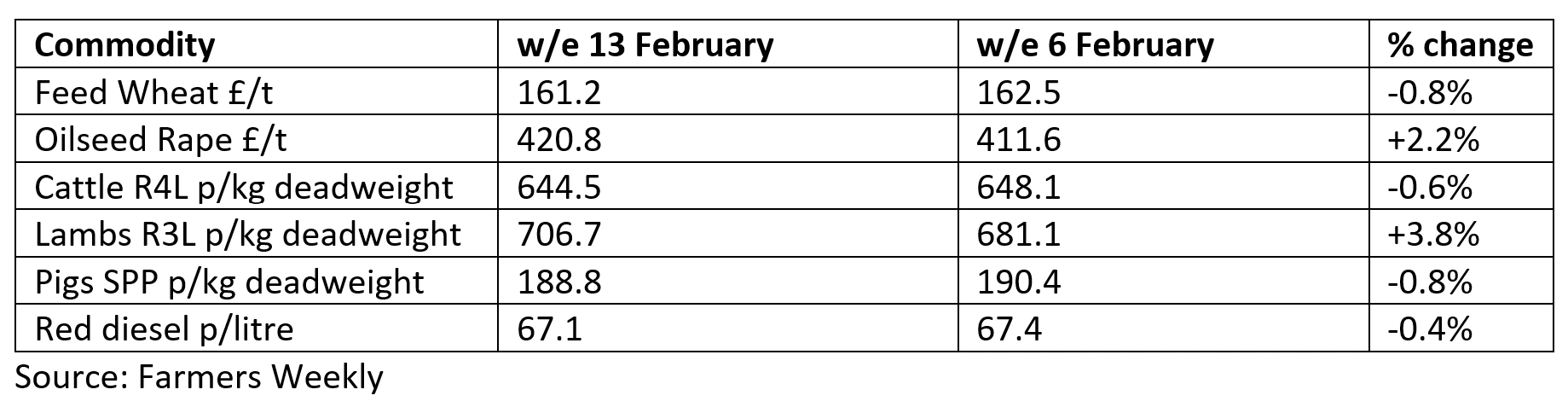
Pig prices have now fallen below farmers’ average cost of production, according to the AHDB. The organisation calculates that it costs 190p/kg to produce a kg of pork, but last week prices dropped by a further 1% to just under 189p/kg. This takes the total fall so far this year to nearly 5%. Year-on-year, values are down by 7%.
Ramadan lamb boost
There is better news for sheep farmers. Lamb prices jumped almost 4% last week, moving back above 700p/kg again, as buyers stocked up on supplies in preparation for Ramadan, which starts this week and is likely to last until 18 or 19 March. Although Ramadan is known as a month of fasting, lamb is a popular meat for breaking the daily fast and for celebrating Eid al-Fitr at the end of the fasting period.
The headline
Environmental scheme concerns
The Sustainable Farming Incentive (SFI) is Defra’s flagship environmental scheme for farms and rural estates, but its abrupt closure to new applicants last year played a key role in the agricultural sector’s loss of confidence in the government.
A new iteration of SFI has been promised later this year by Farming Minister Angela Eagle, but there are already concerns that it may fall well short of previous versions in terms of its benefits for nature and financial support for farming businesses.
As reported in the farming press, Defra seems set to reduce the payment rates for some popular SFI options, such as establishing herbal leys, to below the amount of income foregone by farmers. There could also be a cap on individual agreements.
The aspiration to get a majority of producers signed up for SFI also appears to be waning, with civil servants at the ministry apparently relaxed if only 50% of farmers sign up to the new scheme.
Please contact Mark Topliff for advice on grant schemes.
News in brief
Renewable schemes approved…
Details of the location of the onshore renewable energy schemes that were given the green light under the government’s latest contracts for difference allocation have just been published. They include 125 solar schemes (124 in England and one in Wales), 28 wind projects (21 in Scotland, five in Wales and two in England) and four tidal projects (three in Wales and one in Scotland).
Please contact David Goatman for advice on renewable energy projects.
…But grid update needed
However, the National Energy System Operator (NESO) has admitted that it is unlikely to meet the majority of its current connection obligations. NESO says 210 of the 340 energy projects awarded priority status for connection by 2027 are at risk. A study by engineering consultancy Arup has concluded that investing £34 billion in decarbonising and modernising the UK’s National Grid by 2040 would deliver £194 billion of economic value and create 90,000 jobs.
Local power plan out
Given the delays mentioned above, landowners looking to generate their own renewable energy may prefer to consider more local schemes. The government has just published its Local Power Plan, which includes £1 billion of funding to help encourage the development of more community-owned generation projects.
Woodland carbon issues
Tree planting has been touted as one of the best ways to mitigate carbon emissions, but a new study by the University of Stirling suggests the situation may be more nuanced in certain circumstances. The research found that soils under mature pine forests had about half as much carbon as nearby soils that stayed as grassland, and that the carbon lost from the soil was equal to around a third of the carbon that the trees had absorbed from the atmosphere.
Border carbon consultation
The government has just opened a technical consultation paper on another carbon issue that could have significant consequences for farmers. The Carbon Border Adjustment Mechanism (CBAM), set to be introduced on 1 January 2027, is designed to ensure imports of carbon-intensive products such as steel and cement face a comparable carbon price to that of UK manufacturers. However, CBAM also applies to fertiliser, the bulk of which is imported, and is likely to push farmer costs up significantly. The consultation closes on 24 March.
Development land bottoms
UK greenfield residential development land values fell 5% during 2025, but remained flat through the final quarter of the year, according to the latest instalment of the Knight Frank Residential Development Land Index. Uncertainty ahead of the Autumn Budget weighed on developers’ appetite for land, but positive signs are emerging. “The prevailing view is that Q4 2025 will mark the bottom of the market,” says Oliver Knight, Head of Res Dev Research.
Oat drink is not milk
The UK’s Supreme Court has ruled that Oatly, the Swedish oat drink producer, can no longer use the word ‘milk’ or the slogan ‘Post milk generation’ to market its products in Britain. The ruling ends a long-running saga that started in 2021 when Oatly tried to register the slogan as a trademark. The ruling could have implications for other plant-based products.
NFUS plant-based labelling call
Meanwhile, tougher action to stop plant-based alternatives from using names or branding that imitate traditional meat and mislead consumers is one of the eight proposals in Fair Labels, Fair Markets, a new policy paper from NFU Scotland that calls for urgent reform of UK food labelling regulations. It warns that current rules are “confusing, inconsistent and unfair” to both consumers and domestic producers.
EU meat-free burger ban query
However, the Vegetarian Society has sent a letter, signed by numerous plant-based food companies and backed by retailers Aldi and Lidl, to the European Commission arguing that its planned restrictions on the labelling of meat-free foods are unnecessary. It claims that such products are already clearly identified, and removing descriptive words like ‘sausage’ and ‘burger’ would actually cause more confusion for consumers.
Interview with Minette Batters
A reminder not to miss our thought-provoking interview with former NFU President Minette Batters. Baroness Batters talks in detail about why the 57 recommendations contained in her recently published Farming Profitability Review are so crucial to boosting the resilience of the country’s agricultural and food industries. Read highlights of the interview.
Rural Report out now
The Autumn Winter 25/26 edition of The Rural Report, Knight Frank’s thought-leadership publication for rural property owners and their advisors, is available now. Full of insight from leading landed estates and our Rural Consultancy experts, it’s a must-read.
Property markets Q4 2025
Farmland - prices stabilise
According to the Knight Frank Farmland Index, which tracks the value of bare agricultural land in England and Wales, the average price of land fell only marginally in the final quarter of 2025. However, diminishing farmer confidence and Inheritance Tax (IHT) worries saw prices slide by around 5% over the year. An acre is now worth just under £8,700. The government’s partial IHT U-turn just before Christmas should help stabilise prices during 2026.
Country houses - values slide
The Knight Frank Country House Index, which tracks the value of properties outside London above £750,000, lost 5.7% of its value in 2025 due to economic uncertainty and worries about what might be included in Labour’s second Autumn Budget. Properties classified as farmhouses were hit particularly hard, sliding by 7.3%. However, the market looks to be bottoming out with prices falling only marginally in the final quarter of the year and exchanges rising by 5%. Contact Tom Bill for more insight and data.
