
The Rural Update: Is Defra ready to change?
Your weekly dose of news, views and insight from Knight Frank on the world of farming, food and landownership.
08 September 2025

Viewpoint
It is doubtful that too many in the farming community will be sad to see the back of Defra Secretary Steve Reed, following Keir Starmer’s cabinet reshuffle last week. Mr Reed rapidly burned through the cautious goodwill that he brought with him after Labour’s election victory last year, particularly his unwillingness to challenge the Treasury over its reforms of Agricultural and Business Property Relief. Numerous polls show farmer optimism is at rock bottom, so Emma Reynolds, the new head of Defra, has a tough task on her hands to rebuild confidence. Convincing her former colleagues at the Treasury to take another look at the much-hated ‘family farm tax’ would be a great start, but if the predictions of a new report on UK food security are to be believed, not to mention the imminent Countryside Stewardship Scheme funding gap crisis (both discussed below), that is just one of many challenges waiting in her in-tray.
Sign up to receive this newsletter and other Knight Frank research directly to your inbox
Commodity markets
Beef and sheep drop
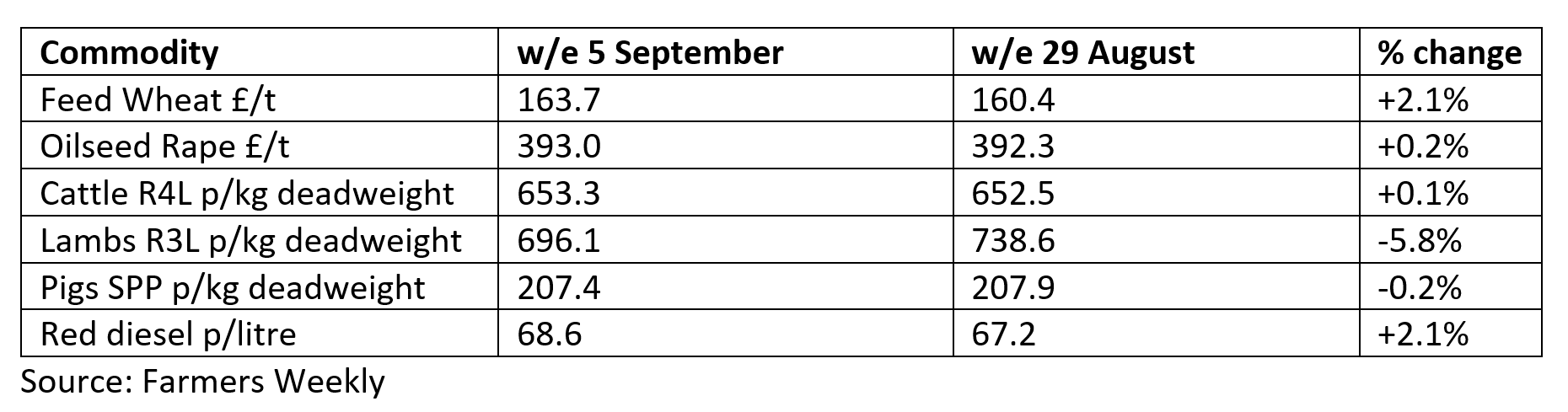
The latest figures from Defra reveal that England’s beef and sheep numbers have hit record lows. As of 1 June 2025, the English sheep flock totalled 13.3 million head, a decline of 3.8% year-on-year, down almost 520,000 head. This marks another year of contraction in the flock, continuing a long-term downward trend. The total female breeding flock fell by 2.1% to 6.43 million head, the lowest level in fifteen years. Over the same period, the English cattle herd also contracted further, with the total population at 4.91 million head, down 1.4% year-on-year. This represents the lowest level recorded by the Defra June survey.
The headlines
New broom at Defra
It’s all change at Defra following the downfall of Angela Rayner.
Prime Minister Keir Starmer has used the resignation of his Housing Secretary, who admitted to underpaying stamp duty on a home purchase, as an opportunity for a significant cabinet reshuffle.
Steve Reed, the embattled Defra chief, has been switched to Ms Rayner’s role, while Daniel Zeichner has been sacked from his post as farming minister.
Emma Reynolds, Economics Secretary at the Treasury, replaces Mr Reed, while veteran Labour politician Angela Eagle, who has been an MP since 1992 and held multiple ministerial and shadow roles, takes over from Mr Zeichner.
CLA President Victoria Vyvyan welcomed the change at the top: "We offer our warmest congratulations to Emma, who we have known for some time as a champion of the rural cause.
“She will already know of the immense potential of the rural economy to generate growth and create jobs. We will do everything in our power to support her in unlocking that potential.
"This reshuffle offers a profound opportunity to draw a line under a very difficult year for industry-government relations. But to move on, the government must first recognise that its current position on inheritance tax is completely untenable and will do nothing but harm to the rural and national economy."
However, not everybody is pleased about the departure of Mr Zeichner and the impact it could have on the government’s food strategy, which he was leading.
James Bielby, Chief Executive of the Federation of Wholesale Distributors, told The Grocer: “Having worked closely with several ministers over the years, Daniel Zeichner was head and shoulders above any incumbent.”
Food security warning
A new report is warning that the UK could face a food security crisis if it doesn’t focus on using technology to boost agricultural production.
UK Food Security - Outlook to 2050, published by the think tank Science for Sustainable Agriculture, says the loss of farmland to housing, renewable energy, and environmental schemes, combined with the uptake of less intensive farming techniques and population growth, will have a detrimental effect on yields per capita, leading to more food imports.
The report’s worst-case scenario model predicts that if government policies for housing, net zero, tree planting and nature restoration are fully implemented, almost 25% of the country’s farmland, mostly arable soil, could be lost.
Report author Derrick Wilkinson says policymakers need to rethink their current multi-functional land-use strategies.
“Scientific evidence increasingly points to ‘land sparing’, concentrating high-yield production on the most suitable farmland, whilst setting aside other areas for environmental purposes, as a more effective route to reconciling food security with net zero and biodiversity goals.”
News in brief
Tech innovation fund
Although it won’t go as far as the changes advocated by Science for Sustainable Agriculture, the government has just announced a new round of competitive funding to help boost agricultural innovation. £12.6 million is up for grabs to help develop new farmer-led technologies that will “cut costs, reduce seasonal labour, improve animal health and tackle wider industry challenges”.
M&S regen commitment
Meanwhile, retailer Marks & Spencer announced yesterday (8 September) that all the British products available on its shelves will come from farmers using regenerative practices by 2030. The ambition is part of the store’s four-point Plan A for Farming strategy document. An additional £7 million will be available to help farmers become more profitable and sustainable. Global food and drink giant PepsiCo has also just announced a new plan to help deliver the adoption of regenerative, restorative, or protective practices across 10 million acres by 2030.
Stewardship gap
However, as reported in Farmers Weekly, a significant chunk of the environmental work done by farmers is now at risk. Over 5,500 Countryside Stewardship agreements are set to expire before March 2026, with details of replacement schemes yet to be released. Environmental groups are urging the government to introduce a 12-month extension for expiring agreements.
Wildfire threat
Analysis from carbon insurer Artio predicts that wildfires could cause £12 million of damage to the countryside in England and Wales this month, as well as the potential loss of over 200,000 tonnes of CO2 storage and threats to major peatland and woodland carbon projects. Landowners’ lobby groups say moorland burning bans will exacerbate the problem, while the National Sheep Association believes the impact of declining flock numbers in the uplands (see Commodity markets) due to alternative land uses is also being overlooked.
Peatland restoration grants
In Scotland, the next round of funding for peatland restoration projects under the NatureScot Peatland ACTION scheme closes on 30 September for initiatives with an intended start date after 1 April 2026. Although peatlands store more carbon than forests, it is claimed that damage to 80% of Scotland’s moors means they are now net emitters of carbon, accounting for 15% of the country’s emissions.
Planning opinion
Although Steve Reed, is no longer running Defra, his decisions as the new Housing Minister could still have a significant impact on rural property owners. The first issue to demand his attention will likely be the progress of the Planning and Infrastructure Bill through Parliament. Part 3 of the bill, which deals with the establishment of a national Nature Restoration Fund, is currently being lambasted by environmental groups for not doing enough to protect nature. Despite amendments, a new opinion from David Elvin QC for NatureSpace Partnership says the bill could still break the government’s manifesto pledges by being “regressive” for nature.
The Rural Report SS 25 – Out now
The Spring Summer 2025 edition of The Rural Report, Knight Frank’s flagship publication for rural businesses, which looks in more detail at many of the issues discussed in The Rural Update, is out now. The new report includes the latest news, research and insights from Knight Frank’s rural property experts, as well as thought-provoking contributions from some of Britain’s most iconic estates. Available online and in print, you can click here to access the full report.
Properties of the week
Scotland island idyll
Shuna Island could be the ultimate Scottish hideaway for somebody who loves farming, nature, history and country sports. The history of the completely private 1,110-acre island near Oban, off the Argyll coast, spans 9,000 years, starting with Stone Age burial mounds and including a mention in the Vita Columbae. There are 81 acres of permanent pasture, 640 acres of rough grazing, and over 300 acres of native woodland and foreshore. In terms of accommodation, the island has numerous options, from timber lodges to more substantial farmhouses, and even castle ruins. Red and fallow deer roam freely, alongside woodcock, snipe, and a long tradition of pheasant shooting. For over 50 years, the owners have hosted renowned woodcock shoots and deer stalking during the autumn rut. For more information please contact Tom Stewart-Moore.
Historic Kent estate home to rent
If you need a place to stay while you get started with your new vineyard, Knight Frank’s Rural Consultancy team in Kent has an intriguing option on offer. Newhouse at Mersham, near Ashford, which was once home to Countess Mountbatten of Burma and Lord Brabourne, is part of the idyllic 2,700-acre Hatch Park Estate. Now available to rent, the nine-bed period property costs £7,995 a month. For more information, please contact Katie Bundle.
Discover more of the farms and estates on the market with Knight Frank
Property markets Q2 2025
Development land – Market weakens
The value of development land continues to fall, despite the government’s pledge to build 1.5 million new homes during this parliamentary term. According to the newly published Q2 2025 instalment of the Knight Frank Residential Land Index, prices for green and brownfield sites have dropped by 5% over the past 12 months. Lower levels of supply mean values in London slid by just 2.5%. Housebuilders are grappling with planning delays, viability challenges, skills shortages and weak demand, explains Oliver Knight.
Farmland – Uncertainty dominates
Despite cuts to support payments and lacklustre grain prices, the average price of bare agricultural land fell just 2.3% in the second quarter of the year, according to the latest edition of the Knight Frank Farmland Index. “It’s really difficult to discern any clear value trends at the moment because of reduced transaction levels,” says Will Matthews, Head of Farms & Estate Sales. Download the full report for more data and insight.
Country houses – buyers’ market
It’s a buyers’ market when it comes to rural homes, according to the latest research from Tom Bill, Knight Frank’s Head of UK Residential Research. The Knight Frank Prime Country House Index slipped by 2.5% in Q2, the second-largest quarterly decline since Q1 2009. At the same time, the number of properties for sale is up 9% compared with this time last year. On average, there are six prospective buyers for each new instruction, compared with 19 at the height of the Covid-19 pandemic, while sales are achieving 94% of the asking price.
