

The Rural Update: Communicate for better profits
Your weekly dose of news, views and insight from Knight Frank on the world of farming, food and landownership.
30 September 2025

Viewpoint
Agriculture in the UK is facing some significant challenges. As we discuss below, these include Inheritance Tax reforms, loss of support payments and dwindling arable profitability. Planting paddy fields may not be the answer just yet, but better communication across the industry is a simple, achievable and cost-effective outcome that could help deliver other innovative solutions. As Alastair Paul of our Rural Consultancy team suggests, increased dialogue between landlords and tenants following the appointment of the country’s first dedicated tenant farming commissioner could deliver more productive and collaborative outcomes across England’s agricultural holdings, around 45% of which are wholly tenanted or of mixed tenure.
Sign up to receive this newsletter and other Knight Frank research directly to your inbox
Commodity markets
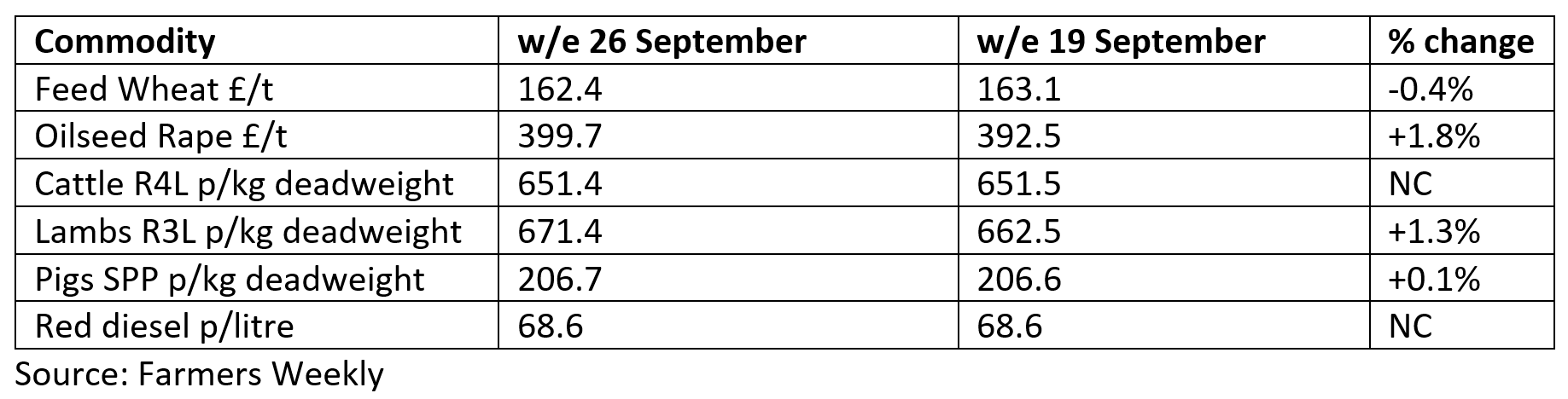
Milk prices hold up
The average farmgate price of milk across the UK was 45.62p/litre in August, a 1.6p/litre rise on July and almost 10% higher than August 2024. At 1.259 billion litres, production was also up 5.5% on the year. Looking at the longer-term trend, production in 1994 was similar at 1.102 billion litres. That volume, however, was produced on almost 36,000 farms compared with just 7,040 today.
The headline
Tenant farming boost
England’s first Commissioner for the Tenant Farming Sector has just been announced by Defra’s new Secretary of State, Emma Reynolds.
Alan Laidlaw, who previously ran the Crown Estate’s 250,000-acre rural portfolio, where he introduced innovative tenancy agreements and co-investment models, takes on the role, which was a key recommendation of the Rock Report.
The commissioner will promote the standards set out in the Agricultural Landlord and Tenant Code of Practice, working closely with Defra and the Farm Tenancy Forum, the government/industry group that advises Defra on supporting and improving the farm tenancy sector in England.
Laidlaw’s responsibilities will include investigating complaints, tracking trends, offering guidance, and reporting regularly on tenant-landlord relations.
Commenting on the appointment, Alastair Paul of Knight Frank’s Rural Consultancy team, who specialises in landlord/tenant relationships, said: “It’s good news that a commissioner has been appointed. I believe the first part of his role is to make sure that everyone engages properly with the code.
“Reading the document and spending time reflecting on the reasons why it has been put in place and what it recommends is a valuable exercise. Approaching landlord and tenant relationships in that mindset will lead to more collaborative and productive outcomes.”
Regional farm incomes
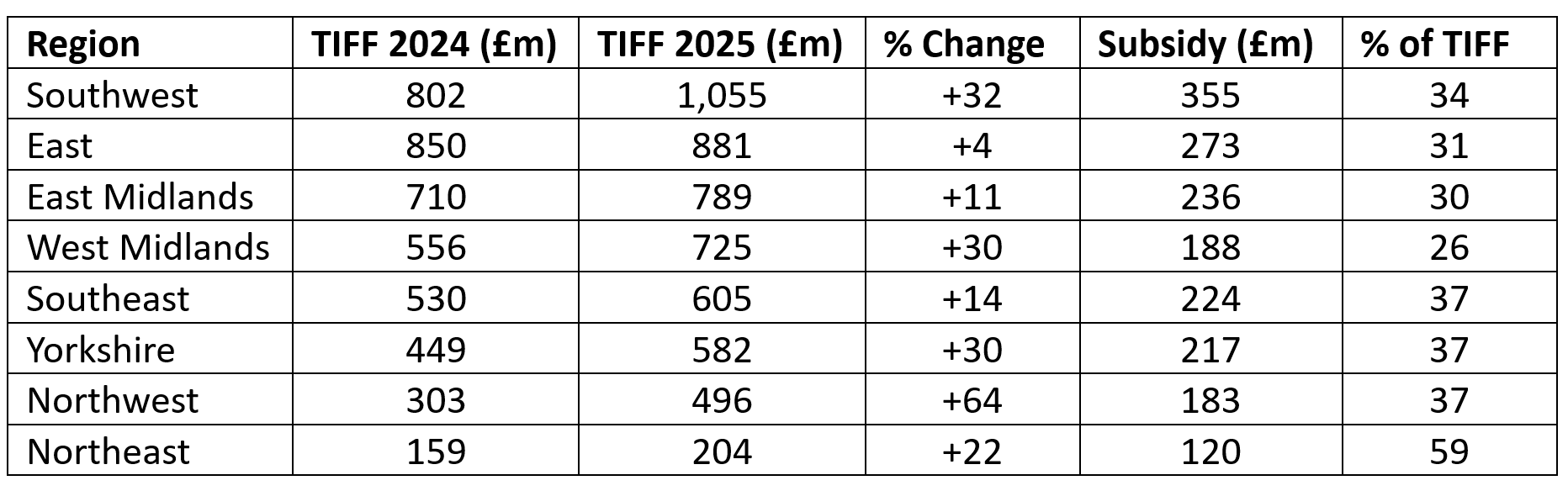
Total Income from Farming (TIFF) increased in every English region last year, according to new figures released by Defra. The Northwest saw the biggest rise, while the East of England remained relatively flat.
However, despite cuts to the Basic Payment Scheme, subsidy payments, including income from environmental schemes, still make up a significant proportion of TIFF, averaging 36% across the regions and rising to almost 60% in the Northeast.
News in brief
Arable incomes go red
In addition to the continued reliance on support payments discussed above, new figures contained in the latest Nix Farm Management Pocketbook paint a worrying picture for arable farmers. According to the farming bible’s estimates for harvest 2026, the average combinable crop producer will incur a loss of over £70/ha if all their costs, including unpaid labour, are properly accounted for. Healthier returns are predicted for livestock and dairy businesses next year, with milk producers set to make a profit of £977/ha.
Lords launch IHT review
The House of Lords Finance Bill Sub-Committee is inviting contributions to its inquiry looking at the government’s Draft Finance Bill, which includes the controversial Inheritance Tax (IHT) reforms widely dubbed the “family farm tax”, and the application of IHT on unused pension pots. The committee’s recommendations on how the government’s tax policy can best be implemented and administered are not binding, but may influence further discussion of the bill before it is passed by the House of Commons later this year. The deadline for evidence is 7 October.
New towns announced
The recommendations of the New Towns Taskforce, which include possible locations for 12 new towns, have just been published. In response, the government says it is determined to begin building at least three of the towns over the course of this parliament. The likely sites are at Tempsford, Bedfordshire; Crews Hill, Enfield; and Leeds South Bank. Each new town should have at least 10,000 homes, with an ambition for a minimum of 40% affordable housing, says the taskforce.
Brownfield opportunities
Meanwhile, the CPRE is claiming that much of the proposed new housing on greenfield sites is unnecessary. Research conducted by the organisation concludes that there is already space for almost 1.5 million new homes on brownfield sites across England, with planning consent for 800,000 houses already secured.
Traditional tenancies fall
The area of English farmland rented under traditional Agricultural Holding Act (AHA) Tenancies has dropped slightly over the past 12 months, according to the latest Defra figures. In 2025, there were an estimated 1,119,590 hectares under AHA agreements compared with 1,128,836 hectares in 2024 – a fall of 0.8%. In 2002, the figure was almost two million hectares. Over the same period, Farm Business Tenancy agreements have risen from 777,661 hectares to 1,271,014 hectares.
Tree-planting target fail
The UK is set to miss the tree-planting targets set by the government’s Commission on Climate Change (CCC). According to an analysis by the Energy and Climate Change Intelligence Unit, based on existing and extrapolated planting rates, the level of underplanting by 2030 will total around 42,000 hectares, roughly the size of the Isle of Wight. The CCC says high rates of tree planting are needed if the UK wants to hit its net-zero targets.
UK rice harvest
A warming climate is opening up new opportunities for the UK’s farmers – think vineyards and olive groves – but now even paddy fields are on the cards. The first rice is due to be harvested soon as part of a trial by the UK Centre for Ecology and Hydrology on rewetted peat soils in Lincolnshire. The crop could become commercially viable here if average temperatures rise two to four degrees above pre-industrial levels.
Waitrose free-range pork
Waitrose is inviting free-range pig producers to get in touch following an announcement last week that 100% of the supermarket’s own-label pork will be reared on free-range units by 2027. As part of the 10-year deal with its suppliers, all pork mince, steaks, chops and joints on Waitrose’s shelves will be free range from next month.
The Rural Report SS 25 – Out now
The Spring Summer 2025 edition of The Rural Report, Knight Frank’s flagship publication for rural businesses, which looks in more detail at many of the issues discussed in The Rural Update, is out now. The new report includes the latest news, research and insights from Knight Frank’s rural property experts, as well as thought-provoking contributions from some of Britain’s most iconic estates. Available online and in print, you can click here to access the full report.
Properties of the week
Cumbrian castle auction
Anybody interested in medieval history has a unique opportunity to acquire one of the only three complete Norman keeps left in the UK. Built in 1100, the keep is part of Appleby Castle, near Borough Gate, which centres around a Grade I listed 12-bed castle with a 100-seat banqueting hall, surrounded by 25 acres of parkland enclosed within 10-foot walls. There is also a separate five-bed wing and three self-contained holiday cottages, plus fishing rights on the River Eden, which borders the castle. The property, which regularly hosts weddings, conferences and other events, will be auctioned on 30 October with a £5.5 million guide price. Please contact Freddie Sandercock or Peter Mayo for more information.
Historic Kent estate home to rent
Knight Frank’s Rural Consultancy team in Kent has an intriguing option on offer. Newhouse at Mersham, near Ashford, which was once home to Countess Mountbatten of Burma and Lord Brabourne, is part of the idyllic 2,700-acre Hatch Park Estate. Now available to rent, the nine-bed period property costs £6,995 a month. For more information, please contact Katie Bundle.
Discover more of the farms and estates on the market with Knight Frank
Property markets Q2 2025
Development land – Market weakens
The value of development land continues to fall, despite the government’s pledge to build 1.5 million new homes during this parliamentary term. According to the newly published Q2 2025 instalment of the Knight Frank Residential Land Index, prices for green and brownfield sites have dropped by 5% over the past 12 months. Lower levels of supply mean values in London slid by just 2.5%. Housebuilders are grappling with planning delays, viability challenges, skills shortages and weak demand, explains Oliver Knight.
Farmland – Uncertainty dominates
Despite cuts to support payments and lacklustre grain prices, the average price of bare agricultural land fell just 2.3% in the second quarter of the year, according to the latest edition of the Knight Frank Farmland Index. “It’s really difficult to discern any clear value trends at the moment because of reduced transaction levels,” says Will Matthews, Head of Farms & Estate Sales. Download the full report for more data and insight.
Country houses – buyers’ market
It’s a buyers’ market when it comes to rural homes, according to the latest research from Tom Bill, Knight Frank’s Head of UK Residential Research. The Knight Frank Prime Country House Index slipped by 2.5% in Q2, the second-largest quarterly decline since Q1 2009. At the same time, the number of properties for sale is up 9% compared with this time last year. On average, there are six prospective buyers for each new instruction, compared with 19 at the height of the Covid-19 pandemic, while sales are achieving 94% of the asking price. Read more of Tom’s numbers and insight.
