

The Rural Update: The right way to boost nature
Your weekly dose of news, views and insight from Knight Frank on the world of farming, food and landownership.
19 August 2025

Viewpoint
Natural England is rightly proud that one of its grant schemes, as discussed below, has helped improve the prospects for 150 of the country’s most vulnerable species. It’s no bad thing that the funding has also generated volunteering activity estimated to be worth £1.2 million. But how much additional value for nature could a confident, vibrant farming sector deliver? It would certainly run into the billions. Let’s flip the equation. How much support for nature will be lost because of the government’s ill-judged reforms to Inheritance Tax that have hammered farmers’ confidence at a time when, as also mentioned below, the sector is already facing low arable commodity prices, increasingly erratic weather, staffing issues and the loss of the Basic Payment Scheme? It may be a bit of a cliché, but the adage that you can’t go green if you are in the red has never been more relevant. The government was all too keen to listen to CenTax (see The Headline) when it proposed reforming Agricultural Property Relief. Let’s hope it listens just as hard now that the organisation has concluded the reforms the government plans to implement are unlikely to achieve some of their core objectives.
Sign up to receive this newsletter and other Knight Frank research directly to your inbox
Commodity markets
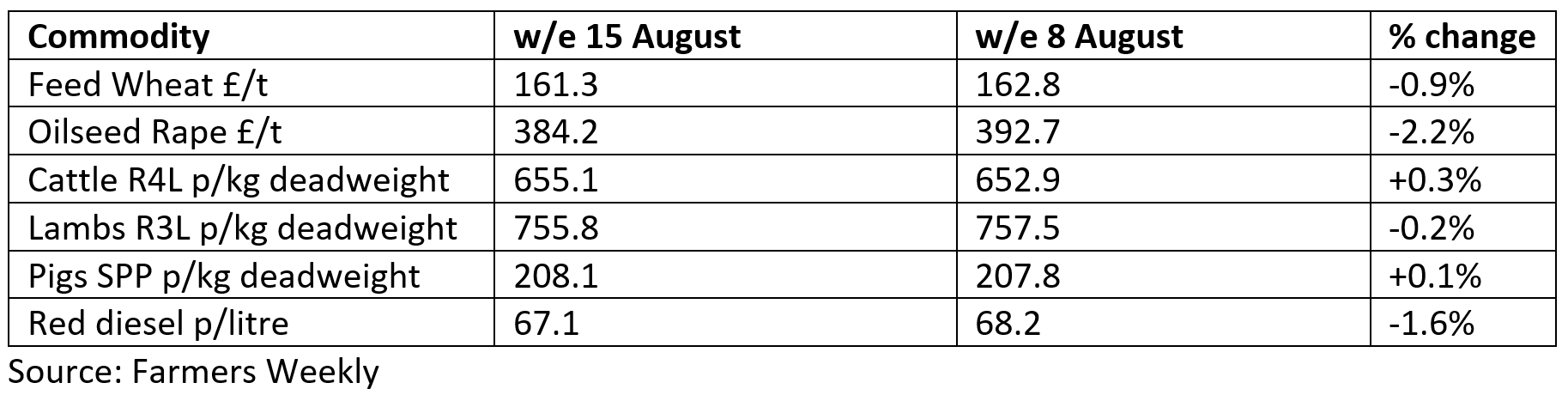
Wheat under pressure
Wheat prices edged lower again last week, with the Chicago Board of Trade (CBOT), Paris and London futures all dropping to new contract lows, according to trader Frontier. Prices were pushed down by a particularly bearish corn update from the US Department of Agriculture. The August instalment of its World Agricultural Supply and Demand Estimates (WASDE) report included a higher-than-expected US corn yield that added over 25 million tonnes to the previous estimate.
The headline
Report urges IHT rethink
A new report from an influential think tank on the impact of the government’s proposed Inheritance Tax (IHT) reforms has received a mixed response from rural lobby groups.
Claims made in The Impact of Changes to Inheritance Tax on Farm Estates by the Centre for the Analysis of Taxation (CenTax) that reforming Agricultural and Business Property Relief (APR and BPR) will affect fewer than 600 farms a year have been disputed by the CAAV.
The organisation’s Jeremy Moody says the report’s calculations do not take into account the total value of farming businesses.
Eyebrows have also been raised by the report’s claim that 87% of affected farms or estates would not need to sell any land to pay their IHT bills.
A “clawback” proposal by groups such as the NFU and CLA to defer any IHT claims unless land was sold off by future generations within seven years of their inheritance was also branded as unworkable by the report’s authors.
However, the report does acknowledge that the IHT reforms, as currently structured, will have more of an effect on working farms than the tax-driven passive investors in farmland that they were partly designed to target.
To remedy this, the report makes a number of suggestions. These include a “minimum share” rule that would restrict relief to businesses where APR/BPR claims cover at least 60% of the total estate. It is estimated this could fund an increase in the combined allowance for 100% relief to £5 million per estate.
An upper limit on relief could also be applied and would be the most direct way to reduce the concentration of relief, which was one of the government’s stated aims of the reform. Making the combined allowance transferable between couples is also proposed.
The report concludes: “We have sought to explore options that could extend protection for farms and other small businesses whilst further reducing the use of agricultural and business property as a tax shelter. We think these options merit serious consideration.”
Hopefully, the government will agree.
News in brief
Lifetime gifting cap
To add to farmers’ IHT worries, rumours are swirling that the lifetime-gifting regime is next in line for some tough treatment from the Treasury. Currently, any amount of assets can be gifted to, say, children or grandchildren, free of IHT as long as the person doing the gifting lives for a further seven years. Changes to the regime could include a lifetime cap on the amount that can be gifted and tweaks to the tapering process for larger gifts. This reduces the IHT bill even if the gifter doesn’t live for the full seven years. If implemented, such changes could make it harder to use gifting as a way to mitigate IHT when passing farming businesses between generations.
National drought
Of more immediate concern for many, the ongoing lack of rain across the country has been declared a “nationally significant incident” by the National Drought Group. Five areas of England are officially in drought, with six more experiencing prolonged dry weather following the driest six months to July since 1976. Despite some rain in July, which was still the fifth warmest on record, many river flows and reservoir levels in England continued to recede compared with June. August’s fourth heatwave of the summer will pile more pressure on fodder supplies for livestock farmers.
Species rebound
On the brighter side, some positive news for nature. Around 150 rare species of flora and fauna have a brighter future due to the success of the Species Recovery Programme Capital Grant Scheme, according to Natural England. The scheme, which has been running for two years, has provided £12.8 million of funding, generating £5.4 million of match funding from partners, and a strong volunteer element, valued at £1.2 million. Over 2,400 hectares of wildlife-rich habitats have been created and enhanced.
Egypt halal win
Good news as well for the dairy industry, as the Egyptian government has decided not to press ahead with its plan to insist that all dairy imports to the country are labelled as halal. Defra says preventing the trade barrier, which was due to come into force in January, will protect an estimated £250 million in additional export opportunities for farmers over five years. The halal requirement would also have added significant additional certification costs to every shipment.
Dairy worker shortage
However, Arla Foods, the UK’s largest milk processor, has urged the government to do more to help with the dairy sector’s chronic shortage of workers or risk food security. A survey of the co-op’s 1,900 UK suppliers revealed that five out of six of those looking to recruit new workers had received few or zero responses. Arla MD Bas Padberg said: “What we’re seeing is the real impact of these workforce shortages on our farming industry, whether that’s in higher costs or lower milk production.”
Defra job cuts
Meanwhile, it has been reported that Defra has cut 10% of its workforce as part of Chancellor Rachel Reeves’ departmental efficiency drive. Around 750 posts have been axed over the past 12 months. What impact the cuts will have on farmers remains to be seen. In 2016, the department employed 1,706 people, but by last year this had risen to well over 7,000.
The Rural Report SS 25 – Out now
The Spring Summer 2025 edition of The Rural Report, Knight Frank’s flagship publication for rural businesses, which looks in more detail at many of the issues discussed in The Rural Update, is out now. The new report includes the latest news, research and insights from Knight Frank’s rural property experts, as well as thought-provoking contributions from some of Britain’s most iconic estates.
Available online and in print, you can click here to access the full report.
Properties of the week
Stunning Kent wine opportunity
An oven-ready vineyard and winery near Ashford has just been launched by Knight Frank’s specialist viticulture team. The Woodchurch Wine Estate, which was first planted in 2010, includes 12.13 acres of vines and produces an award-winning range of sparkling and still white and rosé wines. The property features an attractive cellar door/restaurant facility, which attracted 5,000 visitors in 2024 with the potential for significant growth. The estate, which is guided at £1.5 million, can also host weddings and other events. For more information, please contact Will Banham.
Historic Kent estate home to rent
If you need a place to stay while you get started with your new vineyard, Knight Frank’s Rural Consultancy team in Kent has an intriguing option on offer. Newhouse at Mersham, near Ashford, which was once home to The Countess Mountbatten of Burma and Lord Brabourne, is part of the idyllic 2,700-acre Hatch Park Estate. Now available to rent, the nine-bed period property costs £7,995 a month. For more information, please contact the team’s Katie Bundle.
Discover more of the farms and estates on the market with Knight Frank
Property markets Q2 2025
Development land – Market weakens
The value of development land continues to fall, despite the government’s pledge to build 1.5 million new homes during this parliamentary term. According to the newly published Q2 2025 instalment of the Knight Frank Residential Land Index, prices for green and brownfield sites have dropped by 5% over the past 12 months. Lower levels of supply mean values in London slid by just 2.5%. Housebuilders are grappling with planning delays, viability challenges, skills shortages and weak demand, explains Oliver Knight.
Farmland – Uncertainty dominates
Despite cuts to support payments and lacklustre grain prices, the average price of bare agricultural land fell just 2.3% in the second quarter of the year, according to the latest edition of the Knight Frank Farmland Index. “It’s really difficult to discern any clear value trends at the moment because of reduced transaction levels,” says Will Matthews, Head of Farms & Estate Sales. Download the full report for more data and insight.
Country houses – buyers’ market
It’s a buyers’ market when it comes to rural homes, according to the latest research from Tom Bill, Knight Frank’s Head of UK Residential Research. The Knight Frank Prime Country House Index slipped by 2.5% in Q2, the second-largest quarterly decline since Q1 2009. At the same time, the number of properties for sale is up 9% compared with this time last year. On average, there are six prospective buyers for each new instruction, compared with 19 at the height of the Covid-19 pandemic, while sales are achieving 94% of the asking price. Read more of Tom’s numbers and insight.
