

The Rural Update: New harvests
Your weekly dose of news, views and insight from Knight Frank on the world of farming, food and landownership.
11 August 2025

Viewpoint
Last year’s harvest was one to forget, not just for arable farmers but also, as we discuss below, for the UK’s growing number of wine producers. In terms of yield and quality, this season generally looks more promising for cereal producers. But that comes with a downside – wheat prices are already under pressure as the UK’s supply could exceed demand, meaning traders will be reliant on the fickle export market to soak up any surplus. The higher quality also means the premium paid for quality breadmaking wheat is much lower than last year. A bumper harvest of grapes will also create issues for winemakers, but at least they have more control over their routes to market, business generation and branding. Nobody is suggesting vines are the answer for all but a relatively small number of farmers, but with the Basic Payment Scheme virtually finished, the viability of some traditional crops looks less assured. Some kind of diversification in terms of cropping and routes to market that can command a price premium and offer more control to growers may be required.
Sign up to receive this newsletter and other Knight Frank research directly to your inbox
Commodity markets
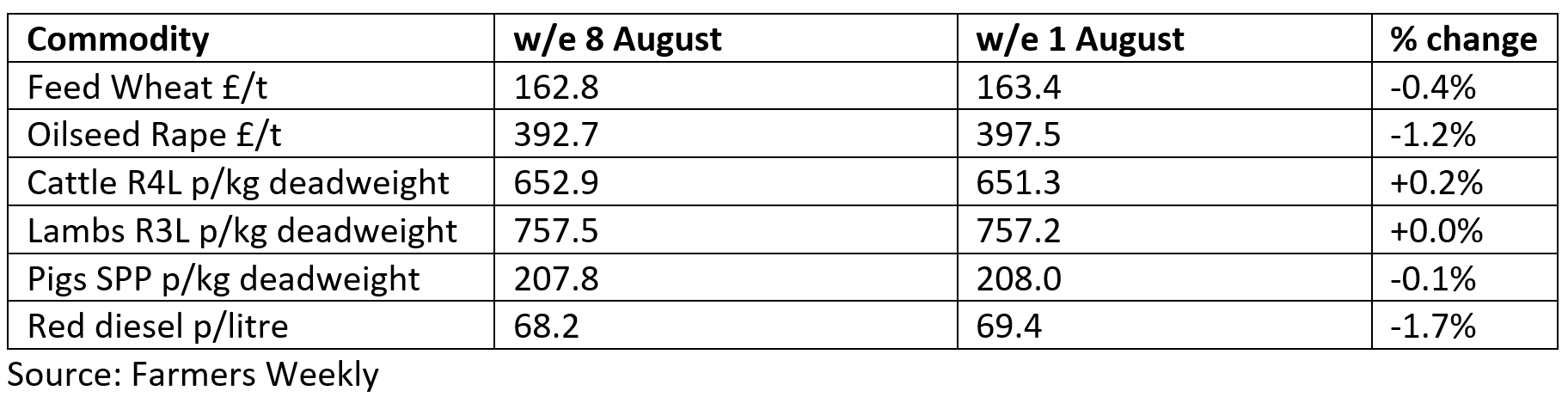
Wheat outlook uncertain
A slight drop in the value of sterling and uncertainty regarding the size of this year’s UK wheat crop have helped insulate the domestic market from a global fall in prices. Ample supplies and good planting conditions in the southern hemisphere are weighing on the market. Some parts of England have experienced lower yields, while others are up on the year. As a result, the current harvest estimate for the UK sits at between 11.5 and 13 million tonnes. At the top end, this would lead to an exportable surplus, which could put downward pressure on values. Milling wheat quality so far is reported as excellent, which has seen the premium over feed wheat reduced to around 15%, compared with 25% this time last year.
The headline
Grapes hit hard in 2024
The latest market report from WineGB reveals the extent to which growers were hit by last year’s exceedingly wet weather.
Just under 11 million bottles of wine were produced, down 51% on 2023’s record-breaking 21.6 million. The average yield of 21.3 hectolitres/hectare was also the lowest since 2016. Despite this, the increased number of vines planted over the past decade meant the 2024 harvest was still the UK’s fourth largest.
Total sales of British wine, however, were up 3% with 9.1 million bottles being sold. Almost 9% of these went for export, a 35% jump on the year. Sales of sparkling wine were flat at 6.2 million bottles, but still wine sales jumped by 10% to almost 3 million bottles.
Commenting on the report, Bertie Gilliat-Smith of our dedicated viticulture team said: “Ten percent growth in still wine sales is very encouraging and reflects trends that we are seeing in the wider market. In particular, US and French investment in still wine production in the east of the country.
“Static sales of sparkling wine are reflective of consumer trends seen throughout the global wine industry, but compare favourably with UK sales of Champagne, which fell by 12.7% in the same period.
“With cellar door and online sales making up 30% of the channel splits, there is scope for significant further growth in direct-to-consumer sales. In a wholesale environment where margins are very tight, direct-to-consumer sales are becoming ever more important to the profitability of small and medium-sized producers.
“Looking ahead, as the industry matures, we expect to see existing producers and new entrants expand their brand pyramid to include a wider range of still and sparkling wines at a variety of price points. The charmat production method, in particular, is likely to grow as producers diversify their wine styles and price points.”
Interested in acquiring your own vineyard? Scroll down to Property of the Week for details of a new opportunity.
News in brief
Fair trade for pork farmers
Pig producers will be better protected from sharp practices in the supply chain when The Fair Dealing Obligations (Pigs) Regulations kick in later this week (13 August). Any new contracts must be in writing, signed, and include clear terms about pricing, how long the contract lasts, how it can be ended, and how disputes will be settled.
BNG proposal bad for nature
Government plans to exempt sites of less than a hectare with nine or fewer houses from Biodiversity Net Gain (BNG) requirements would damage the environment and risk losing billions of pounds of health, recreational and environmental benefits, as well as threatening the entire BNG market, claims a new report from ecology consultancy Arbtech. Such sites account for 70% of residential planning applications and exempting them would threaten habitat eight times the area of Manchester by 2029, says the report. Knight Frank was a signatory to an open letter sent to Keir Starmer warning of the dangers of the changes.
Homeowner pylon payment
The government has confirmed that it is pressing ahead with its plans to pay households that live within 500 metres of new or certain types of upgraded electricity pylons an annual £250 compensation payment for 10 years. A consultation on the proposals, which will also apply to the owners of second homes and short-term holiday lets, was launched last week. Households affected by multiple power lines will only be able to claim once.
Base rate cut
The Bank of England’s Monetary Policy Committee voted to cut its base lending rate from 4.25% to 4% at its August rate-setting meeting last Thursday. The drop takes the base rate to its lowest level in two years. However, the vote was split, with four of the committee’s nine members preferring to keep rates the same due to inflation still tracking above the bank’s 2% target rate. Analysts still expect further cuts in the short term, but perhaps fewer than previously forecast. For the latest rural lending deals, please contact Bradley Smith or Matt Clapp of Knight Frank Finance.
French say “non” to neonics
France’s constitutional court has rebuffed a move by farmers and some politicians to overturn a ban on the neonicotinoid acetamiprid. The court vetoed the re-authorisation of the chemical, which was part of a farming bill passed last month, because it said sufficient safeguards for its use had not been provided. Neonicotinoids are alleged to kill bees and other insects.
Chemicals match climate crisis
The growing number of chemicals, including pesticides, in the environment could be just as much of a threat to humans as climate change, according to a new report. Toxicity: The Invisible Tsunami, written by Deep Science Ventures, claims that pervading toxicity from tens of thousands of manmade chemicals is threatening human and planetary health, but still receives far less attention than climate change. It says the impact of pesticide use on cancer incidence may rival that of smoking.
Food security at risk
New analysis from the Energy and Climate Intelligence Unit is the latest to warn of the threat to the UK’s food security from climate change. The organisation says £3 billion of food imports from 20 of the worst-affected countries are under threat. In addition to the impact of extreme weather on the yields of crops such as rice, tea and mangos, the report, Climate change impacts on food and migration, points out that climate-driven rural depopulation is also affecting food production.
Gun licensing tightened
Anybody applying for a shotgun licence will now have to get two referees who have known the applicant for at least two years. Any convictions other than parking offences will also have to be disclosed. The Home Office is advising the police to consult with family members to assess the risk of domestic violence.
Labour allotment spat
The Ministry of Housing, Communities and Local Government (MHCLG) has been forced to defend itself after former Labour leader Jeremy Corbyn accused Angela Rayner, Housing Minister and Deputy Prime Minister, of allowing councils to sell multiple allotment plots to developers. In a blog post, MHCLG said there were strict rules concerning the sale of allotments and the number of consented disposals in 2024 - eight - was actually lower than in some recent years.
Lynx comeback?
Over 72% of the people living in an area targeted for the reintroduction of lynx would be in favour of the cat’s return to the UK, according to the results of a year-long consultation run by the Missing Lynx Project. The vote of confidence coincided with the release of a research paper showing that the Kielder forest area, along with neighbouring habitat in the Scottish Borders, could support a population of 50 lynx. The paper also showed that Kielder is the only part of England and Wales where a reintroduction would be realistic.
The Rural Report SS 25 – Out now
The Spring Summer 2025 edition of The Rural Report, Knight Frank’s flagship publication for rural businesses, which looks in more detail at many of the issues discussed in The Rural Update, is out now. The new report includes the latest news, research and insights from Knight Frank’s rural property experts, as well as thought-provoking contributions from some of Britain’s most iconic estates.
Available online and in print, you can click here to access the full report.
Properties of the week
Stunning Kent wine opportunity
An oven-ready vineyard and winery near Ashford has just been launched by Knight Frank’s specialist viticulture team. The Woodchurch Wine Estate, which was first planted in 2010, includes 12.13 acres of vines and produces an award-winning range of sparkling and still white and rosé wines. The property features an attractive cellar door/restaurant facility, which attracted 5,000 visitors in 2024 with the potential for significant growth. The estate, which is guided at £1.5 million, can also host weddings and other events. For more information, please contact Will Banham.
Historic Kent estate home to rent
For anybody looking to sample estate living without making a long-term commitment, Knight Frank’s Rural Consultancy team in Kent has an intriguing option on offer. Newhouse at Mersham, near Ashford, which was once home to The Countess Mountbatten of Burma and Lord Brabourne, is part of the idyllic 2,700-acre Hatch Park Estate. Now available to rent, the nine-bed period property costs £7,995 a month. For more information, please contact the team’s Katie Bundle.
Discover more of the farms and estates on the market with Knight Frank
Property markets Q2 2025
Development land – Market weakens
The value of development land continues to fall, despite the government’s pledge to build 1.5 million new homes during this parliamentary term. According to the newly published Q2 2025 instalment of the Knight Frank Residential Land Index, prices for green and brownfield sites have dropped by 5% over the past 12 months. Lower levels of supply mean values in London slid by just 2.5%. Housebuilders are grappling with planning delays, viability challenges, skills shortages and weak demand, explains Oliver Knight.
Farmland – Uncertainty dominates
Despite cuts to support payments and lacklustre grain prices, the average price of bare agricultural land fell just 2.3% in the second quarter of the year, according to the latest instalment of the Knight Frank Farmland Index. “It’s really difficult to discern any clear value trends at the moment because of reduced transaction levels,” says Will Matthews, Head of Farms & Estate Sales. Download the full report for more data and insight.
Country houses – buyers’ market
It’s a buyers’ market when it comes to rural homes, according to the latest research from Tom Bill, Knight Frank’s Head of UK Residential Research. The Knight Frank Prime Country House Index slipped by 2.5% in Q2, the second-largest quarterly decline since Q1 2009. At the same time, the number of properties for sale is up 9% compared with this time last year. On average, there are six prospective buyers for each new instruction, compared with 19 at the height of the Covid-19 pandemic, while sales are achieving 94% of the asking price. Read more of Tom’s numbers and insight.
