

The Rural Update: Big decisions need to be made
Your weekly dose of news, views and insight from Knight Frank on the world of farming, food and landownership.
26 August 2025

Viewpoint
It’s time for some soul-searching, or at least for the survival instinct to kick in. Yet another poll, discussed below, highlights just how much the changes to the Inheritance Tax (IHT) regime and bungled management of the Sustainable Farming Incentive (SFI) and Basic Payment Scheme (BPS) are already hitting the confidence of the countryside to invest in the future. And perhaps more importantly for the politicians themselves, it shows the far-reaching potential impact on the electoral landscape. But will they listen in time? The omens so far aren’t good. But it also raises important questions for farmers. Are returns that are already razor-thin going to be sustainable without the SFI and BPS under current farming systems? That question will remain, even if the government does backtrack on its IHT proposals.
Sign up to receive this newsletter and other Knight Frank research directly to your inbox
Commodity markets
Wheat pressure mounts
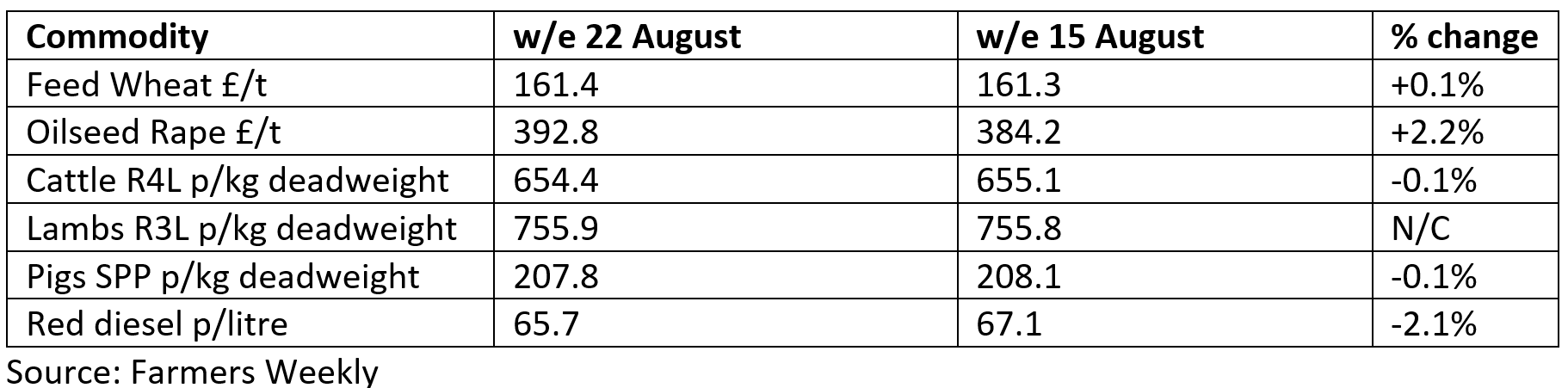
News that the AHDB’s first estimates of UK wheat yields may have been a little optimistic was not enough to boost the market, which remains stuck at around £160/tonne for feed wheat. A report released by the organisation earlier in August suggested yields were just 1% below the five-year average. Revised figures have widened the gap to a more realistic 3.5% - an average of 7.46 tonnes per hectare. A bumper US corn crop and upward revisions to Russia’s exportable wheat surplus are putting pressure on global wheat prices. Meanwhile, the premium for breadmaking wheat in the UK has shrunk to barely more than £20 per tonne.
The headlines
Poll lays bare discontent
The government has completely lost the confidence of the farming sector, according to the results of a survey of CLA members conducted for The Times newspaper.
When asked how they would vote if there was a General Election tomorrow, 38% said the Conservatives, 36% Reform, 4% the Lib Dems, 1% another party and 21% undecided.
Almost 80% of respondents were worried that their business would not survive the next 10 years.
In addition, 90% said that they had paused investment decisions since the introduction of the “family farm tax” in last autumn’s controversial Budget, with 60% saying they would consider selling their farms and leaving the industry in the next five years.
CLA President Victoria Vyvyan said: “Already, families are weighing up which parts of their business they can afford to keep. Others are wondering if they can hand the farm on at all.”
Soil carbon markets
Soil carbon markets need to be restructured to make them more applicable to smaller and regenerative farming businesses, according to a thought-provoking new paper from Climate Farmers, a research organisation.
The paper says the current market “favours standardisation, scale, and uniformity”, traits common in industrial systems but often absent in regenerative ones. “Markets must evolve to accommodate the dynamic and diverse nature of living systems, including soil carbon’s variability over time”, it points out.
A single-metric focus on CO₂ also creates blind spots and mistaken incentives, claims the report. Markets that treat farmers as carbon suppliers rather than land stewards and food producers also risk losing trust, it says.
News in brief
Food price inflation
A rise in the cost of food, including beef and milk, helped contribute to the highest rate of UK inflation since January 2024. According to the Office for National Statistics, year-on-year inflation jumped to 3.8% in July. The food and non-alcoholic beverages category, however, rose by 4.9% with meat up by 6.1%. Persistent inflation may dampen the Bank of England’s enthusiasm for further base rate cuts this year.
Bird flu shoot rules
From today (26 August), shoots in England must now follow enhanced biosecurity rules as part of the country’s avian influenza control measures. Some of the new requirements include disinfecting any vehicles upon first entry to the site, providing one feeding station per 60 released game birds, avoiding feeding pheasants in release pens within 50 metres of a water body frequented by ducks and other wildfowl, conducting a daily search of the area within a 50 metre radius of release pens for carcasses of dead game birds and dead wild birds and reporting dead wild birds to Defra.
Farm renewable usage
Almost a third of farms in England are now generating some form of renewable energy, according to Defra’s new analysis of farm energy usage, which is based on the results of its annual Farm Business Survey. Solar was the most popular type of energy, present on 27% of businesses. Within these businesses, 84% had solar panels installed on farm buildings and 10% had field-based panels. By 2023/24, carbon audits had been carried out on 20% of all farm businesses, with dairy farms (57%) most likely to have been audited, Defra adds.
Nutrient mitigation change
For the first time, Natural England will be selling nutrient mitigation credits on a rolling basis in one of its catchment areas. The credits, which developers must buy to offset nutrient emissions from their developments in pollution-sensitive catchment areas, are usually offered in specific date-defined rounds. Now, however, applications for credits in the Tees catchment area can be made at any time. Applicants need to have submitted a planning application and have the planning application reference before applying for credits, but do not need to have received permission.
UK border checks eased
The government is suspending the introduction of extra border checks on live animal imports from the EU, and on specific animal and plant goods from Ireland. It says the move will support British businesses and ease trade ahead of its new sanitary and phytosanitary (SPS) deal with the EU that will establish a UK-EU SPS zone. It claims this will cut costs and red tape for businesses that export and import from the EU and reduce delays at the border. Critics argue it means the UK is subservient to EU legislation and increases our vulnerability to potential disease-carrying illegal imports.
Arbitration update
The Arbitration Act 2025, which came into effect at the beginning of the month, could be helpful for rural property owners, according to legal firm Charles Russell Speechlys. One of the Act’s provisions allows arbitrators to dismiss weak claims/defences without a full hearing. This could help “deter tactical Case B referrals aimed primarily at causing delay to development or renewable energy projects to improve position in surrender negotiations”, the firm says.
The Rural Report SS 25 – Out now
The Spring Summer 2025 edition of The Rural Report, Knight Frank’s flagship publication for rural businesses, which looks in more detail at many of the issues discussed in The Rural Update, is out now. The new report includes the latest news, research and insights from Knight Frank’s rural property experts, as well as thought-provoking contributions from some of Britain’s most iconic estates. Available online and in print, you can click here to access the full report.
Properties of the week
Devon delight
Those looking for a small residential estate with extra income in the South West may well want to take a look at Ebberly House at Roxborough, near Winkleigh. A Grade II* listed Georgian house with nine bedrooms sits at the heart of the picturesque 249-acre property, while seven further houses let under assured shorthold tenancies generate a significant rent roll. For more information, please contact Will Oakes or Florence Biss.
Historic Kent estate home to rent
If you need a place to stay while you get started with your new vineyard, Knight Frank’s Rural Consultancy team in Kent has an intriguing option on offer. Newhouse at Mersham, near Ashford, which was once home to The Countess Mountbatten of Burma and Lord Brabourne, is part of the idyllic 2,700-acre Hatch Park Estate. Now available to rent, the nine-bed period property costs £7,995 a month. For more information, please contact the team’s Katie Bundle.
Discover more of the farms and estates on the market with Knight Frank
Property markets Q2 2025
Development land – Market weakens
The value of development land continues to fall, despite the government’s pledge to build 1.5 million new homes during this parliamentary term. According to the newly published Q2 2025 instalment of the Knight Frank Residential Land Index, prices for green and brownfield sites have dropped by 5% over the past 12 months. Lower levels of supply mean values in London slid by just 2.5%. Housebuilders are grappling with planning delays, viability challenges, skills shortages and weak demand, explains Oliver Knight.
Farmland – Uncertainty dominates
Despite cuts to support payments and lacklustre grain prices, the average price of bare agricultural land fell just 2.3% in the second quarter of the year, according to the latest edition of the Knight Frank Farmland Index. “It’s really difficult to discern any clear value trends at the moment because of reduced transaction levels,” says Will Matthews, Head of Farms & Estate Sales. Download the full report for more data and insight.
Country houses – buyers’ market
It’s a buyers’ market when it comes to rural homes, according to the latest research from Tom Bill, Knight Frank’s Head of UK Residential Research. The Knight Frank Prime Country House Index slipped by 2.5% in Q2, the second-largest quarterly decline since Q1 2009. At the same time, the number of properties for sale is up 9% compared with this time last year. On average, there are six prospective buyers for each new instruction, compared with 19 at the height of the Covid-19 pandemic, while sales are achieving 94% of the asking price. Read more of Tom’s numbers and insight.
