

The Rural Update: Optimism boost needed to hit climate targets
Your weekly dose of news, views and insight from Knight Frank on the world of farming, food and landownership.
03 November 2025

Viewpoint
This week’s Update highlights once again how dependent the government is on farmers and landowners voluntarily participating in environmental schemes to help it hit its net-zero targets. However, the results of yet another sentiment survey show just how pessimistic many farming businesses are about their future. We also discover that the UK’s glasshouse sector, which plays a crucial role in boosting the country’s self-sufficiency in horticultural crops, is facing a crisis due to another hike in energy costs. And it has been revealed that one of the government’s few concessions to mitigate the impact of its Inheritance Tax reforms could be virtually useless. The arithmetic is not complicated. You cannot bank on positive outcomes when there are so many negative factors in the equation. Policymakers really need to start looking at their sums more carefully.
Sign up to receive this newsletter and other Knight Frank research directly to your inbox
Commodity markets
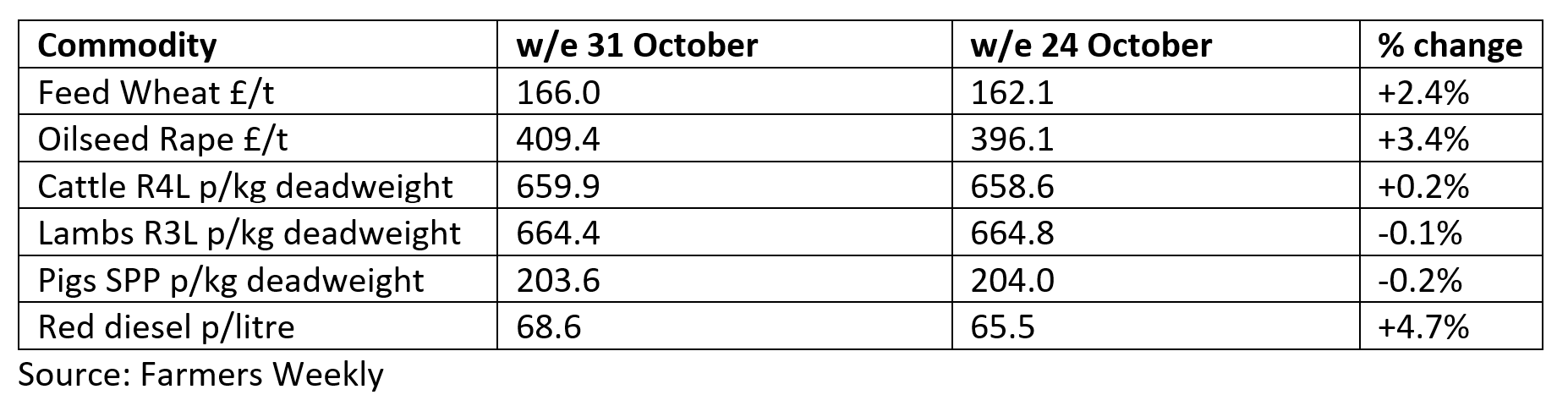
US-China talks boost markets
Grain, oilseed and crude markets all reacted positively to last week’s trade talks between the US and China during Donald Trump’s grand tour of Asia. Traders appear confident that a deal allowing the resumption of US soybean exports to China will be struck. Sunflower seed harvests in southern Europe are also coming in worse than expected, increasing the demand for rapeseed. In addition, UK rapeseed values also being supported by the weakness of the sterling.
The headline
Carbon reduction plans
The government has just published new plans for hitting its legally mandated carbon budgets up to 2037.
A previous strategy published by the former Conservative administration was challenged by environmental NGOs and ruled invalid by the High Court for failing to detail sector-specific measures as well as its over-reliance on untested carbon-removal technologies.
Net-zero Minister Ed Miliband claims the new Carbon Budget and Growth Delivery Plan accounts for 96% of the emissions reductions that will need to be made by 2030.
Some of the plan’s key targets include zero-emission cars accounting for half of the nation’s car stock by 2035, up from 5% today, more than nine million heat pumps being in operation by 2035, up from 500,000 currently, and 75% of farmers engaging in emissions reduction activities in 2035, up from 60% at present.
Reducing emissions from agriculture is considered crucial if the government is to hit its targets, but the delivery plan relies heavily on Defra’s existing environmental stewardship and tree-planting initiatives and has been criticised by some NGOs for not including measures to encourage a reduction in meat consumption.
The plan states: "Some of the agriculture and wider land use measures will be delivered through our environmental land management schemes (ELMs). These are voluntary schemes and depend on sufficient uptake.”
Tom Cantillon, Senior Analyst at the Energy and Climate Intelligence Unit, said: "With climate change worsening flooding in the UK, unless we work with nature by planting more trees and restoring habitats like peatlands to capture rainfall, people’s homes and farmers’ fields will be at ever greater risk.”
“But this plan seems to reduce that ambition. And since farmers in England have just suffered their second-worst harvest following an extremely dry spring and the hottest summer on record, reducing the ambition of schemes that could protect crops and livestock is a real head-scratcher."
Mark Topliff from our Rural Consultancy team said: “The government’s plans to increase carbon emissions reduction activities in agriculture can seem daunting, but natural capital tools like Trinity AgTech's Sandy can help identify what can be done to help this and, at the same time, are very likely to save costs as well.” Please contact Mark for more information.
News in brief
IHT interest blow
A House of Lords Committee was told last week that the government’s interest-free Inheritance Tax (IHT) payment scheme is fundamentally flawed. To soften the blow of its reforms to Agricultural and Business Property Relief, the Treasury will allow IHT payments to be spread over 10 years, but only if the first payment is made within six months of death. Witnesses from the NFU, CAAV and CLA all said this was unrealistic, given the complexities of probate valuations for farms and rural estates. Please contact Tom Barrow for advice on rural property valuations.
Farm energy call
The UK’s glasshouse sector should be classified as an energy-intensive industry to help safeguard food production, according to a director of the country’s largest greenhouse complex. Rob James of Thanet Earth told Farmers Weekly that the latest hike in electricity bills would cost the firm £820,000 a year. The government announced last week that certain energy-intensive industries would receive a 90% discount on their electricity network charges, which typically account for around 20% of bills.
Peers’ planning bill amends
Members of the House of Lords have voted in favour of several amendments to the government’s flagship Planning and Infrastructure Bill, which many believe does not do enough to protect the environment from the impact of new developments. Amendment 130 requires developers to commit to not harming any sensitive natural habitats and species, such as ancient woodlands and sand dunes. Amendment 94 introduces specific protections for chalk streams by defining them as “irreplaceable” habitats.
Drought continues
Farmers in England should prepare for more drought conditions in 2026, the National Drought Group has warned. It said a significant increase in rainfall over the autumn and winter would be needed to prevent a recurrence of this year’s dry summer. According to the Environment Agency, England needs at least 100% of average rainfall (482mm) to largely recover from drought by the end of March next year. However, only two months of 2025 have seen more than 100% of average rainfall so far.
Request a copy of the forthcoming edition of The Rural Report to discover how one of the country’s biggest farms is delivering water resilience.
Chip survey gloom
New survey findings from chip manufacturer McCain add to the sense of pessimism spreading across the UK’s agricultural sector. The firm’s inaugural Farmdex Report found that 86% of farmers were pessimistic about Britain’s long-term food security, only 12% were optimistic about the overall future of farming in Britain, while 40% thought they would be forced to leave the industry over the next 10 years.
Poultry housing order
Defra has announced that flocks of more than 50 birds in certain parts of England must be kept inside to help control the spread of avian flu. The order, which came into effect on 30 October, applies to Cheshire, Cumbria, Derbyshire, Durham, East Riding of Yorkshire, Greater Manchester, Lancashire, Leicestershire, Lincolnshire, Merseyside, Norfolk, North Yorkshire, Northumberland, Nottinghamshire, Rutland, Shropshire, South Yorkshire, Staffordshire, Suffolk, Tyne & Wear and West Yorkshire.
Renters’ Rights warning
The CLA has warned that the Renters’ Rights Act, which received Royal Assent last week, will have a disproportionate impact on rural landlords. In a statement, the organisation said: “Rural landlords who charge below-market rents and support their communities deserve recognition, not regulatory punishment. The Renters' Rights Act may achieve its aims in urban markets, but in the countryside, it risks destroying rural housing provision. Without urgent reconsideration, villages across England and Wales will lose the landlords who have been quietly, responsibly housing their communities for generations.” Read our latest guide to the new act.
Shoot Room sessions
The latest Shoot Room Sessions podcast from Oxygen Conservation features a thought-provoking conversation between their CEO Rich Stockdale and James Shepherd, a partner and natural capital specialist in our Rural Consultancy team. James explains how overcoming adversity in early life has shaped his approach to leadership.
Properties of the week
New Hampshire stud launch
Headley Stud near Thatcham has just hit the market. The 188-acre property offers exceptional equine and leisure facilities, including an indoor school and an Olympic-size outdoor manège. There are 47 stables plus a separate 11-stable foaling block, 2.15 km of all-weather gallops and 71 acres of post-and-rail paddocks. In terms of accommodation, there is an attractive four-bed farmhouse, a guesthouse, staff accommodation and planning consent for a 16,000 sq ft country house. There are also 104 acres of woodland. The guide price is £8.5 million. For more information, please contact Will Matthews.
Historic Kent estate home to rent
Knight Frank’s Rural Consultancy team in Kent has an intriguing option on offer. Newhouse at Mersham, near Ashford, which was once home to Countess Mountbatten of Burma and Lord Brabourne, is part of the idyllic 2,700-acre Hatch Park Estate. Now available to rent, the nine-bed period property costs £6,995 a month. For more information, please contact Katie Bundle.
Discover more of the farms and estates on the market with Knight Frank
Property markets Q3 2025
Farmland – Prices dip
According to the Knight Frank Farmland Index, which tracks the value of bare agricultural land in England and Wales, the average price of land fell by just 1.6% to £8,719/acre over the third quarter of the year. That equates to an annual fall of 6.8%. As ever, the market remains highly localised, and where there is competitive bidding, prices have even been going up in some locations. Download the full report for more insight and data.
Country houses – Budget uncertainty
The average price of country houses has fallen by 5.4% so far this year, according to the Q3 edition of the Knight Frank Prime Country House Index. Properties worth below £1 million dropped by 4.7%, while those worth over £1 million lost 6.7% of their value. Owners of higher-priced properties are particularly concerned about any further property taxes being announced by Rachel Reeves as part of her Autumn 2025 Budget, which is due to be delivered at the end of November, points out Tom Bill, Head of UK Residential Research.
