

The Rural Update: Understanding the countryside
Your weekly dose of news, views and insight from Knight Frank on the world of farming, food and landownership.
13 April 2026

Viewpoint
As many of the stories in this week’s Rural Update reveal, there is an increasing dissonance between those living and working in the countryside and policymakers and NGOs. The description in a new report of the relationship between farmers in the English uplands and environmentalists as “civil war” may be the most worrying indication of the breakdown, but renewables tensions in Lincolnshire and Green Belt concerns around London all suggest the malaise is widespread. The allocations in the recently published Land Use Framework for the amount of land needed for housing, renewables and food production may make sense at a national level, but without genuine local engagement, the countryside will remain a tinderbox of anger and frustrated ambition.
Sign up to receive this newsletter and other Knight Frank research directly to your inbox
Commodity markets
Oil up again
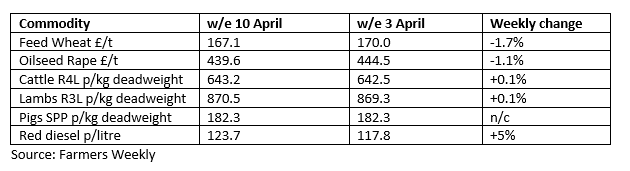
Optimism regarding last week’s peace talks between the US and Iran, which had pushed oil prices down and stock markets up, turned out to be misplaced. After negotiations at the Pakistan-hosted meeting broke down with no agreement and Donald Trump threatened his own blockade of the Strait of Hormuz, Brent Crude futures rose back over US$100/barrel.
But industry analysts point out that the real impact of the crisis on oil prices could be worse than published figures suggest. Most numbers quoted in the press refer to Brent crude futures, which relate to delivery prices sometime in the future. However, the Dated Brent index, a basket of four grades of oil produced in the North Sea and one produced in the US, tracks the price of oil for immediate delivery. This hit an all-time high of US$145/barrel last week.
Wheat: bears v bulls
The wheat market remains finely balanced with the first US National Crop Progress Report painting a bearish picture. As of early April, only 35% of the American crop was rated ‘good/excellent’. This time last year, almost half the crop had made the grade. However, wheat production estimates in Russia have been revised upwards from 86.5 million tonnes to almost 89 million. UK growers should monitor developments in the US weather outlook and Black Sea geopolitical dynamics closely, as these “will significantly influence price trajectories in the weeks ahead”, advises trader Frontier.
Agflation hits high
The cost of farm inputs is rising at the fastest rate since early 2022 when prices spiked following Russia’s invasion of Ukraine, says farm business consultant Andersons. The firm’s Agflation Index, which tracks a basket of input prices, rose 7.6% in the 12 months to March, well ahead of CPI at 3%. However, unlike the last spike, farmgate commodity prices are not following suit to offset the hikes.
The headlines
Rebirth of the uplands
Towards a flourishing uplands, the initial findings of a Defra-commissioned review of the issues facing farmers in the uplands has just been published.
Written by social entrepreneur Hilary Cottam, the report identifies a number of problems that prevent upland areas from reaching their full economic potential. These include top-down government policymaking, the growing tension between farmers and environmentalists, housing pressures, planning restrictions and a decline in public services and rural infrastructure like abattoirs and vets.
Dr Cottam says many of the farmers who contributed to her fieldwork give up much of their time to help Defra shape new policies, but complain there is limited evidence that their local insight and knowledge has played a role in the design of current systems. “There is an urgent need to re-gear Defra to enable thinking and practice in small-scale networks within large-scale systems.”
She also points out that the relationship between upland farmers and environmentalists has been described to her team as “civil war”. “There is widespread resentment on the part of farmers, most of whom see themselves as guardians of nature, that they are being forced to pay the high costs of environmental problems made elsewhere.
“There generally seems to be a lack of wider political and public awareness about how detrimental industrial environmentalism and financialised nature is, in its current form, for both people and planet. Investment is needed within a new approach,” Dr Cottam adds.
A Defra-funded team led by Dr Cottam will now engage with upland communities, starting in Dartmoor, as part of a seven-year programme to inform policy change based on her findings and create the conditions for “economic, environmental and social flourishing”.
Solar farm furore
The government’s decision last week to approve the UK’s largest solar farm has reignited the debate between proponents and critics of renewable energy.
The 800MW, 3,160-acre Springwell Solar Farm development, between Lincoln and Sleaford, will power 180,000 homes, reduce the country’s reliance on imported energy and cut bills, says Energy Minister Michael Shanks. However, local campaigners say it will destroy valuable farmland and landscapes.
Andrea Jenkyns, the Reform mayor of Greater Lincolnshire, says she is considering applying for a judicial review of the decision, which coincided with the UK’s highest-ever period of solar energy generation.
Another report claims that solar and wind helped the UK avoid £1 billion of gas imports, equivalent to just 18 tankers of liquefied natural gas due to price hikes caused by the Iran war, during March.
News in brief
Lowland peat grant open
Landowners and farmers in England can now apply for a lowland peat water discovery grant.
Projects can receive between £50,000 and £300,000 in funding to help local stakeholder groups explore what changes to water management could mean for farmland on lowland peat. Each project will produce a practical plan to show how water tables could be raised safely and sustainably on land used for conventional farming, wetter farming and paludiculture, or peatland restoration. Please contact Mark Topliff for advice on environmental grant schemes and payments.
Peat AI mapping error
Meanwhile, as reported in Farmers Weekly, Natural England’s new national peat map, which was designed to underpin peat restoration investment and funding efforts, is critically flawed. Cat Frampton, a Dartmoor farmer, says the map mistakenly identifies areas of rock, water and even shadows on her land as peat. She believes the AI model used to help create the map was inadequately trained. To discover how accurately visualising critical land data can inform estate management strategies please contact Patrick Dillon.
Gene editing v foie gras
A gene-edited barley developed at the Rothamsted Research Centre, designed to cut livestock emissions and boost feed efficiency, has become the first crop approved under the UK’s new precision breeding rules, which were brought in following Brexit. Gene-editing is currently banned in the EU. However, animal rights campaigners have accused Labour of backing down on its manifesto commitment to ban the import of foie gras as part of trade negotiations with the EU in return for concessions on gene-edited crops.
Green Belt worries
Countryside campaigners are claiming that new planning policies are eating away at London’s Green Belt and concreting over productive farmland. In a bid to build more homes, government reforms have made it easier to build on the so-called ‘grey belt’ – previously developed areas, such as former commercial sites, within the Green Belt. However, a new report from the London Green Belt Council and CPRE Hertfordshire, reveals that 83% of planning appeals on sites in the London Metropolitan Green Belt between February and December 2025 were permitted specifically on ‘grey belt’ grounds - over twice the proportion granted during the previous ten years on any basis.
Grocery adjudicator rejig
Farmers will be hoping for a more joined-up approach to ensuring food-chain fairness following news that from July the Groceries Code Adjudicator (GCA) will come under the aegis of Defra rather than the Department for Business and Trade. The change implements a key recommendation from Minette Batters’ landmark Farming Profitability Review to streamline oversight of the grocery supply chain and strengthens links to the Agricultural Supply Chain Adjudicator. Read our interview with Baroness Batters.
Golden eagle comeback
English twitchers could be in for a treat if a new government initiative takes off. Following a feasibility study by the Forestry Commission, Defra has just announced £1 million of funding to encourage the return of the golden eagle, the UK’s second-largest raptor, to northern England. Once widespread, the country’s last resident bird died in the Lake District in 2016.
Property of the week
Suffolk splendour
Georgie Veale, of Knight Frank’s Woodbridge office, has just launched a cracking 240-acre East Anglian estate with diversified income streams. Haughley Park, near Stowmarket, includes a converted 16th-century stable block that can host evening events for up to 240 guests and wedding breakfasts for 120 people. The main house is a Jacobean Grade 1 listed, seven-bedroom manor house, which is surrounded by 100 acres of woodland and 119 acres of park and pasture. The guide price is £4.25 million. Please contact Georgie for more information.
Discover more of the farms and estates on the market with Knight Frank
Property markets Q4 2025
Farmland - prices stabilise
According to the Knight Frank Farmland Index, which tracks the value of bare agricultural land in England and Wales, the average price of land fell only marginally in the final quarter of 2025. However, diminishing farmer confidence and Inheritance Tax (IHT) worries saw prices slide by around 5% over the year. An acre is now worth just under £8,700. The government’s partial IHT U-turn just before Christmas should help stabilise prices during 2026.
Country houses - values slide
The Knight Frank Country House Index, which tracks the value of properties outside London above £750,000, lost 5.7% of its value in 2025 due to economic uncertainty and worries about what might be included in Labour’s second Autumn Budget. Properties classified as farmhouses were hit particularly hard, sliding by 7.3%. However, the market looks to be bottoming out with prices falling only marginally in the final quarter of the year and exchanges rising by 5%. Contact Tom Bill for more insight and data.
Development land - prices bottom
UK greenfield residential development land values fell 5% during 2025, but remained flat through the final quarter of the year, according to the latest instalment of the Knight Frank Residential Development Land Index. Uncertainty ahead of the Autumn Budget weighed on developers’ appetite for land, but positive signs are emerging. “The prevailing view is that Q4 2025 will mark the bottom of the market,” says Oliver Knight, Head of Res Dev Research.
