
The New Frontier - Your weekly science and innovation update - 25th September 2026
Your weekly pulse check on science and innovation. Those on the supply side of real estate can track the trends set to drive demand, while occupiers gain fresh perspective on competitor activity and sector dynamics.
25 September 2026

Architecture versus outcomes
This week’s devolution debate centred not on the principle, but on pace, scale, funding and accountability. The government is due to publish its devolution white paper alongside the Budget on 28 October, following July’s “Rewiring the State” statement.
The case for
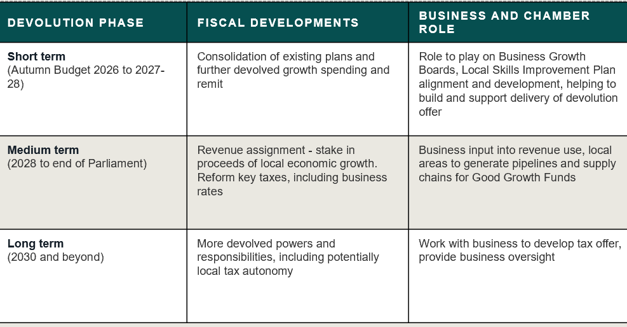
The BCC’s new report says devolution should be judged on whether it helps businesses invest, recruit and trade. Its three-stage roadmap is:
- Complete the devolution map by the end of 2027–28.
- From 2028, give areas a direct stake in growth through measures such as greater business rates retention, creating clearer incentives to attract investment and jobs.
- After the next election, let mature authorities vary local taxes within nationally determined parameters.
The report also calls for stronger SME support and a meaningful business voice in local decisions.
The sceptics
Lord Jim O’Neill, an informal adviser to the Prime Minister, delivered the sharpest critique. Speaking at a Centre for Cities event, he warned that Burnham risked “overpromising”, questioned whether all mayors were ready for greater powers and argued that equal treatment could backfire. London, he added, must “be given some kind of priority” to drive national growth.
O’Neill backs devolution, but not its uniform application. In his foreword to this week’s IPPR North report, he argued that the strongest answer to “cynics” was to give the mayors of the most populated areas the greatest powers.
IPPR North supports devolution but identifies accountability as its biggest risk: one poor decision or funding failure could damage public confidence. It proposes regional audit offices and questions whether newer, smaller combined authorities have the capacity to manage expanded powers.
Source: BCC
Where it lands
Support is broad, but key questions remain: should powers be universal or targeted at places with proven capacity, and how should income tax retention balance wealthier and less affluent areas? For occupiers, business investment depends on certainty. A credible roadmap must define the destination, delivery steps, the business role in local growth plans and the incentives for implementation.
Hunting the super scalers
A report from The Data City and Enterprise Britain identifies 10,000 UK “super scalers”: OECD-defined scale-ups with at least 50 employees and annual turnover of £5m or more. They represent less than 1% of British businesses but created more than 30% of new jobs between 2020 and 2024. While small businesses cut employment, super scalers grew headcount at more than three times the rate of larger corporates. Two-thirds of their operations are outside London and the South East, led by clusters in the North West and South West. Despite automation concerns, 74% expect AI to leave headcount unchanged or increase it.
Regional super-scaler clusters offer occupiers growing talent pools and business networks, strengthening their case as expansion locations. Super scalers need space that can accommodate growth; for landlords and investors, they are an important source of demand.
A vote of confidence in Daresbury and vital sector signals
Croda International has opened a global biotechnology R&D centre at Sci-Tech Daresbury in the Liverpool City Region. The laboratories will be its global hub for biotechnology, biocatalysis and synthetic biology, developing ingredients for pharmaceuticals, beauty and agriculture.
Chief Executive Steve Foots said Croda considered several countries but chose the UK for its science base, talent and innovation ecosystem. A biotech-derived keratin hair-repair ingredient developed at the site is already being commercialised globally. Liverpool City Region Mayor Steve Rotheram described the investment as a powerful vote of confidence in the region’s science base.
The UK life sciences sector attracted more than £3bn of public-private investment over the past year, yet the latest Office for Life Sciences (OLS) data points to recalibration rather than growth. For developers and investors, the data establishes a new baseline, restarts a comparable time series and restores site-level location data for the first time since the methodology changed.
The numbers:
In 2024/25, about 6,500 businesses operated through 7,600 companies, employing 306,700 people, down 2%, and generating £125.8bn of turnover, down 1% in real terms. Business numbers fell 4%; company numbers fell 3%.
OLS reduced its earlier 2023/24 national employment and turnover estimates by 13%, mainly after cleaning the underlying company list.
Medtech is larger by count, with 59% of companies and 52% of jobs; biopharma generates the value, with £81.5bn of turnover—nearly two-thirds of the sector total—versus £44.2bn for medtech. Biopharma employment was broadly flat at 148,200, while medtech employment fell 4%.
Manufacturing-led companies employed 120,200 people, up 2% and equal to 39% of the workforce. By contrast, R&D-led company numbers and headcount both fell 4%, although turnover rose 10% to £15.9bn. These firms employ just under 40,000 people in the UK.
SMEs represent 88% of companies but only 42% of employment and 30% of turnover. Overseas-owned companies account for 27% of the total, but 52% of employment and 57% of turnover.
The UK had 8,800 life sciences sites, down 3%. The South East led with 1,700, followed by London, the East of England, the North West and the East Midlands. South Cambridgeshire had the most sites of any local authority, at 260, followed by Westminster, Camden, Cheshire and Cambridge.
The North West was the only region to grow employment in 2024/25, up 8% year on year.
Five implications for developers and investors
- Reset the baseline. Investment memos or marketing decks still citing £147bn and 360,000 jobs overstate the sector by roughly one-eighth. The occupier base also shrank slightly in 2024/25.
- Do not overlook manufacturing space. Manufacturing is adding jobs, albeit slowly, and already employs nearly two in five sector workers. It is the primary activity of 31% of medtech companies, versus 15% of biopharma companies.
- Core clusters retain their advantage. East of England companies generated £24.8bn of biopharma turnover, 30% of the UK total. Cambridge’s site density supports its long-term fundamentals, while the wider Golden Triangle accounted for 52.7% of UK turnover.
- Watch the North West. It was the leading region for headcount growth, up 8%, with biopharma employment up 25%.
The final frontier
Britain’s defence build-up is moving beyond barracks and battlefields into space, procurement, skills and a fast-growing generation of defence-tech firms. This week’s news shows the shift gathering pace.
The RAF has formed No. III Space Effects Squadron, its first unit dedicated to disrupting, degrading and denying hostile activity in orbit. Announced at the inaugural UK Space Power Conference, it completes a three-squadron capability to detect, warn of and respond to threats. As Air Chief Marshal Sir Harv Smyth said, space is now “a domain of direct competition”.
The Ministry of Defence has reaffirmed £880m of investment from 2026/27 to 2029/30 in space-based intelligence, surveillance, reconnaissance and control. Construction of the UK site for the Deep Space Advanced Radar Capability, a joint programme with the US and Australia, is due to start in April 2027. Space will be among the first portfolios under the new procurement structure as defence becomes a more active customer of domestic industry. The sector already contributes about £20bn and employs more than 55,000 people.
Skills and institutions remain critical. In Scotland, only one of two proposed Defence Technical Excellence Colleges will proceed without Scottish Government match funding, according to the Scottish Affairs Committee. The £50m Defence Growth Deal allocates £5m each to the Arrol Gibb Innovation Campus at Rosyth and the Clyde Engineering and Innovation Centre. Without matching funds, the committee warned, “an important opportunity will be lost”.
Labour could become the binding constraint. Scotland’s aerospace, defence, security and space sectors contribute about £3.7bn and support roughly 37,000 jobs, yet smaller firms struggle to recruit and retain graduates.
A new government-industry agreement aims to widen the pipeline, providing jobs and work experience for 40,000 people aged 18–24 at companies including BAE Systems, Lockheed Martin and Airbus by 2030, rising to 50,000 by 2035.
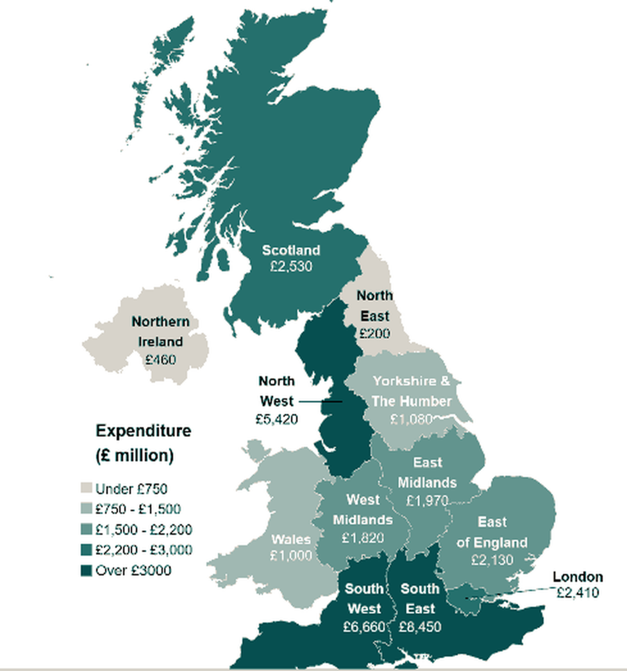
Government investment in UK defence rose 3.2% to a record £34.1bn in 2025/26, with the geography shifting alongside the scale. Northern Ireland recorded the largest proportional increase, at 63%, followed by the East of England at 24.7% and the East Midlands at 21%. Defence is becoming a tool of regional growth as well as national security. Higher European spending has made the region the largest market for UK defence exports, reducing reliance on UK MoD contracts. European NATO defence spending is expected to reach €650–750bn by 2030, a 7–10% CAGR.
MOD Expenditure with UK Industry by Region 2025/26
A new UK–US partnership on AI and autonomy will apply advanced systems to protect critical infrastructure, from sea lanes to airspace. Britain’s Rapid AI Delivery Taskforce and the US Chief Digital and Artificial Intelligence Office will develop trusted, interoperable capabilities. The goal is both military and commercial: stronger deterrence and a technological edge that domestic suppliers can help deliver.
Private capital is responding. UK-active defence-tech company Tekever raised $580m, lifting its valuation fivefold to $6.4bn. Its expansion into new markets mirrors that of European peers Quantum Systems and Helsing, signalling defence tech’s shift from a specialist niche to an investable growth sector.
Higher defence spending is already feeding demand for industrial and logistics space, as my colleague Claire Williams explains in this article.
In other news...
UK science and deep-tech fundraising remained active. London-based Basecamp Research raised $140m in a Series C round led by S32 and backed by NVIDIA and Anthropic to develop AI-designed medicines. StandardX secured £10m in seed funding for what it calls the world’s first isotope refinery, supporting team growth and its first industrial site in London. Isotopes are critical to fusion energy and cancer treatment. London-based Unit1 Studio, founded by Barney Wragg, Jonathan Butterell and Pavle Mihajlovic, raised €23.3m to scale avatar-concert technology that enables simultaneous performances across venues worldwide.
Novo Nordisk cut 13,000 jobs over the past year as it seeks renewed growth through new drug launches and additional treatment areas.
The Medicines and Healthcare products Regulatory Agency, Medical Research Council and Office for Life Sciences launched a £20m programme to establish four Centres of Excellence for Regulatory Science and Innovation, each funded for up to five years.
Anthropic quietly established a Bay Area laboratory for physical biology work as it expands into drug discovery.
Sign up to Knight Frank Research.
