

Super-Prime Activity Resilient as Tight Supply Weighs on London Lettings Market
August 2026 PCL lettings index: 227.5 August 2026 POL lettings index: 233.9
04 September 2026

Lettings activity and rental value growth in prime London markets continue to be shaped disproportionately by supply.
Overall, tight stock levels are pushing the number of tenancies agreed lower and rents higher.
The number of new listings in prime central (PCL) and prime outer London was 10% lower than the five-year average in the three months to August, Rightmove data shows. In fact, new listings haven’t risen above their five-year average since April 2021.
The reason for the decline is a series of tax and legislative changes in recent years that have undermined the viability of letting property for landlords.
For example, the Renters Rights Act, which came into effect in May, sets stricter rules around collecting and increasing rent, reforms the possession process and introduces safeguards to prevent properties being re-let after they have been recovered for sale, as we explore here.
As a result, new lettings activity is also down. The number of tenancies agreed in London in the three months to August was 8% lower than last year, which exactly matched the fall in new supply over the same period, Knight Frank data shows.
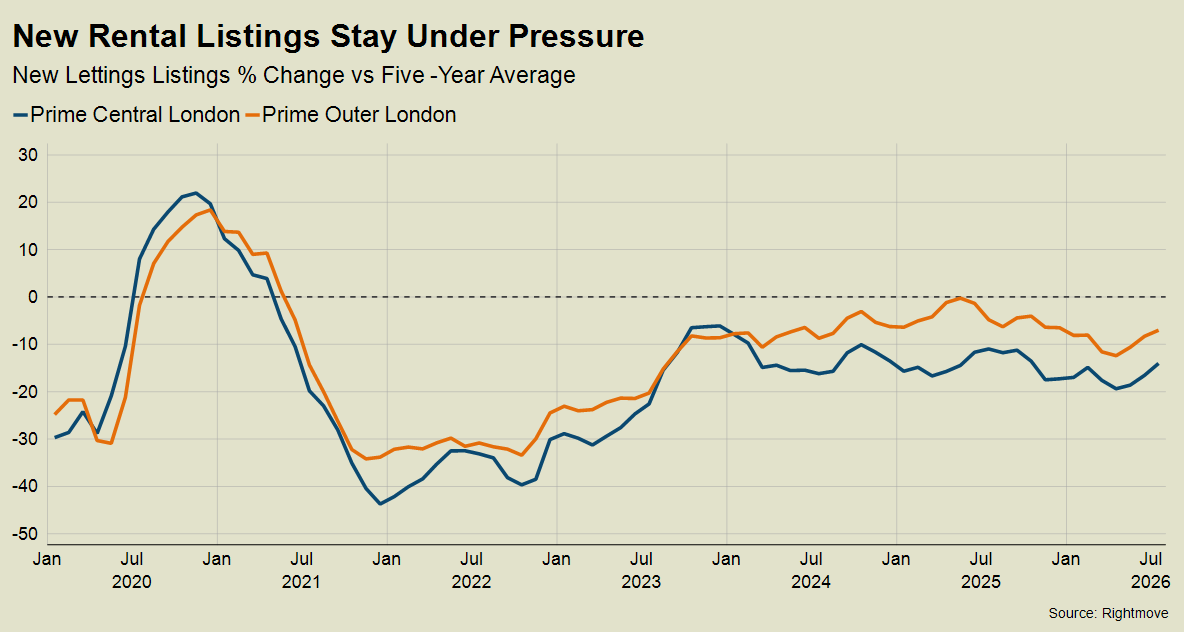
The imbalance is less stark in higher price brackets due to the greater number of discretionary owners who can let out their property rather than sell in a weak sales market.
The number of new listings above £1,000 per week in London was 13% higher than the five-year average in the three months to August, Rightmove data shows.
Rents Pushed Higher
The same effect means that while average rents increased by 3% in POL in the year to August, there was a smaller increase of 1.2% in PCL.
Meanwhile, there were 8.7 new prospective tenants for every new listing in POL in August, which was the highest figure in five years. That compared to a ratio of 5.2 in PCL.
Activity remains strong in the super-prime market above £5,000 per week, which has also been underpinned by weaker demand in the high-value sales market due to the ending of non dom tax status, a rise in the additional rate of stamp duty and ongoing concerns around the taxation of wealth.
The flexibility of renting appeals to some high-net-worth individuals, as I discussed on the last episode of Housing Unpacked.
The number of super-prime tenancies started in the three months to August was 13% higher than the five-year average, Knight Frank data shows.
“One of the most consistent themes we are seeing is prospective buyers continuing to defer purchasing decisions and opting to rent for a further 12-24 months,” said Tom Smith, head of super-prime lettings at Knight Frank. “While concerns around non-dom reforms and wider tax policy remain relevant, many occupiers continue to adopt a wait-and-see approach.”
Sign up to Knight Frank Research.
