
Steady as she goes budget, plus heat networks, Alpine property & EVs
06 November 2026

Last week John Healey’s first budget was delivered to a muted reaction, here we unpack the relevant announcements for energy and sustainability, as well as highlighting the trajectory of heat networks, Alpine locations and EV’s.
Power moves further up the political and property agenda
Energy was at the heart of the Budget, although much of the detail and delivery is still to come. For property, two issues we often highlight were central: the cost of and access to sufficient power.
Affordability was a clear focus. While immediate support was weighted towards households, the Budget also signalled longer-term reform through a new Cost Control Framework, due at the 2027 Spending Review. Until then, the government has said no further policy costs will be placed on energy bills unless they reduce bills or are essential for security of supply. This matters against a backdrop of non-domestic electricity and gas prices that remain materially above their pre-energy-crisis levels - around 77% above their 2019-21 average in Q2 2026, while gas prices were approximately 98% higher, according to DESNZ data. Although below the peak reached during the 2022 energy crisis, these costs continue to influence occupier decisions, building operations and business competitiveness.
There were also measures aimed at reducing costs over the longer term. The pre-Budget Energy Wealth Fund seeded with £2 billion will reinvest North Sea oil and gas revenues into renewable and low-carbon infrastructure. Meanwhile, the government is consulting on a Wholesale Contracts for Difference scheme, for existing low-carbon generation, covering eligibility, (e.g. 5 or 10MW), allocation, commercial arrangements and potential market impacts.
Energy availability is a big part of the equation. The Budget followed the announcement of GB Grid and proposals to expand self-build connections, potentially giving customers and private capital a greater role in delivering the infrastructure needed to connect. Alongside the budget, the government outlined that they will enable NESO to prioritise strategic demand projects identified; and align data centre connections after 2030 to regional infrastructure targets.
Taken together, the Budget pointed towards greater intervention in both how electricity is priced and how capacity is delivered. The subsequent introduction of the Energy Independence Bill, reinforces that direction, broadening the focus to energy efficiency, community participation in renewables and faster infrastructure delivery. I summarise the key measures and implications for property and energy investment here.
Read the Commercial Insight team’s Budget reaction here.
Heat networks: from building service to strategic consideration
Heat networks are moving from a sustainability consideration to a strategic asset-management issue. Two policy developments are converging: existing heat networks are now regulated by Ofgem, while future heat network zoning could require some buildings to connect where networks are considered the most cost-effective route to decarbonising heat.
The scale of potential exposure may be larger than many owners realise. Knight Frank analysis of the Glenigan Planning Database identified more than 600 completed developments, both residential and commercial, since 2010 containing references to district heating, communal heating systems or energy centres. More than one-third were in London, reflecting a decade of planning policy support for low-carbon heat infrastructure. While these developments represent only around 0.6% of completed projects, they account for 2.4% of completed units, suggesting heat networks are disproportionately associated with larger schemes. Residential developments dominate, with almost 200 private housing projects identified, representing around 43,000 units.
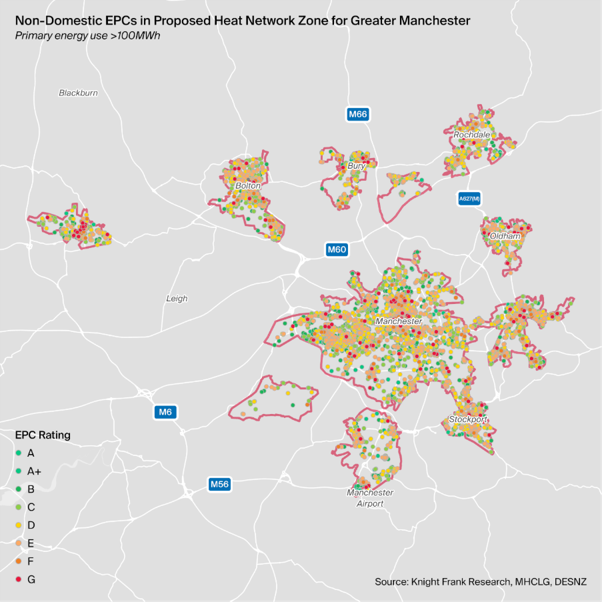
Future growth could be significant. Government ambitions would see heat networks increase from supplying around 3% of UK heat demand today to 7% by 2035 and 20% by 2050. To illustrate the potential scale, our analysis of pilot heat network zones in Greater Manchester identified 9,122 non-domestic EPC records exceeding the proposed 100 MWh threshold for connection consideration, although EPC records do not directly equate to individual buildings (see Figure below).
As David Goatman, Global Head of Energy & Sustainability, notes: “The expansion of heat networks presents a significant decarbonisation opportunity for commercial real estate owners. However, it is crucial that the up-front costs and ongoing charges are well understood so that building owners maximise the commercial benefits from what are long-term contracts.”
For owners, the key questions are increasingly practical: does the portfolio already contain regulated heat networks, could assets fall within future zones, and what might that mean for governance, capital expenditure and long-term decarbonisation strategies?
Beyond snow: the rise of the climate-resilient Alpine resort
In this newsletter we have previously highlighted that Alpine real estate is wary and adapting due to warming climates and snowfall being more unpredictable and scarce. With snowfall declining by an average 34% between 1920 and, 2020, as highlighted in the Knight Frank 2026/27 Alpine Report, the discussion is evolving as resorts turn to year-round attractions with a broadening tourism base.
Across key Alpine gateway airports, summer flight schedules are now 8% higher than in 2023 and 2% above 2016 levels, according to analysis of Official Airline Guide (OAG) data. Switzerland recorded a record 25.2 million hotel nights between May and October 2025, compared with 18.6 million during the 2024/25 winter season. Summer admissions on Swiss mountain railways were also 29% above the previous five-year average, while summer passenger arrivals at Aspen increased by 20% between 2019 and 2025.
At the same time, the report highlights how destinations are adapting to changing climatic conditions through investment in snowmaking, water storage, mountain infrastructure and broader lifestyles and amenity offers. Property performance is increasingly differentiated by altitude, as well as the ability to support year-round demand. For real estate, the lesson extends beyond the Alps. As climate risks become more material, long-term asset value will increasingly depend on resilience, adaptability and the ability to remain relevant across changing environmental and consumer conditions.
90 - Stat of the month
That is the indicative number of office parking spaces for every EV charger across the GB office sites analysed by Knight Frank. Only around 2% of office car parks were identified as currently having charging provision, with equipped sites averaging approximately three chargers. This is increasingly important as plug-in vehicles accounted for 36.7% of new car registrations in the 12 months to Q2 2026, rising to more than 40% among new company-car registrations. As corporate fleets electrify, workplace charging may become less of an amenity and more an indicator of asset readiness.
The figures should be treated as a market benchmark rather than a precise national measure because of limitations in matching individual buildings, car parks and charging locations. Nevertheless, they raise an important question for owners: can today’s electrical capacity accommodate tomorrow’s occupier requirements?
Sign up to Knight Frank Research.
