

Heat networks: what all property owners need to know whether you already connect or not
Two policy shifts are converging: existing heat networks are now regulated, while zoning could require more buildings to connect. Owners need to know which role they play, where their assets sit and what obligations may follow.
04 November 2026

The quick read
• Regulation is a live issue: Since 27 January 2026, heat network operators and suppliers in Great Britain have been subject to Ofgem regulation and consumer-protection requirements, shifting heat provision from an operational consideration to a regulated activity with legal and financial consequences.
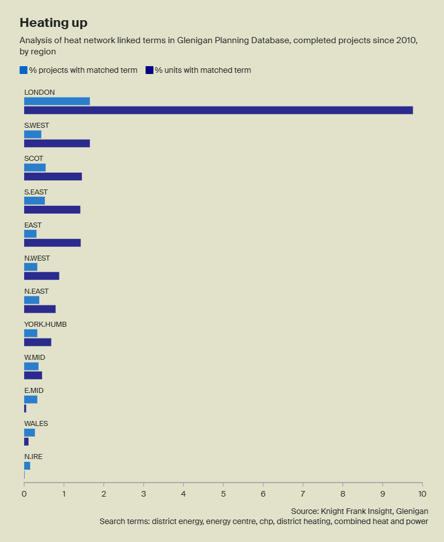
• London particularly in focus: Analysis of the Glenigan Planning Database identified more than 600 completed developments since 2010 with references to energy centres, district heating or communal heating systems. More than one-third are located in London, reflecting a decade of planning policy support for heat networks and low-carbon heat infrastructure.
• Zoning may be coming: While detailed legislation is yet to emerge the government signalled intent to develop further heat network zoning, with targets of 7% of heat demand met via heat networks by 2035 and 20% by 2050, from 3% currently. Indicative pilot zone boundaries can identify potential exposure, but building-level exposure may depend on energy usage and existing systems and economics, not just locations.
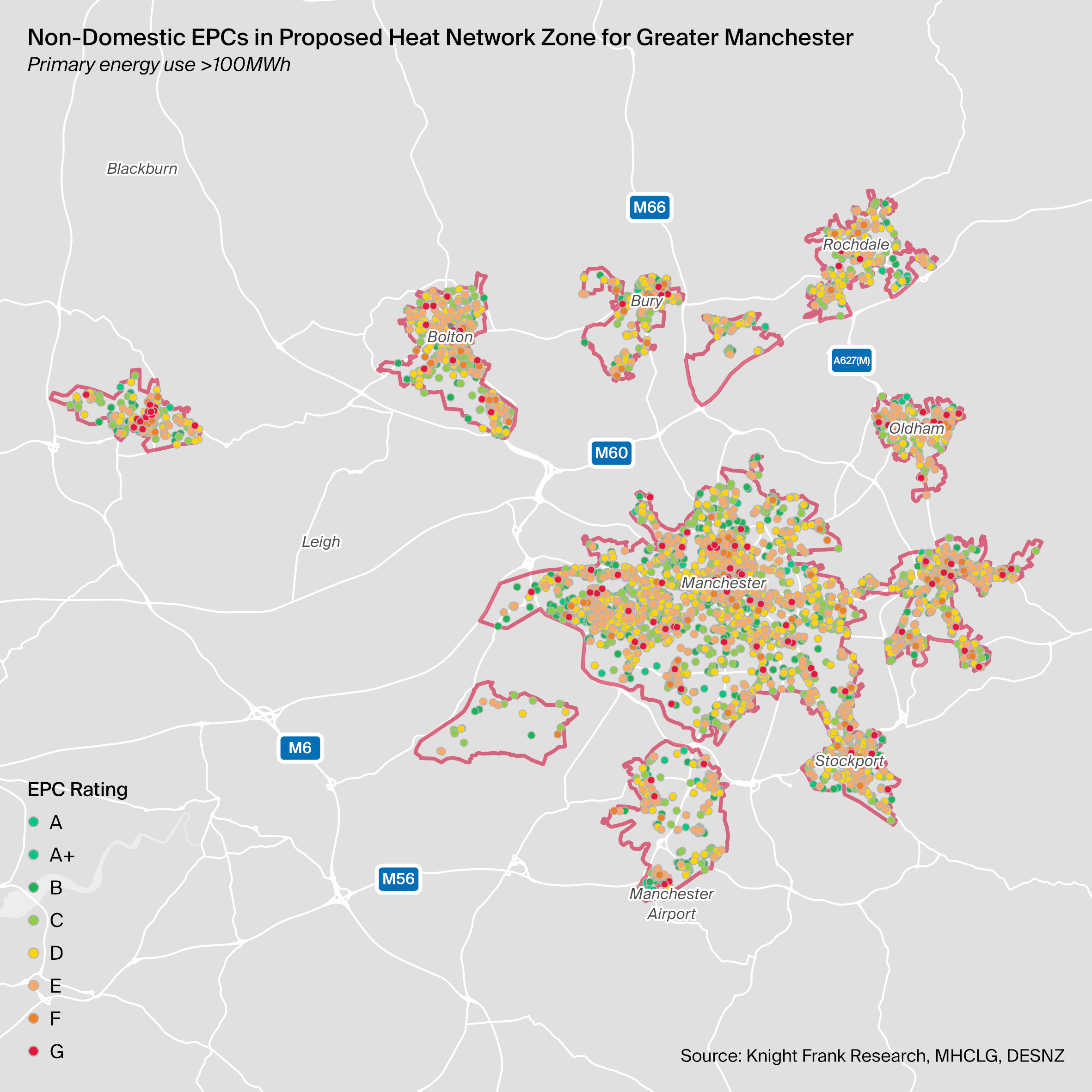
• Manchester in the spotlight: To illustrate the potential scale of future zoning, analysis of pilot heat network zones in Greater Manchester identified 9,122 non-domestic EPC records with estimated energy consumption above the proposed 100 MWh threshold. While EPCs often represent occupiers or units rather than whole buildings, the analysis provides an indication of the potential scale of exposure.
• Exposure may be broader than expected: Landlord, management company or estate vehicles may be the operator or supplier even where heat provision has historically been treated as an ancillary service.
The detail
Heat networks, sometimes referred to as district heating systems, distribute heat from a central source to multiple buildings through insulated underground pipework, replacing individual boilers and heating systems. They are increasingly viewed as a route to decarbonising heat at scale, particularly in dense urban areas, when supplied by low-carbon or waste heat sources. However, the carbon savings ultimately depend on the heat source rather than the network itself.
Two distinct policy developments mean property owners should now pay closer attention. The first brings existing heat networks into a formal regulatory regime. The second seeks to accelerate deployment through heat network zoning, which could require some buildings to connect in designated areas.
1. Existing networks become regulated infrastructure
What does it mean?
Implementation is phased but binding. From 27 January 2026, existing heat network operators were granted deemed authorisation, allowing continuity of service. However, this is a transitional measure. By 26 January 2027, all operators and suppliers must register with Ofgem, providing details on ownership structures, financial resilience, network characteristics and customer arrangements. Once registered, entities become subject to ongoing authorisation conditions, with Ofgem able to audit, enforce and penalise non-compliance.
For property owners, this matters because the responsible entity may be a landlord, management company, residents' management company or specialist energy services provider, depending on how the scheme is structured. What was often viewed as a building service is becoming regulated infrastructure, bringing new compliance, governance and reporting obligations.
How many properties are impacted?
The scale is difficult to quantify precisely as there is no comprehensive register of communal heating systems. Analysis of the Glenigan Planning Database identified just over 600 completed developments submitted since 2010 containing references to district heating, district energy, energy centres or communal heating systems. London accounted for more than one-third of these developments, reflecting a decade of planning policies designed to reduce operational emissions and encourage heat network deployment.
While these developments represent only 0.6% of completed projects, they account for 2.4% of completed units, suggesting heat networks are disproportionately associated with larger schemes. Residential developments dominate, with almost 200 private housing projects identified, representing around 43,000 units. In London, almost 10% of completed units were linked to heat-network-related terminology within planning documentation.
This likely understates the true scale of exposure. The DESNZ Heat Networks Planning Database records identified existing and proposed heat network schemes, but it is not intended to be a comprehensive register of all communal heating or energy-centre developments. Many smaller or privately developed systems may not be captured. Even so, the database identifies 57 operational schemes serving 4,788 customer connections, alongside a substantial future pipeline comprising more than 600 schemes awaiting construction, almost 300 under construction and nearly 400 at application stage.
The implication is clear: a significant number of assets, particularly larger residential-led developments delivered over the past decade, may now fall within a regulated heat network environment. For owners and operators, this is increasingly a portfolio-level consideration with implications for governance, capital expenditure and operational management.
2. Zoning could create connection requirements
What does it mean?
Government views heat networks as a key component of its heat decarbonisation strategy, with ambitions for them to supply around 20% of UK heat demand by 2050, up from around 3% today. Areas identified as suitable for heat networks may be designated as Heat Network Zones, where heat networks are considered the lowest-cost route to decarbonising heat.
The zoning methodology has been developed using a national model and pilot exercises across 28 towns and cities. Within designated zones, certain buildings may be required to connect to a heat network within a specified timeframe, including:
- New developments receiving planning permission after zone designation;
- Existing communally heated residential and non-domestic buildings; and
- Existing non-domestic buildings with annual heat demand above 100 MWh and wet heating systems, typically including larger offices, hotels, healthcare facilities and mixed-use assets.
While the detailed secondary legislation is still emerging, heat network zoning represents a significant shift in policy. Rather than simply supporting network development, it introduces the possibility that connection could become an obligation for certain assets where heat networks are deemed the most cost-effective decarbonisation pathway.
Local authorities are already moving from heat network zoning analysis towards delivery. Areas including Plymouth are progressing plans through the government's Advanced Zoning Programme, while others are procuring development partners or undertaking detailed feasibility work. Vale of White Horse District Council, for example, has commissioned a study into the feasibility and delivery of a potential low-carbon heat network around Didcot, including the potential to utilise waste heat from proposed data centres.
How many properties are impacted?
Again, the precise scale remains uncertain because final zone boundaries have not yet been designated and building-level eligibility will depend on factors such as heat demand, existing heating systems and potential exemptions.
However, early indications suggest the potential exposure could be significant. The City of London Corporation is among the most advanced authorities and is consulting on proposals that could see much of the Square Mile designated as a heat network zone, with around 1,200 buildings identified as potentially affected.
To understand the possible scale beyond London, we analysed pilot heat network zones in Greater Manchester. Within the proposed zone boundaries, we identified 9,122 non-domestic EPC records with estimated energy consumption above the 100 MWh threshold. EPCs frequently represent individual occupiers or units rather than whole buildings, meaning the true building count could be different, but the analysis provides an indication of the potential order of magnitude rather than a precise measure of exposure.
For owners, the key question is not simply whether an asset sits within a proposed zone. It is whether the final zone is designated, whether the building meets the qualifying criteria, whether exemptions apply and, ultimately, what the commercial implications of connection will be. As zoning develops, heat networks are shifting from a voluntary sustainability consideration towards a potential infrastructure requirement that may influence asset value, refurbishment strategies and capital expenditure planning.
How are real estate owners responding
‘’The expansion of heat networks presents a significant decarbonisation opportunity for commercial real estate owners,” notes David Goatman Global Head of Energy & Sustainability.
“However it is crucial that the up-front costs and ongoing charges are well understood so that building owners maximise the commercial benefits from what are long-term contracts. The experience from residential developments connecting to heat networks is that many developers did not fully understand what they were signing up to.’’
The regulatory framework and zoning regime continue to evolve, but the key takeaway for real estate owners is clear. Heat networks are increasingly becoming a strategic consideration with implications for compliance, asset management, refurbishment planning and long-term decarbonisation strategies.
Sign up to Knight Frank Research.
