

The Rural Update: Prepare for rental reform
Your weekly dose of news, views and insight from Knight Frank on the world of farming, food and landownership.
27 April 2026

Viewpoint
Most rural estates will have at least a few residential properties that they let out. Some will have large portfolios that generate a significant proportion, if not most, of their business income.
The implementation of the Renters’ Reform Act this week will have significant implications for both. Some small-scale landlords may feel that renting out homes is no longer worth the effort, but with the right advice and appropriate record-keeping, combined with data-driven decision-making, the transition to the new regime should be manageable.
However, being proactive will be vital. A lack of planning or awareness of what the changes might mean could be extremely costly.
Sign up to receive this newsletter and other Knight Frank research directly to your inbox
Commodity markets
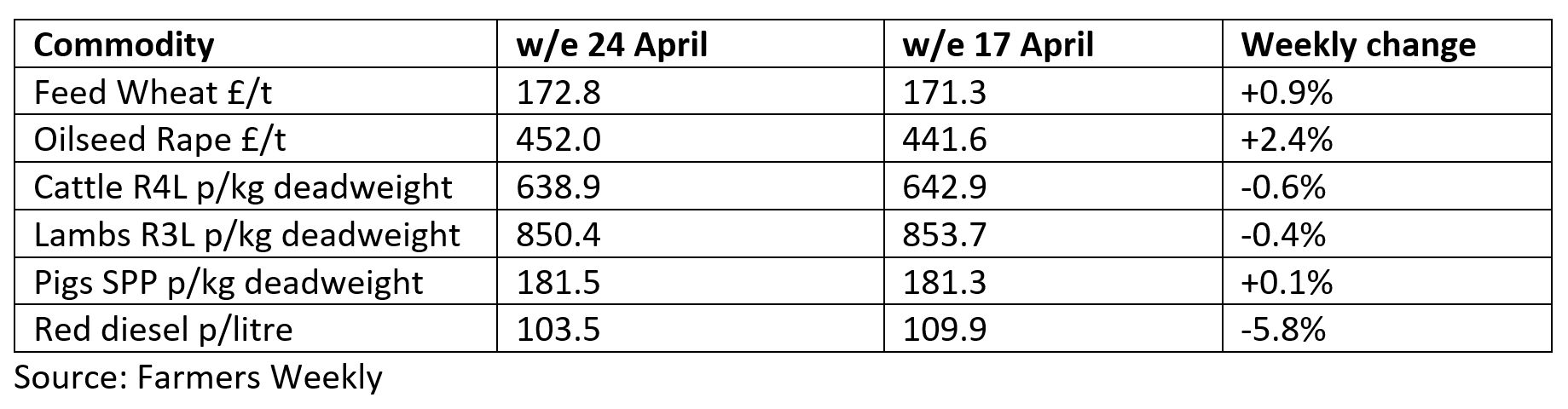
Fertiliser conundrum
Northern hemisphere arable farmers have been spared the worst of the hike in fertiliser prices because most had already bought this season’s supplies prior to the current Middle East crisis.
Those in the southern hemisphere, where crop establishment is just getting going, have been much harder hit. This could have an impact on commodity prices.
A significant number of Australian farmers, for example, are reportedly planning to ditch wheat and plant the less nitrogen-hungry oilseed rape instead, which could put downward pressure on prices.
In the UK, traders are warning that if farmers hold off from replenishing their fertiliser stocks for too long due to the high costs, the dwindling number of manufacturers who supply the European market could cut back on production, leading to a potential shortage and even higher prices.
The headline
Renters’ Rights Act live
The first phase of the controversial Renters’ Rights Act comes into effect this week (1 May). Landlords have until the end of May to provide each of their tenants with the government’s factsheet detailing the changes or face significant fines.
Perhaps the most fundamental change brought about by the Act is the abolition of assured shorthold tenancies and fixed-term assured tenancies. All residential tenancies will become periodic tenancies from the outset, meaning that tenants can no longer be locked into a fixed term and will only need to provide two months’ notice.
Crucially, tenants can no longer be removed by a simple Section 21 “no-fault” eviction notice. Landlords instead must provide valid reasons – via an updated Section 8 process – to regain possession, such as rent arrears or the intent to sell. The inability to recover possession without establishing a statutory ground will require a more robust and evidence-based approach to tenancy management.
The likelihood of court proceedings in the majority of cases will result in increased costs to the landlord and a delay in the reletting of properties. This represents a significant constraint on landlord flexibility.
The Act also introduces new restrictions on rent increases, limiting landlords to one increase per year and requiring a minimum of two months’ notice (previously one month) to be given to tenants.
For advice on what the Act could mean for you, please contact Jess Waddington.
News in brief
IHT woodland hit
Chancellor Rachel Reeves’s reform of the agricultural and business property relief regimes could hit the government’s tree-planting targets, according to the results of a new survey. A poll by the CLA and Confor found that 60% of woodland owners are less likely to invest in creating new woodland, with many considering earlier timber harvesting, selling woodland, altering succession arrangements or reducing future investment in woodland management.
Fertiliser vulnerability
A new report from the National Preparedness Commission lays bare our vulnerability to disruptions in the global fertiliser supply chain. The Strategic Geography of Fertilisers: Implications for UK Preparedness highlights the country’s minimal capacity to produce its own crop nutrients and how production is concentrated in the hands of a small number of multi-national companies. The EU has relaxed rules on fertiliser subsidies as part of its AccelerateEU package of responses to the current energy crisis.
River court case kicks off
The UK’s largest environmental pollution claim hit the High Court yesterday (27 April). Law firm Leigh Day is representing around 4,500 people in the landmark case against poultry super-producer Avara Foods and Welsh Water, who are accused of polluting the rivers Wye, Lugg and Usk with chicken manure and sewage. Lawyers at Leigh Day have already criticised Avara for attempting to shift the blame to farmers who spread the manure.
Welsh pylon battle
Meanwhile, another High Court legal battle got underway in Cardiff last week, which could have implications for compulsory purchase cases. The judicial review, brought by community group Justice for Wales against Green GEN Cymru, revolves around the legality of energy companies using section 172 notices to enter private property to carry out surveys prior to compulsory purchase orders being issued. Green GEN is proposing to build a network of pylons to transfer renewable energy across Wales, affecting 500 farmers and landowners. Please contact Tim Broomhead for advice on any compulsory purchase or compensation issues.
Energy infrastructure access
The government has also just published its response to a consultation on energy network infrastructure consents, land access and rights. It says (page 76) that it will “clarify in legislation that access rights for existing legislation apply to all land insofar as it is necessary for that purpose, irrespective of the number of land parcels required or the location of the land”.
Carbon credit dividend
A new report from the City of London Corporation estimates that the carbon credit industry contributed £1.2 billion to the UK’s economy last year. Seizing the UK’s carbon credit opportunity: Measuring value to enable action says £336 million has now been invested in UK nature-based carbon credits, with schemes like Nattergal’s rewilding projects delivering an estimated £500 million of ecosystem services such as cleaner air and flood mitigation each year. Read our interview with Nattergal CEO Archie Struthers.
Land tenure data
Defra has just published its latest landownership and tenure statistics for England. As of June 2025, 2.9 million hectares of land were rented under agreements of over one year. Of those, 1.1 million hectares were let under traditional Agricultural Holdings Act tenancies, 1.3 million hectares under Farm Business Tenancies, and 468,000 hectares under other arrangements. Almost 600,000 hectares were rented on a seasonal basis. About 14% of English farms are wholly tenanted, and 31% are mixed tenure.
Wind wastage
Around 3.6 Terawatt-hours (TWh) of potential wind output was wasted across Britain in the first quarter of 2026 due to a lack of network capacity, according to energy analyst Montel EnAppSys. Electricity generation from wind reached record levels for the first quarter of 2026, with almost 30 TWh produced.
Next Gen Dales' discussion
Our Northern Rural team is helping to host a CLA Next Generation event at the stunning Ingleborough Estate in the Yorkshire Dales on 5th June. The day will help equip those managing a diversified rural business or planning for the next generation. Attendees will also hear how the Farrer family has strengthened Ingleborough’s financial resilience, from a café renovation to land-use planning, offering an honest insight into the estate’s development so far. Sign up for the event.
Property of the week
Northumberland natural capital
There is still a chance to own a stunning agricultural, lifestyle, environmental and natural capital portfolio in one of the country’s most desirable upland areas. West Ditchburn & Hagdon, near Alnwick in Northumberland, includes 1,095 acres of commercially managed pastureland and 915 acres of moorland. The guide price is £9.5 million for the whole. Please contact Claire Whitfield for more information.
Discover more of the farms and estates on the market with Knight Frank
Property markets Q1 2026
Farmland - market treads water
The average value of farmland remained relatively unchanged in the first three months of the year, according to the Knight Frank Farmland Index. Continued political and economic uncertainty, exacerbated by the current conflict in the Middle East, which has seen input costs like fuel and fertiliser spiral, and poor weather, means few new farms, blocks of land or estates were put up for sale during the traditional spring selling season. But despite a perception by vendors that now is not a good time to sell, demand remains firm from a range of buyers. If you are thinking of selling, please contact Will Matthews.
Country houses - values stabilising
The average price of houses in the countryside fell 5.5% in the 12 months to the end of the first quarter of 2026, which was a modest improvement on the 5.7% decline recorded in December, despite the uncertainty caused by the Middle East crisis, according to the Knight Frank Country House Index. The annual price decline for flats (-3.8%) and townhouses (-5.1%) was lower than for farmhouses (-7.1%), underlining how demand has been stronger in needs-driven markets. Prices are now 13% lower than their pandemic-era peak in Q2 2022, when demand increased for more space and greenery. Contact Tom Bill for more insight and data.
