
The Rural Update: More action, less talk is needed
Your weekly dose of news, views and insight from Knight Frank on the world of farming, food and landownership.
30 March 2026

Viewpoint
It would be difficult to accuse the government of not wanting to listen or talk to rural stakeholders. Over the past few weeks, it has launched consultations on numerous topics, including the now critical issue of fertiliser policy; published its response to last year’s call for evidence on expanding the role of the private sector in nature recovery; held the first meeting of the Farming and Food Partnership Board – a key recommendation of Batters’ Farming Profitability Review – and published its long-awaited, although ultimately nebulous, Land Use Strategy.
But one can’t help but feel that despite all this communication, the government still hasn’t grasped the urgency of the situation facing farmers, landowners and the public. The war in Ukraine should have been the wake-up call that highlighted our dependency on energy and fertiliser from geopolitical hotspots and the vulnerability of our food chain to global market volatility.
Yet farmers are once again facing spiralling input costs, but this time with no commensurate increase in commodity prices to at least offset some of the pain. Some big decisions need to be made, and soon. Kicking the can further down the road with yet more consultations won’t wash.
Sign up to receive this newsletter and other Knight Frank research directly to your inbox
Commodity markets
Oil chaos continues
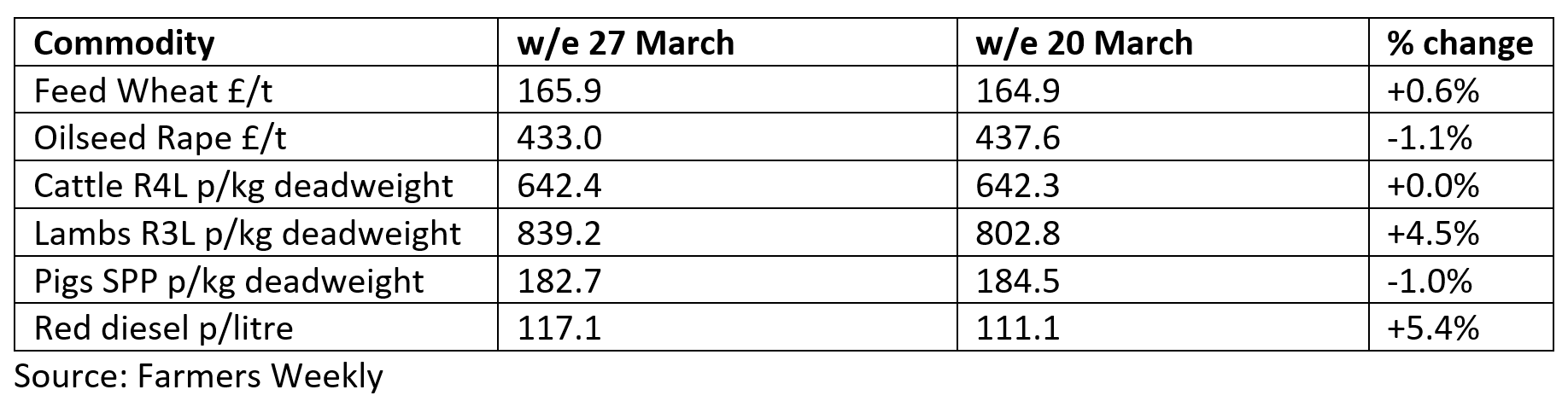
Oil prices rose sharply again at the beginning of the week following more bellicose language from Donald Trump regarding potential strikes on Iran’s energy infrastructure, combined with threats from Yemen’s Houthi rebels to ramp up attacks on shipping in the Red Sea. Brent Crude hit US$117/barrel by Monday (30 March) morning, with red diesel approaching £1.20/litre. Keir Starmer held a crisis meeting with oil bosses, while some countries such as South Korea are even mulling restrictions on private motorists to save fuel.
Livestock herd falls
Higher beef and sheep prices seem to have done little to persuade English livestock farmers to boost output. According to the latest data from Defra, the number of beef cattle fell 4.3% last year to 569,000. The total number of sheep and lambs dropped almost 4% to just over 13 million. Fattening pigs saw a slight fall of 0.4% to 3.3 million animals.
Chickens up, eggs down
Meanwhile, a search for cheaper protein by shoppers saw poultry broiler numbers jump sharply by 8% to 95 million, although the egg-laying flock declined by 6%. Annual egg imports to the UK have surged 60% since 2021 to 1.6 billion. A new industry report, Shell Shocked, warns that many of these eggs do not meet UK food standards and are from birds kept in conditions that would be illegal here.
Dairy pain
The UK average farm-gate milk price in February was just 36.07p/litre, a 3.8% fall from the previous month and a whopping 21% decrease on the price dairy farmers were receiving 12 months earlier. At 1.2 billion litres, milk volumes were 8.3% lower than January, but still 4% up on February 2025. The Agricultural Supply Chain Adjudicator has also just launched a timely survey asking for views on how to make the dairy sector fairer. It closes on 20 April.
The headline
Scottish farm support
Farmers in Scotland are set to receive what the government in Edinburgh is describing as “the most generous support package in the UK,” following the publication last week of the country’s new Rural Support Plan for 2026 to 2030.
Unlike England’s post-Brexit agricultural schemes, which are largely based around environmental payments, around 70% of the four-tier Scottish plan will still be made up of direct payments to farmers, although enhanced levels of funding will be available to those who deliver more for climate and nature.
Agriculture Minister Jim Fairlie said any reforms would be introduced gradually and there would be no “cliff-edge” cut in existing payments.
The plan has received a mixed response. Farming organisations have welcomed the retention of direct payments but warned that a fixed £677 million budget over the next five years means support will drop in real terms.
Others argue that it doesn’t do enough to support crofters and smaller farms, while environmental groups have complained that it is a missed opportunity for delivering more nature-friendly farming across Scotland.
Nature investment plans
Relying on voluntary action by the private sector will not be sufficient to deliver the country’s nature-recovery aspirations.
That is one of the main conclusions from the government’s just-published response to its 2025 call for evidence on expanding the role of the private sector in nature recovery.
In addition to the introduction of mandatory Biodiversity Net Gain rules, incorporating the UK’s Sustainability Reporting Standards into the disclosure requirements for listed companies was being consulted on.
The government has also consulted on climate-related transition plan requirements and whether nature should be integrated into these plans.
Respondents also noted that a coherent, joined up and predictable long-term policy framework for nature recovery, including setting expectations of the role of the private sector, will also be critical to guide investment and provide the certainty that businesses and investors need to act.
It was also pointed out that the government has a vital role to play in de-risking early investment in nature markets through blended finance and should develop mechanisms to de-risk nature investment at scale, learning from successes in supporting the renewable energy sector.
In response, the government said it was exploring the creation of a £250 million Woodland Carbon Purchase Fund to provide upfront demand for woodland carbon, as well as working closely with the BSI to develop a market-ready standard supporting the growth of nature-based carbon markets while guarding against greenwashing.
News in brief
Trail hunting consultation
The government is asking for views on how it should implement its manifesto pledge to ban trail hunting where hounds follow a pre-laid animal-based scent across the countryside. This, it is claimed, still leads to the death of wild animals and even pets, but ministers say they recognise the economic and social value of hunts and are keen for alternatives, such as drag hunting and clean‑boot hunting that use non‑animal scents, to continue. The consultation closes on 18 June.
Wild bird hunting reform
A consultation has also been launched on how to better protect wild birds that are currently allowed to be hunted. Schedule 2 (2.1) of the Wildlife and Countryside Act 1981 lists 19 species of wild birds in England and Wales and 23 in Scotland, mainly ducks, geese and wading birds that can be shot outside the close season. The consultation proposes removing a number of species, such as the European white-fronted goose, from the list entirely or extending the close season for others, including snipe and woodcock. It also suggests introducing an open season for woodpigeon. The BASC has said the proposals are unnecessary.
Bumper wine harvest
UK winemakers enjoyed a stellar harvest last year, according to new data from the Food Standards Agency (FSA). Total production jumped 55% to 124,377 hectolitres, the equivalent of 16.5 million bottles. White wine saw the biggest surge in output, jumping by 132% to 31,813 hectolitres. However, red and rosé production also rose sharply – up 82% to 12,814 hectolitres. The number of vineyards registered with the FSA was 1,158 (+4.3%), while the area of productive vines rose 16% to almost 10,800 acres. Please contact our viticultural team for advice on acquiring, selling or managing a vineyard.
Padel IHT power
Padel, currently the UK’s fastest growing sport with over 400,000 players, could be a good way for estates to boost their trading income and protect valuable Inheritance Tax reliefs, says Florence Wolfe-Jones of our Rural Consultancy team. Read Florence’s valuable insights in the latest edition of Farmers Weekly.
Forest carbon competition
A new research paper has concluded that existing native woodlands are much better at storing carbon than forests managed for timber and bioenergy production than was previously thought. The Swedish-based study found that old-growth forests store up to 90% more carbon than managed forests. It says this highlights the value of protecting forests in their natural state.
EU news – Australia trade deal
The UK’s livestock producers are casting a jealous eye over the free trade deal that the EU has just struck with Australia. To the chagrin of some European farmers, the agreement will see more beef and lamb imports from down under, though these will remain capped after 10 years. By contrast, the UK equivalent, negotiated by the previous government, will see all quotas removed and tariffs fall to zero within a decade.
Rural Report out now
The Autumn Winter 25/26 edition of The Rural Report, Knight Frank’s thought-leadership publication for rural property owners and their advisers, is available now. Full of insight from leading landed estates and our Rural Consultancy experts, it’s a must-read.
Property of the week
Lambourn Valley land
This 217-acre parcel of Grade 3 land at Cranes Farm, East Garston, near Hungerford, Berkshire, will be an interesting early test of the spring market for bare land. Priced at £2.39 million, the sale includes 187 acres of arable soil, 27 acres of pasture and a 3.5-acre block of woodland. The land is entered into a mid-tier Countryside Stewardship Scheme and the Sustainable Farming Incentive. It is currently down to winter oats and wild bird seed mixture. Please contact Will Matthews for more information.
Property markets Q4 2025
Farmland - prices stabilise
According to the Knight Frank Farmland Index, which tracks the value of bare agricultural land in England and Wales, the average price of land fell only marginally in the final quarter of 2025. However, diminishing farmer confidence and Inheritance Tax (IHT) worries saw prices slide by around 5% over the year. An acre is now worth just under £8,700. The government’s partial IHT U-turn just before Christmas should help stabilise prices during 2026.
Country houses - values slide
The Knight Frank Country House Index, which tracks the value of properties outside London above £750,000, lost 5.7% of its value in 2025 due to economic uncertainty and worries about what might be included in Labour’s second Autumn Budget. Properties classified as farmhouses were hit particularly hard, sliding by 7.3%. However, the market looks to be bottoming out with prices falling only marginally in the final quarter of the year and exchanges rising by 5%. Contact Tom Bill for more insight and data.
Development land - prices bottom
UK greenfield residential development land values fell 5% during 2025, but remained flat through the final quarter of the year, according to the latest instalment of the Knight Frank Residential Development Land Index. Uncertainty ahead of the Autumn Budget weighed on developers’ appetite for land, but positive signs are emerging. “The prevailing view is that Q4 2025 will mark the bottom of the market,” says Oliver Knight, Head of Res Dev Research.
