

The Rural Update: Food security matters
Your weekly dose of news, views and insight from Knight Frank on the world of farming, food and landownership.
09 March 2026

Viewpoint
Speculation is mounting that the government is set to publish its long-awaited Land-Use Framework shortly. Given current events, it is hoped that the framework will include a focus on food production and security, which, as several recent reports have highlighted, does not seem to be a major priority for policymakers. But we must also acknowledge that food security goes far beyond farmers’ fields. Our “just-in-time” supply chain, which hinges on nine large retailers supplied via just 131 distribution centres, is incredibly vulnerable. This weakness also applies to our regional food processing capabilities. News that a hike in inspection charges will add tens of thousands of pounds in extra costs to local abattoirs doesn’t bode well for the sector’s already precarious future. The vast majority of the government’s funding for agriculture is targeted at the environment, but more thought needs to be given to food chain resilience to avoid future crises and even public disorder.
Sign up to receive this newsletter and other Knight Frank research directly to your inbox
Commodity markets
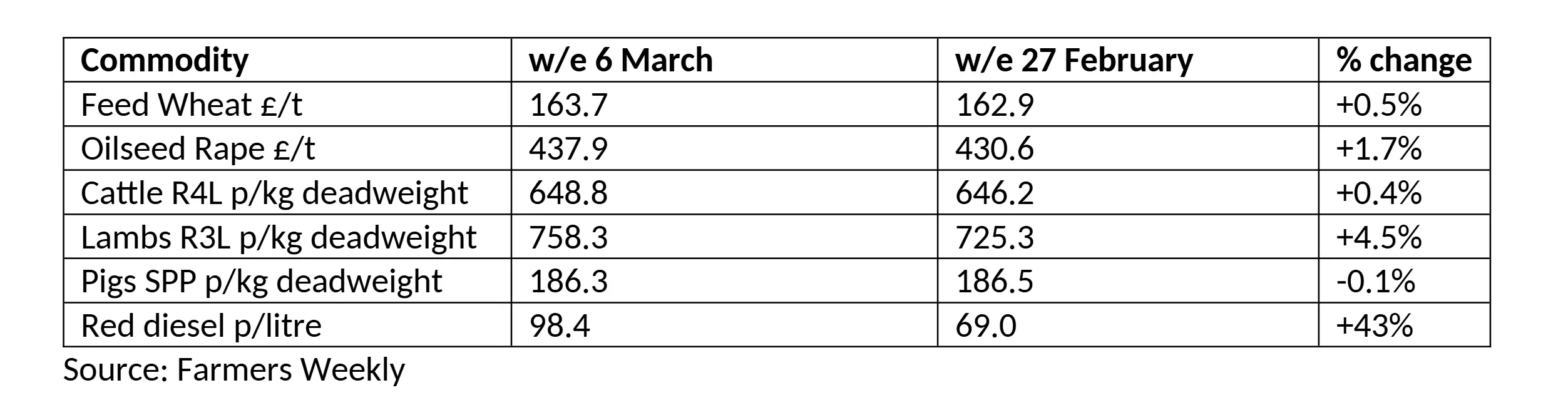
Red diesel surge
War in the Middle East is now having a material impact on farm input costs in the UK. By the end of last week, the rising cost of crude oil had pushed up red diesel prices by over 40%. Further rises are expected as the Strait of Hormuz remains off limits to shipping, with few signs that the conflict will end soon. Brent crude oil futures rose by more than 15% on Monday morning to over US$100/barrel, the highest price since June 2022. With no price cap on commercial energy costs, farming businesses are also set to pay more for gas and electricity. UK prices are already among the most expensive across Europe.
Fertiliser fears
The price of natural gas, a key ingredient for the production of the ammonia used in nitrogen-based fertilisers, is rising even faster than oil, just as farmers are looking to order supplies for their spring applications. Around a third of the world’s globally traded urea passes through the Strait of Hormuz, while in Qatar, the world's largest liquid natural gas (LNG) plant has been shut down since last Monday after being hit by an Iranian drone strike. Several UK fertiliser suppliers have withdrawn from the market due to the price volatility.
Grain and OSR boost
Cereal and oilseed prices also nudged up last week, with Chicago Board of Trade (CBOT) wheat futures climbing to their highest levels since July 2025 as traders worried about the implications of the Middle East crisis on shipping and production costs. Oilseed rape values are closely linked to crude oil prices, so traders expect the market to remain volatile. Futures prices hit €500/t last week for the first time in seven months.
The headline
Food security worries mount
Critics of the government’s apparent inertia when it comes to tackling the UK’s food security issues have seized on the ongoing crisis in the Middle East to argue that action is urgently needed.
A recent study by the University of York claims one major shock to the food chain could spark social unrest and even food riots in the UK, because chronic issues have left the food system a “tinderbox”.
Contributors to the study identified a series of issues that are making access to food vulnerable in the UK, including climate issues, low incomes, poor farming policy and fragile just-in-time supply chains.
Shocks that could tip this already vulnerable system into a full-blown food crisis were then analysed. Extreme weather events, cyber-attacks or international conflicts ranked top. These shocks would hit supply chains and push up food prices, which could lead to increased social tensions.
Another recent report, Just in case: 7 steps to narrow the UK Civil Food Resilience Gap, published by the National Preparedness Commission, and co-written by Professor Tim Lang, lays bare the lack of preparation by policymakers to help the country’s population deal with a significant food security event.
Although the government recognises food as one of 14 Critical National Infrastructure (CNI) sectors deemed essential for the functioning of society and economy, the report notes that very little resource or budget has been allocated to it.
By contrast, the National Cyber Security Strategy, which addresses another CNI sector, has a budget of £2 billion a year to reduce risks and threats, and is specifically set up to protect and work with both the public and business.
The report’s recommendations include legislation formalising an obligation on the state to ensure the public is fed in crises, as in Sweden, and prioritising food production in the planning system.
News in brief
Local abattoir threat
A huge hike in fees by the Food Standards Agency (FSA) will place even more pressure on the rapidly diminishing network of small and medium-sized abattoirs, says the Association of Independent Meat Suppliers (AIMS). In a letter to FSA Chair Susan Jebb this week, AIMS Chairman John Thorley said: “With overall inflation at around 3%, the new 2026/27 charges are to rise by a jaw-dropping 24%. We have surveyed 40 of our medium-sized members and calculated that these increased FSA charges will result in a hit of between £50,000 and £100,000 in the coming year, with a further £50,000 increase in the following year as a result of the loss of the industry discount.”
IHT case hits High Court
A judicial review challenging the government’s lack of consultation when it introduced changes to the Agricultural and Business Property Relief regimes, as part of Chancellor Rachel Reeves’s 2024 Autumn Budget, is set to be heard at the Royal Courts of Justice next week. The changes will see some farming and other family-owned businesses hit with huge Inheritance Tax bills from next month.
Prepare for EU alignment
Defra is urging the UK’s food producers to prepare for the introduction of the government’s new and controversial Sanitary and Phytosanitary (SPS) agreement with the EU, which is due to kick in next year. Speaking last week, Defra Secretary Emma Reynolds said the move would boost food and agricultural exports to the EU, which she claimed had dropped by 22% since 2018, by cutting paperwork, certification costs and food sampling at the border. Others claim it will force UK businesses to follow EU rules and regulations while having no say in how they are drafted.
But UK border not safe
However, lax border controls could be putting the UK at risk from plant and animal diseases, according to the House of Commons’ Environment, Food and Rural Affairs Committee (Efra). New figures obtained by the committee reveal that 18% of commercial food consignments requested to stop at the Sevington border control post, which is 22 miles from the Port of Dover, failed to do so.
Veggie burger reprieve
The EU has agreed measures to prohibit the use of 31 animal-associated names and cuts of meat for the sale of plant-based products. Beef, pork, chicken, breast, thigh, steak and bacon are among the forbidden terms, but burger, sausage and nuggets will still be allowed, as long as products are clearly labelled as being plant-based.
Bacon backlash
However, sales of genuine bacon are falling as consumers increasingly worry about the impact of additives contained in their food. Data from consumer analyst Worldpanel shows that the value of nitrite-cured bacon sales fell by 7.3% to £238 million during the 12 weeks to 25 January, compared with the same period the year before. Sales of more expensive nitrite-free rashers rose 22% to £9.4 million over the same period.
Tories’ labelling pledge
Meanwhile, Conservative Party leader Kemi Badenoch has pledged to close a loophole that allows food manufactured in the UK, but using imported ingredients, to be labelled with the Union flag, if she wins power. “Right now, food grown overseas but packaged here can still carry those labels. That's not fair on consumers, and it's not fair for our farmers,” she said.
New litter rules
Last week, we reported that fly-tipping had reached record levels across England. Now, the government has just published a new Code of Practice on Litter and Refuse. The code contains statutory guidance that outlines the standards expected of local authorities and other duty bodies, such as National Highways, regarding their duty to keep their land clear of litter and refuse. Under the rules, councils have the power to issue on-the-spot fines of up to £500 for littering, including when litter is thrown from a vehicle.
Rural Report out now
The Autumn Winter 25/26 edition of The Rural Report, Knight Frank’s thought-leadership publication for rural property owners and their advisors, is available now. Full of insight from leading landed estates and our Rural Consultancy experts, it’s a must-read.
Property of the week
NZ vineyard opportunity
As we wait for the UK farmland market to kick into gear, here’s another tempting vineyard opportunity from Bayleys, our New Zealand partner. Properties in Grovetown, near Blenheim, in the Marlborough winegrowing region, rarely come to the market, so this 35-acre block of vines is set to attract strong interest. Replanted in 2021, the vineyard includes almost 10 acres of sauvignon blanc grapes and 11 acres of pinot gris. A nine-acre parcel of grazing land has scope for further vineyard development or the opportunity to build a new homestead. Offers over NZ$2.1 million are invited. Please contact Georgie Veale for more information.
Property markets Q4 2025
Farmland - prices stabilise
According to the Knight Frank Farmland Index, which tracks the value of bare agricultural land in England and Wales, the average price of land fell only marginally in the final quarter of 2025. However, diminishing farmer confidence and Inheritance Tax (IHT) worries saw prices slide by around 5% over the year. An acre is now worth just under £8,700. The government’s partial IHT U-turn just before Christmas should help stabilise prices during 2026.
Country houses - values slide
The Knight Frank Country House Index, which tracks the value of properties outside London above £750,000, lost 5.7% of its value in 2025 due to economic uncertainty and worries about what might be included in Labour’s second Autumn Budget. Properties classified as farmhouses were hit particularly hard, sliding by 7.3%. However, the market looks to be bottoming out with prices falling only marginally in the final quarter of the year and exchanges rising by 5%. Contact Tom Bill for more insight and data.
Development land - prices bottom
UK greenfield residential development land values fell 5% during 2025, but remained flat through the final quarter of the year, according to the latest instalment of the Knight Frank Residential Development Land Index. Uncertainty ahead of the Autumn Budget weighed on developers’ appetite for land, but positive signs are emerging. “The prevailing view is that Q4 2025 will mark the bottom of the market,” says Oliver Knight, Head of Res Dev Research.
