

The Rural Update: Embracing carbon positive farming
Your weekly dose of news, views and insight from Knight Frank on the world of farming, food and landownership.
09 February 2026

Viewpoint
Agriculture is often singled out, many feel unfairly, for its perceived contribution to the UK’s carbon emissions. It’s good news, therefore, that the early results from a carbon baselining study (discussed below) suggest that a significant number of farms, including livestock units, across England, Scotland and Wales may already be sequestering more carbon than they are emitting.
Many of the beef and sheep sector’s most vocal critics seem to base their views on numbers originating from intensive production systems in the US and Latin America. The availability of data from local, more extensive grazing units may allow for a more nuanced debate, as well as highlighting where the government should be providing support to encourage more carbon positive farming businesses.
Sign up to receive this newsletter and other Knight Frank research directly to your inbox
Commodity markets
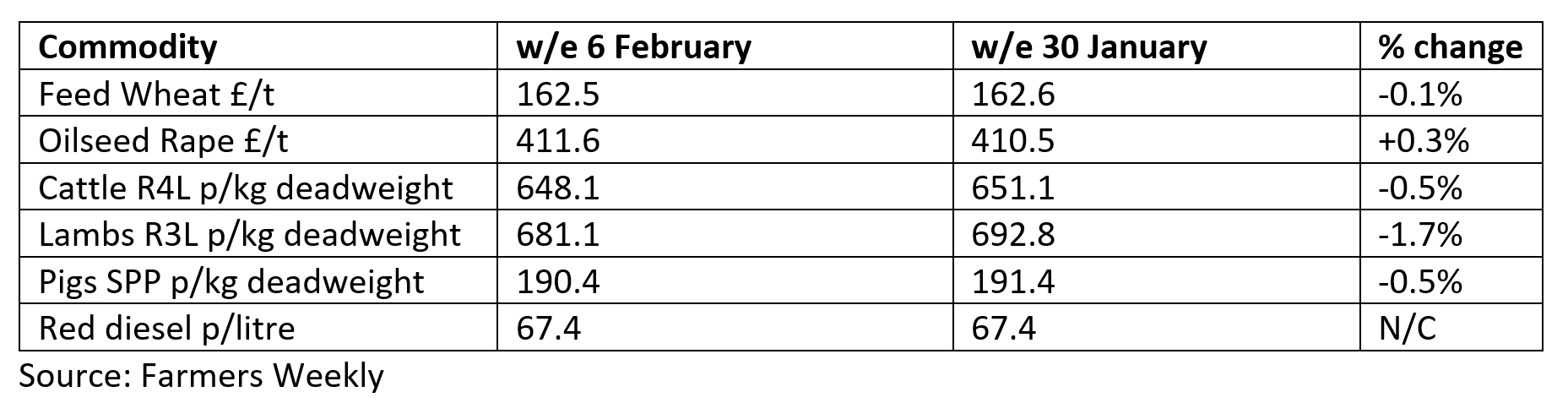
Wheat market bearish
The prospects for an imminent wheat price recovery look challenging, according to the latest data from the AHDB. A drop in demand, partly driven by the closure of the UK’s two bioethanol plants – one permanently – and potentially higher yields this season could lead to an exportable surplus. Therefore, as trader Frontier points out, at some stage domestic wheat prices will need to drop compared with other origins to become competitive.
The headline
More farms carbon positive
A large number of farms across the UK may already be carbon positive, according to the preliminary results from a baselining study of 170 farms across England, Scotland and Wales conducted by AHDB and Quality Meat Scotland.
Of the 147 farms whose results have been analysed so far, 21 are already capturing more carbon than they are emitting.
Over half of these farms were livestock units, a significant finding given that the red meat sector in the UK has been under intense pressure for its perceived contribution to the nation’s carbon emissions and impact on climate change.
News in brief
Landlord/tenant survey
Alan Laidlaw, the recently appointed Commissioner for the Tenant Farming Sector, is asking for the views of tenant farmers, landlords, agents and advisers. “We want to understand how familiar people are with the remit of my role and the code of practice,” he said. “Your responses will also help shape our future priorities and engagement, so we can focus our work where it will have the greatest impact in maintaining and improving behaviour across the sector,” he added. The survey closes on 6 March.
Nutrient planning tool
Defra has just launched a free nutrient management planning tool. By matching nutrient inputs such as nitrogen, phosphate, potash, sulphur and lime to crop and soil needs, the tool “helps farmers create, improve and revise nutrient management plans”. This will maximise nutrient availability for food production while reducing nutrient losses to water and air, says Defra.
Chlorinated chicken pledge
Four of the UK’s largest food retailers have pledged that they will not stock chlorine-washed chicken or hormone-treated beef even if it is allowed into the UK as part of a deal with the US. Aldi, Asda, the Co-op and Waitrose were responding to a public petition launched by campaign group 38 Degrees. Other supermarkets said they had no plans to stock the controversial products but didn’t categorically rule it out in the future.
Moorland burning appeal
The Moorland Association has decided to apply for permission to appeal following the High Court’s refusal to allow its judicial review of the controversial Heather and Grass Burning Regulations 2025 to proceed to a full hearing. The association claims the government failed to adequately address warnings from the emergency services that the extra restrictions on burning increased wildfire risks on moorland.
Burning not so bad for soil?
Meanwhile, a new study of global wildfires and controlled burning has concluded that soil flora and fauna may be more resilient to the impact of heat from such fires than previously thought. The study, recently published in the International Journal of Wildland, claims that the insulating effect of soil means extreme temperatures rarely reach deeper than 0.5cm.
No Lynx for Scotland
Speaking at the NFU Scotland conference last week, First Minister John Swinney reiterated the Scottish Government’s opposition to the reintroduction of Lynx to the country. Farmers are concerned that the big cat could prey on livestock, but advocates for the forest-dwelling feline claim it could help control deer numbers and that data on sheep predation is drawn from Scandinavia where keeping sheep in woodland is much more common.
Sheep shearer shortage
Highly experienced sheep shearers from New Zealand and Australia will no longer be allowed to enter the UK visa free this year. The annual visa concession application for up to 75 shearers, which has been approved since 2011, has just been rejected by the government. The National Sheep Association has warned that blocking the shearers, who between them shear up to two million UK sheep each year, could have an impact on livestock enterprises and sheep welfare.
Interview with Minette Batters
A reminder not to miss our thought-provoking interview with former NFU President Minette Batters. Baroness Batters talks in detail about why the 57 recommendations contained in her recently published Farming Profitability Review are so crucial to boosting the resilience of the country’s agricultural and food industries. Read highlights of the interview.
Rural Report out now
The Autumn Winter 25/26 edition of The Rural Report, Knight Frank’s thought-leadership publication for rural property owners and their advisors, is available now. Full of insight from leading landed estates and our Rural Consultancy experts, it’s a must-read.
Property markets Q4 2025
Farmland - prices stabilise
According to the Knight Frank Farmland Index, which tracks the value of bare agricultural land in England and Wales, the average price of land fell only marginally in the final quarter of 2025. However, diminishing farmer confidence and Inheritance Tax (IHT) worries saw prices slide by around 5% over the year. An acre is now worth just under £8,700. The government’s partial IHT U-turn just before Christmas should help stabilise prices during 2026.
Country houses - values slide
The Knight Frank Country House Index, which tracks the value of properties outside London above £750,000, lost 5.7% of its value in 2025 due to economic uncertainty and worries about what might be included in Labour’s second Autumn Budget. Properties classified as farmhouses were hit particularly hard, sliding by 7.3%. However, the market looks to be bottoming out with prices falling only marginally in the final quarter of the year and exchanges rising by 5%. Contact Tom Bill for more insight and data.
