

The Rural Update: Better landlord-tenant cooperation
Your weekly dose of news, views and insight from Knight Frank on the world of farming, food and landownership.
23 February 2026

Viewpoint
Unsurprisingly, given the drop in cereal prices, average farm rents are coming under pressure, according to the latest government data discussed below. With milk and pig prices also sliding this year, the trend could continue. This raises serious questions for those rural estates that rely on rents for a significant chunk of their income. One option could be to take land back in hand, but that brings its own issues. Another, as highlighted in the latest edition of The Rural Report, would be for landlords and tenants to work more closely together to create innovative business structures that deliver for each party. This week, Defra has asked rural businesses for their views on how it could shape its new Farmer Collaboration Fund. Greater landlord-tenant engagement could be a key piece of the jigsaw.
Commodity markets
Oil jitters
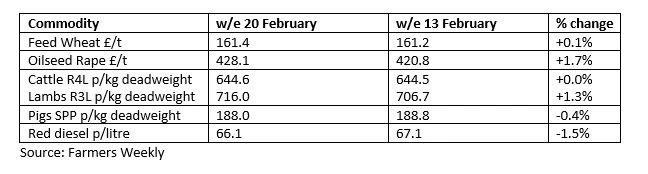
After pushing upwards towards the end of last week, oil prices dropped over 1% on Monday as the US and Iran prepared for a third round of nuclear talks, allaying concerns of an imminent American strike on the regime. Donald Trump’s fresh tariff hikes also created uncertainty for global growth and fuel demand. Brent crude futures slipped 1%, to just over US$71/barrel in early morning trading. However, investment bank Goldman Sachs has raised its Brent crude forecasts for the fourth quarter of the year by US$6 to US$60/barrel on the basis of lower OECD stocks.
Fertiliser fall
Last week, The Rural Update discussed the potential impact of the UK’s proposed Carbon Border Adjustment Mechanism (CBAM), due to be introduced next year, on fertiliser prices. However, growers may not have to wait that long to feel the pain, as the EU’s version, which kicked in at the beginning of 2026, is already having an impact. Figures from the EU Commission show an 80% fall in fertiliser imports during January. However, lobby group Fertilizers Europe says the January drop was really down to a huge volume of imports during December to beat the introduction of CBAM. Ammonium nitrate prices in the UK are up around 12% on the year.
The headline
AHA rents retreat
The average value of traditional Agricultural Holdings Act (AHA) tenancies fell by 6% last year to £174/ha (£70/acre), according to the latest Defra farm rental figures released last week. Adjusted for inflation, the drop rises to 10% in real terms.
Although the value of more flexible Farm Business Tenancies (FBT), introduced in 1995, rose by 4% to £230/ha (£93/acre), Defra describes this as a negligible change in real terms.
In real terms, the average rent for seasonal agreements rose by 4% to £253/ha (£102/acre), the highest level of the past decade.
Defra estimates that there were 83,300 farm tenancy agreements in England last year, a drop of 5% from 2024. The total amount of rent paid also fell 5% to £729 million.
English deer plan
Landowners whose inaction regarding the management of deer is ‘causing demonstrably negative impacts on publicly funded woodlands, biodiversity and public interests of adjoining land’, could be forced to take appropriate management measures as part of a raft of measures contained in the government’s newly published Deer impacts policy statement.
Around one-third of English woodlands are negatively impacted by deer, up from a quarter in the early 2000s.
Harry Howard-Jones of our Rural Consultancy team comments: “This policy paper signals a welcome shift towards supporting landowners to manage deer impacts more effectively, but its success will depend on practical licensing, sensible incentives and genuine landscape-scale collaboration across neighbouring farms and estates.”
News in brief
Chicken challenge
Controversy is brewing in the poultry sector as eight hospitality brands, including KFC, Wagamama and Nando’s, have announced the formation of the Sustainable Chicken Forum (SCF), while at the same time abandoning the Better Chicken Commitment (BCC). They claim the BCC is not viable because it forces them to use slower-growing breeds, which increase carbon emissions. Animal welfare groups, meanwhile, have described the SCF as ‘welfare-washing’.
Renters’ rights update
The owners and managers of rural estates with let residential portfolios are likely to be affected by the Renters’ Rights Act, the impacts of which will start kicking in from 1 May 2026. Join our upcoming webinar on 4 March, where Knight Frank lettings experts, Gary Hall and Beverley Kennard, will explain what the biggest overhaul of the private rented sector in decades, including the end of Section 21, updated possession grounds, new rules on rent increases and further changes will mean for you. Register now to get the support you need.
Lowland peat seminars
Farms and estates in England with lowland peat on their land, such as those in the Cambridgeshire Fens or on the Somerset Levels, can find out more about how a series of new grant schemes launching this year could help them by signing up to a Defra webinar on 25 February. Schemes covered include the Paludiculture and Wetter Farming Fund, which will support farmers growing conventional or specialist wetland crops.
Collaboration views sought
The government is seeking the views of English farmers on how it can best shape its £30 million Farmer Collaboration Fund, which was announced by Defra minister Emma Reynolds at last month’s Oxford Farming Conference. A series of workshops for farmers and landowners is being held around the country from 11 March to 14 April.
Chemical conundrum
While UK farmers worry about the impact of greater EU alignment on the availability of key crop-protection chemicals, US President Donald Trump has just taken the controversial step of issuing an executive order to ramp up the production of weedkiller glyphosate in the interests of national security. The move has upset supporters of the influential Make America Healthy Again (MAHA) movement. Chemical company Bayer says it expects to set aside over £10 billion to cover legal claims related to health issues allegedly caused by the use of Roundup, the firm’s glyphosate-based weedkiller.
Danish rewilding grant
Meanwhile, the European Commission has approved €1 billion of funding under state aid rules that the Danish government plans to spend as part of its pledge to turn 15% of the country’s farmland and forestry over to nature in a bid to cut water pollution and carbon emissions. Part of the cash will be used to cover the loss of income to farm businesses that voluntarily take land out of production.
Rural Report out now
The Autumn Winter 25/26 edition of The Rural Report, Knight Frank’s thought-leadership publication for rural property owners and their advisors, is available now. Full of insight from leading landed estates and our Rural Consultancy experts, it’s a must-read.
Property of the week
Icelandic equine opportunity
If the Winter Olympics have inspired you to head for cooler climes, this Icelandic property with stunning panoramic views could be just the ticket. Strandarhöfuð is a 593-acre farm in the V-Landeyjar region of South Iceland, conveniently located near the town of Hvolsvöllur. The land, almost 75 acres of which is currently cultivated with the potential for further expansion, is meticulously defined by fences and ditches. The soil quality is excellent, resulting in a verdant landscape. Strandarhöfuð has a modern five-bedroomed house and excellent equestrian facilities, including 36 stalls and an indoor riding hall. The guide price is £3 million. Please contact Jason Mansfield for more information.
The cultivated area spans approximately 30 hectares, with the potential for further expansion. The property offers breathtaking panoramic views in all directions.
Property markets Q4 2025
Farmland - prices stabilise
According to the Knight Frank Farmland Index, which tracks the value of bare agricultural land in England and Wales, the average price of land fell only marginally in the final quarter of 2025. However, diminishing farmer confidence and Inheritance Tax (IHT) worries saw prices slide by around 5% over the year. An acre is now worth just under £8,700. The government’s partial IHT U-turn just before Christmas should help stabilise prices during 2026.
Country houses - values slide
The Knight Frank Country House Index, which tracks the value of properties outside London above £750,000, lost 5.7% of its value in 2025 due to economic uncertainty and worries about what might be included in Labour’s second Autumn Budget. Properties classified as farmhouses were hit particularly hard, sliding by 7.3%. However, the market looks to be bottoming out with prices falling only marginally in the final quarter of the year and exchanges rising by 5%. Contact Tom Bill for more insight and data.
Development land - prices bottom
UK greenfield residential development land values fell 5% during 2025, but remained flat through the final quarter of the year, according to the latest instalment of the Knight Frank Residential Development Land Index. Uncertainty ahead of the Autumn Budget weighed on developers’ appetite for land, but positive signs are emerging. “The prevailing view is that Q4 2025 will mark the bottom of the market,” says Oliver Knight, Head of Res Dev Research.
