

The Rural Update: A positive start for 2026
Your weekly dose of news, views and insight from Knight Frank on the world of farming, food and landownership.
19 January 2026

Viewpoint
Much of the farming industry’s energy in 2025 was consumed by the battle against Rachel Reeves’s hated Inheritance Tax (IHT) reforms. Along with other government missteps, this soured farmer confidence and put investment plans on hold. Whether it was down to the government’s partial IHT U-turn just before Christmas, the replacement of unloved Defra Secretary Steve Reed with the reportedly more user-friendly Emma Reynolds, or just the advent of a new year, it was good to hear news from LAMMA, the UK’s largest farm machinery show, that suggests sentiment may be shifting. With banks once again vying with each other to lend to farmers, combined with the December cut to the Bank of England’s base rate, some attractive borrowing terms to fund on-farm investments are now available. But farmers should also take every chance to fight their corner, so hopefully a few more than just the 200 or so arable producers who have already contributed to Defra’s review of unfair practices in the cereal supply chain will grab the opportunity before the consultation closes on 4 February.
Sign up to receive this newsletter and other Knight Frank research directly to your inbox
Commodity markets
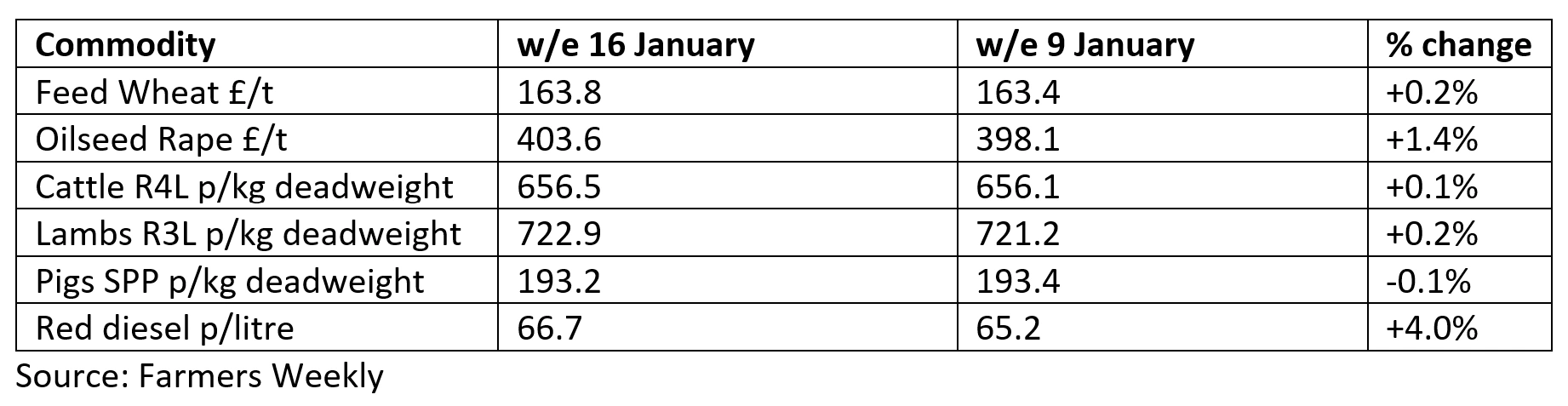
China/Canada OSR boost
A trade deal agreed between China and Canada last week could offer support for oilseed rape prices. Canada slashed its 100% import tariffs on Chinese EVs, imposed at the behest of the Biden administration, to just 6.1% for an initial annual quota of 46,000 cars. In return, China will reduce its tariff on Canadian canola (oilseed rape) imports from 84% to 15% from 1 March. A similar move on lobster and crab is also expected. The deal should support rape prices in the UK because European producers will face less pressure from Canadian crops that would have been looking for a home without the China deal.
The headline
Nature and energy infrastructure
Farmers in England and Wales could face challenges and opportunities as plans for a new national park and forest progress.
Following a review of the evidence and the findings from its 2025 statutory consultation, Natural Resources Wales agreed last week to make a designation order for the proposed Glyndŵr National Park.
The Welsh Government will now further consider the proposal for the national park, which is based on the existing Clwydian Range and Dee Valley National Landscapes. A public notice period, allowing the public to respond to the move, opened on 16 January and will close on 15 February.
In England, Defra has officially started the search for a delivery partner to help create a new national forest in the Oxford-Cambridge Growth Corridor.
The expressions of interest process opened last week and closes at the end of the month. Interested parties must demonstrate they have the “capacity, experience and knowledge to deliver the outcomes required for a new national forest, along with expertise in large-scale woodland creation, community engagement and cross-sector partnership”.
Meanwhile, landowners in the east of England could be affected by a proposed 93-mile hydrogen pipeline running between Immingham in the Humber to Newark in Nottinghamshire.
H2East Pipeline is the brainchild of Cadent, the UK’s largest gas distribution network operator, and will deliver low-carbon hydrogen to manufacturers of steel, chemicals, bricks and heavy industry. More detailed route plans will be announced later this year.
News in brief
Scottish farm budget flat
The Scottish Government confirmed last week that it will provide £660 million of support for farmers and crofters during the 2026/2027 financial year. This will include £26 million for “agricultural modernisation”. Direct support schemes, virtually eliminated in England following the phasing out of the Basic Payment Scheme, account for £540 million of the funding. Although the budget is unchanged from the previous year’s, critics said it represented a drop in real terms and provided little long-term confidence for producers.
LAMMA confidence
The mood was upbeat at last week’s LAMMA farm machinery show at the Birmingham NEC, according to Matt Clapp of Knight Frank’s specialist rural lending team, which was in attendance for the first time. “A lot of the people who spoke to us are planning investments into their farming businesses. They were also surprised at how much lending rates had fallen. Some of the banks we work with now are offering deals at just 1.1% over the base rate.” Please contact Matt for more information on the deals he can offer.
Tractor sales down
Machinery dealers will be hoping that the shift in sentiment on display at LAMMA translates into actual sales. The latest figures from the Agricultural Engineers Association reveal that tractor registrations in the UK have hit their lowest levels since records began and likely since WWII. Only 8,791 units were registered in 2025, a drop of 14%. However, the top of the market was even harder hit with the sale of tractors over 240 horsepower falling by almost a third.
Farmhouse values slide
The Knight Frank Country House Index, which tracks the value of properties outside of London above £750,000, lost 5.7% of its value in 2025 due to economic uncertainty and worries about what might be included in Labour’s second Autumn Budget. Properties classified as farmhouses were hit particularly hard, sliding by 7.3%. However, the market looks to be bottoming out with prices falling only marginally in the final quarter of the year and exchanges rising by 5%. Contact Tom Bill for more insight and data.
Grocery watchdog survey
Supermarket suppliers who feel hard done by may want to consider taking the Groceries Code Adjudicator’s annual survey. The confidential survey, which closes on 22 February, allows suppliers to the UK’s 14 largest supermarkets to share their views on whether the retailers are complying with the Groceries Supply Code of Practice. Last year’s survey results showed a slight drop in compliance problems, but 30% of respondents still reported code issues.
Cereal chain fairness chance
Arable farmers, meanwhile, are being urged to contribute to Defra’s review of unfair practices in the combinable crops sector. As reported by Farmers Weekly, a consultation launched in December as part of the review has only received 200 responses so far. The consultation closes on 4 February.
Rural Report out now
The Autumn Winter 25/26 edition of The Rural Report, Knight Frank’s thought-leadership publication for rural property owners and their advisors, is available now. Full of insight from leading landed estates and our Rural Consultancy experts, it’s a must-read.
Property of the week
Rare vineyard opportunity
What better way to thumb your nose at Dry January than by starting your own vineyard? Knight Frank’s viticulture team is just about to launch a rare opportunity on one of southern England’s most prestigious estates. The Firle Estate near Lewes, in East Sussex, is looking for a long-term partner to develop a vineyard on 28 acres of land identified as having excellent winemaking potential. The wine produced could be sold through the estate’s extensive hospitality enterprises, while the renovation of a walled garden in Firle village may offer exciting options for a tasting and retail site. For more information and details of the tender process, please contact Bertie Gilliat-Smith.
Discover more of the farms and estates on the market with Knight Frank
Property markets Q4 2025
Farmland - prices stabilise
According to the Knight Frank Farmland Index, which tracks the value of bare agricultural land in England and Wales, the average price of land fell only marginally in the final quarter of 2025. However, diminishing farmer confidence and Inheritance Tax (IHT) worries saw prices slide by around 5% over the year. An acre is now worth just under £8,700. The government’s partial IHT U-turn just before Christmas should help stabilise prices during 2026.
