
The Rural Update: Wishing for a more positive outlook in 2026
Your weekly dose of news, views and insight from Knight Frank on the world of farming, food and landownership.
22 December 2025

Viewpoint
The Rural Update will be taking a short break over the festive period, so I would like to take this opportunity to wish you a very happy Christmas and New Year. Looking back, 2025 has certainly been a challenging year with the weather and policymakers both seemingly wanting to make life as difficult as possible for farms and rural estates. It has, however, ended on what could be a more positive note.
If the government is prepared to act on the recommendations contained in Minette Batters’ insightful and thought-provoking Farming Profitability Review, the future could be much brighter. Significant changes to the planning system, which were also announced last week, could be extremely helpful for rural businesses, while harsher penalties for those found worrying livestock acknowledge the growing issues many farmers have to face on a daily basis.
The spectre of Inheritance Tax reform has, of course, not gone away, but it seems unlikely that the government is going to make a U-turn, so as an industry we need to start planning for it as best we can. I hope you find this weekly update informative and useful, and I look forward to sharing more of our insights with you in 2026.
Sign up to receive this newsletter and other Knight Frank research directly to your inbox
Commodity markets
And the top performer is….
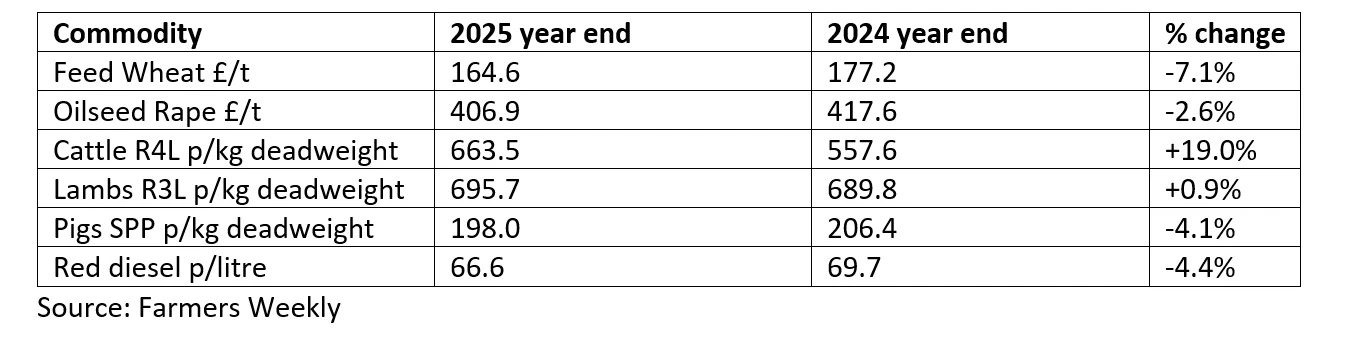
Looking back at the performance of agricultural commodity markets during 2005, one sector stands out. Beef prices have risen by almost 20% over the year on the back of falling supply and firm demand. Unlike arable, dairy and pork values, which are much more at the mercy of global events and markets, the factors driving beef prices are largely domestic. Unattractive prices a few years ago (at the end of 2023 they were 492p/kg) had already encouraged farmers to cut production, and this was exacerbated by the exceptionally dry weather over the summer. Although there has been angst in the media about the rising cost of beef, it could be argued that it is actually a case of shoppers paying the true value of food.
The headline
Batters’ review published
Former NFU President Minette Batters’ government-commissioned Farming Profitability Review was at last published last week.
Cynics had suggested that the review, which was submitted by Baroness Batters in October, was delayed until after the Autumn Budget due to its brief but pointed reference to Chancellor Rachel Reeves’s deeply unpopular reforms to the Inheritance Tax (IHT) regime.
The 155-page document, which the Baroness encourages people to read in full, contains 57 recommendations.
These are underpinned by a call for greater recognition of the farming industry’s wider contribution to the UK’s GDP, which goes far beyond agriculture’s oft-quoted 0.6% share.
More joined-up government thinking, reducing policy uncertainty, greater supply chain fairness, a review of investment incentives for agriculture and ramping up the focus on skills, innovation and productivity, will also be crucial, the review says.
At a time when farmers are facing significant structural and economic pressures, Baroness Batters’ recommendations for closer alignment between agricultural and economic policy, improved supply chain transparency and a fairer distribution of risk and reward point toward a more resilient and commercially confident sector.
BNG rules changed
The government has confirmed that small housing developments of up to 0.2 hectares will now be exempted from Biodiversity Net Gain (BNG) rules as part of its bid to build 1.5 million new homes by the end of this parliament.
Under BNG, any developer must pay to replace natural habitats destroyed by their projects, plus the creation of an additional 10% of new habitat.
Conservation bodies, such as The Wildlife Trusts, have lambasted the move, claiming it will destroy the BNG market, but others say it will affect only a relatively small area of land.
Mark Topliff, our natural capital specialist , said: “It was always going to be a compromise; it was just a question of where the government were going to draw the line.
“Off-site habitat banks will be disappointed that the exemption area will increase, while some developers will think it hasn't gone far enough.
“However, the easements being hinted at for medium-sized development sites may just allow a bit more flexibility in the BNG market for both sides.”
A full response to the government’s consultation on reforming the BNG regime, including the treatment of a new category of medium-sized developments (10 to 49 homes), and applying BNG to Nationally Significant Infrastructure Projects (NSIPs), is set to be published next year.
News in brief
WWF slams farming board
Following the publication of the Farming Profitability Review, Defra Secretary Emma Reynolds has already announced the creation of a new Farming and Food Partnership Board, which she will be chairing. She said: “Baroness Batters’ review underlines the need for government, farming and the food industry to work much more closely together. That is exactly what the new board will do. This is about serious action so farm businesses can grow, invest and plan for the future with confidence.” However, environmental NGO WWF has already criticised the board for appearing not to include wildlife charities and ecologists.
Planning framework changes
In addition to the BNG changes mentioned above, the government has also just launched a consultation on revamping the National Planning Policy Framework. Proposals include planning reforms that will “support farmers and rural communities to grow, diversify and thrive”. The changes will make it clear that the infrastructure needed by the farming industry, like on-farm reservoirs, greenhouses, polytunnels and farm shops, should be supported by local councils.
Planning bill approved
Meanwhile, the Planning and Infrastructure Bill, which the government claims will also speed up the delivery of crucial new housebuilding and infrastructure, such as reservoirs, while still protecting nature, received Royal Assent last week. Among other things, the passing of the bill will see the introduction of a national Nature Restoration Fund, into which developers can contribute, instead of implementing individual measures to mitigate the impact of their developments on nature.
SFI small farmer focus
Farming Minister Angela Eagle told a meeting of parliament’s Environmental, Food and Rural Affairs committee (EFRA) last week that the next iteration of the Sustainable Farming Incentive (SFI) must do more to help smaller farming businesses and be simpler to join. Dame Angela noted that a quarter of SFI funding went to just 4% of farms. The SFI, which was abruptly closed last March, is due to be relaunched in April 2026.
Festive veg wars
The price of vegetables has hit a record low as retailers fight to offer the cheapest Christmas lunch. Bags of carrots, potatoes, parsnips, sprouts and whole swedes are selling for just 5p in Morrisons, Lidl and Aldi. The firms claim the deals are not at the expense of farmers, but as reported in The Grocer magazine, British Growers Association CEO John Walgate said: “The concern is that this puts unrealistic expectations in the minds of consumers of the real cost of food production.”
Livestock worrying fines
A £1,000 cap on fines to those found guilty of worrying livestock has been removed as part of new laws introduced last week. Under the Dogs (Protection of Livestock) (Amendment) Act 2025, dog owners now face unlimited penalties. The police will also have greater powers to investigate and prosecute suspected offenders, including the option to detain dogs believed to pose an ongoing threat to livestock.
Animal welfare review
The harsher livestock worrying penalties are part of the government’s wider Animal Welfare Strategy for farmed livestock, pets and wild animals, which was announced yesterday (22 December). Measures include proposals to ban trail hunting and the use of snares, reforms to dog breeding practices and introducing humane slaughter requirements for farmed fish.
Solar surge
The amount of electricity produced from solar panels in the UK jumped sharply in 2025 as installed capacity rose 18% from 20 GW to almost 24 GW, and sunshine hours hit record levels. According to the National Energy System Operator (NESO), over 18,000 GWh of power was generated compared with just over 14,000 GWh in 2024. The majority of the extra generating capacity (2.5 GW) is projected to come from controversial ground-mounted solar farms, compared with 1.1 GW from installations on residential and commercial buildings. Please contact Chris Monkhouse for advice on your renewable energy projects.
Rural Report out now
The Autumn Winter 25/26 edition of The Rural Report, Knight Frank’s thought-leading publication for rural property owners and their advisors, is available now. Full of insight from leading landed estates and our Rural Consultancy experts, it’s a must-read.
Properties of the week
Stunning equine facility
If you’ve not yet chosen a Christmas gift for the horse lover in your life, Fawley House Stud, high on the Lambourn Downs, could be just what you are looking for. The 123-acre property, near Wantage, Oxfordshire, which boasts a distinguished racing pedigree, includes 52 boxes and an indoor school. The main house is a stunning 10-bay, timber-framed, five-bed barn conversion. The guide price is £4.9 million. For more information, please contact Will Matthews.
Historic Kent estate home to rent
Knight Frank’s Rural Consultancy team in Kent has an intriguing option on offer. Newhouse at Mersham, near Ashford, which was once home to Countess Mountbatten of Burma and Lord Brabourne, is part of the idyllic 2,700-acre Hatch Park Estate. Now available to rent, the nine-bed period property costs £6,995 a month. For more information, please contact Katie Bundle.
Discover more of the farms and estates on the market with Knight Frank
Property markets Q3 2025
Development land – Market hiatus
Greenfield and urban brownfield land values remained flat in Q3, according to the Knight Frank Residential Development Land Index, taking the annual price decline to 5%. At a national level, housebuilders are deferring many decisions until after the Autumn Budget, when reforms to taxation and planning may clarify the government’s policy direction. The prevailing uncertainty is likely to weigh on delivery for several quarters. Some 43% of respondents to Knight Frank’s survey of more than 60 small and volume housebuilders expect housing starts to fall through the fourth quarter of the year, while 45% expect land values to fall further.
Farmland – Prices dip
According to the Knight Frank Farmland Index, which tracks the value of bare agricultural land in England and Wales, the average price of land fell by just 1.6% to £8,719/acre over the third quarter of the year. That equates to an annual fall of 6.8%. As ever, the market remains highly localised, and where there is competitive bidding, prices have even been going up in some locations. Download the full report for more insight and data.
Country houses – Budget uncertainty
The average price of country houses has fallen by 5.4% so far this year, according to the Q3 edition of the Knight Frank Prime Country House Index. Properties worth below £1 million dropped by 4.7%, while those worth over £1 million lost 6.7% of their value. Owners of higher-priced properties are particularly concerned about any further property taxes being announced by Rachel Reeves as part of her Autumn 2025 Budget, which is due to be delivered at the end of November, points out Tom Bill, Head of UK Residential Research.
