
The Rural Update: Government needs to see the bigger picture
Your weekly dose of news, views and insight from Knight Frank on the world of farming, food and landownership.
16 December 2025

Viewpoint
If there’s an idiom that best applies to the country’s rural policymakers at the moment, ‘not seeing the wood for the trees’ could well be it. Last week’s announcement that Defra is consulting on ways to make the combinable crops supply chain fairer is welcome and overdue - farmers have long complained that they are unfairly penalised by some grain buyers.
Launching the consultation, Farming Minister Angela Eagle was absolutely right when she said: “Our strong food system needs to be built on solid foundations with farmers treated fairly.” But farmers will argue that it is the government that has done the most damage to those foundations by reducing the confidence of the UK’s agricultural sector to invest in the future, with its introduction of the ‘family farm tax’ and the botched handling of environmental support schemes.
Any watering down of Biodiversity Net Gain requirements, which could be announced later this week, will be another example of how much of Defra’s good work on the margins is easily undone by broader policymaking.
For their part, farmers should look for ways to reimagine their futures and become less reliant on government support and traditional commodity crops like wheat, where only the most efficient will be able to make a margin when global markets hit the doldrums.
As reported below, in response to climate change, a farmer in the Fens has just delivered the UK’s first commercial olive harvest. Producers as well as the government need to look at the bigger picture.
Sign up to receive this newsletter and other Knight Frank research directly to your inbox
Commodity markets
Grains and seeds bearish
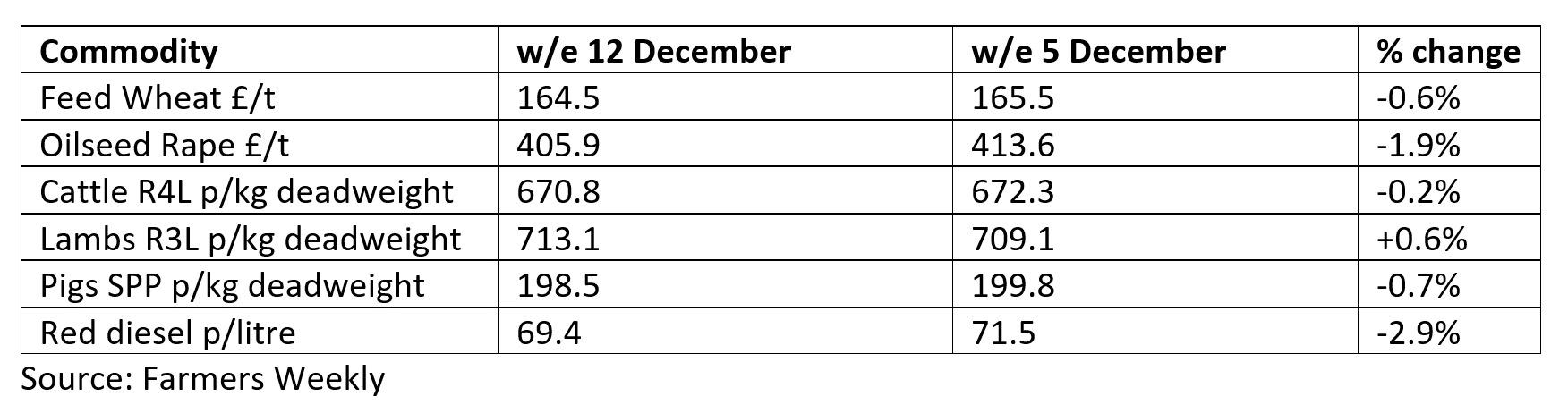
The latest WASDE supply and demand numbers from the USDA have put more downward pressure on global cereal and oilseed markets. Global wheat production is set to hit a record high of 838 million tonnes with several countries, including Canada, Argentina and India, set for their best-ever harvests. Significantly larger canola harvests in Australia and Canada are also hitting oilseed rape prices.
UK harvest finals
Meanwhile, Defra has just released its final estimates for the UK’s 2025 harvest. Wheat output was up 7.3% on the year to 12 million tonnes. This was due to a 9% increase in planted area to 1.7 million hectares, although this was tempered by a 1.7% decrease in yields to 7.2 t/ha. Although the area of oilseed rape harvested fell by 18%, a 30% hike in yields saw output rise 7% to 893,000 tonnes. According to the government’s latest Agricultural Land Use Survey, which was also released last week, the total area of the UK under arable crops fell 1% to 4.1 million hectares in 2025. Cereals, however, rose by 1.6% to 3 million hectares.
The headline
A fairer cereal chain
Defra has just launched a consultation on how arable farmers can be better protected from unfair practices in the combinable crops supply chain.
The eight-week consultation will “seek views on issues such as clarity of standards, sampling and testing procedures, supply volumes, data sharing and dispute resolution, to inform proposals for clearer contracts and fairer treatment for producers”.
Farming Minister Angela Eagle said: “Farmers should have confidence that the contracts they sign are fair and transparent and work as they should.”
“Our strong food system needs to be built on solid foundations, with farmers treated fairly. This consultation is a chance for growers to tell us where changes are needed in their supply chain.”
“By improving clarity and ensuring fair and transparent contracts, we’re backing British producers through our Plan for Change, strengthening our food security and supporting a resilient future for the sector.”
The consultation closes on 4 February.
News in brief
Scots’ small farm support
The Scottish government has just launched a £500,000 capital grants initiative to help small food producers. Under the Small Producers Pilot Fund, grants will help smaller farms, crofts, horticultural enterprises and local food producers invest in equipment, storage or processing facilities that strengthen their resilience and support sustainable growth. To qualify, businesses must be smaller than 30 hectares and have a turnover under £2 million.
Small abattoir boost
Hygiene and vet inspection fees for under-threat small abattoirs could be slashed under new proposals from the Food Standards Agency (FSA) that will be consulted on in the New Year. The smallest abattoirs – those processing up to 1,000 livestock Units per year for red meat, or 150,000 birds annually for poultry – would receive maximum support, with a 90% discount on charges.
Cultured meat review
The FSA has also just published its first guidance on how it plans to categorise cultured meat products once they are approved for human consumption in the UK. It has confirmed that cell-cultivated products produced using animal cells, sometimes called ‘lab-grown meat’, will be defined as products of animal origin. This means that businesses must apply existing food safety regulations during the production process. Some farmers are worried that lab-grown meat will put further pressure on prices. Italy implemented a ban in 2023.
Nature contract barrier
The government’s revised Environmental Improvement Plan, released two weeks ago, included some eye-catching numbers, one of which was a £500 million, 20-year funding commitment to the Landscape Recovery Scheme. However, critics have pointed out that this amounts to a relatively small amount annually. They have also noted that the government is now planning to insert a clause into contracts that will allow it to terminate any agreements with just one year’s notice. Environmental organisations are also concerned that the government could water down Biodiversity Net Gain regulations later this week.
First olive harvest
A Lincolnshire farming business has just bottled the UK’s first commercial pressing of olive oil. The Hoyle family, which has been farming near Spalding for 250 years, planted a 10-hectare olive grove and set up the English Olive Company in 2024 after changing climatic conditions prompted them to investigate new crops and income streams.
Wind power surge
Wind was the primary source of electricity generation in Britain for the fourth consecutive month during November, according to the National Energy System Operator (NESO). It provided 37% of the total supply, with gas second at 27%. NESO says it has also cleared the way for more renewable power by removing 300 GW of stalled projects from the grid connection queue.
ICE ban under pressure
The EU is expected to announce a U-turn later this week on its plans to ban the sale of cars and vans powered by petrol and diesel from 2035. Under pressure from Germany, whose auto industry employs over 700,000 people, the deadline could be extended to 2040 or scrapped altogether for the most efficient internal combustion engines. How the UK will react remains to be seen, but the government has stated that it remains committed to its own targets of scrapping the sale of new petrol and diesel car sales by 2030 and hybrids by 2035.
Rural Report out now
The Autumn Winter 25/26 edition of The Rural Report, Knight Frank’s thought-leading publication for rural property owners and their advisors, is available now. Full of insight from leading landed estates and our Rural Consultancy experts, it’s a must-read.
Properties of the week
Stunning equine facility
If you’ve not yet chosen a Christmas gift for the horse lover in your life, Fawley House Stud, high on the Lambourn Downs, could be just what you are looking for. The 123-acre property, near Wantage, Oxfordshire, which boasts a distinguished racing pedigree, includes 52 boxes and an indoor school. The main house is a stunning 10-bay, timber-framed, five-bed barn conversion. The guide price is £4.9 million. For more information, please contact Will Matthews.
Historic Kent estate home to rent
Knight Frank’s Rural Consultancy team in Kent has an intriguing option on offer. Newhouse at Mersham, near Ashford, which was once home to Countess Mountbatten of Burma and Lord Brabourne, is part of the idyllic 2,700-acre Hatch Park Estate. Now available to rent, the nine-bed period property costs £6,995 a month. For more information, please contact Katie Bundle.
Discover more of the farms and estates on the market with Knight Frank
Property markets Q3 2025
Development land – Market hiatus
Greenfield and urban brownfield land values remained flat in Q3, according to the Knight Frank Residential Development Land Index, taking the annual price decline to 5%. At a national level, housebuilders are deferring many decisions until after the Autumn Budget, when reforms to taxation and planning may clarify the government’s policy direction. The prevailing uncertainty is likely to weigh on delivery for several quarters. Some 43% of respondents to Knight Frank’s survey of more than 60 small and volume housebuilders expect housing starts to fall through the fourth quarter of the year, while 45% expect land values to fall further.
Farmland – Prices dip
According to the Knight Frank Farmland Index, which tracks the value of bare agricultural land in England and Wales, the average price of land fell by just 1.6% to £8,719/acre over the third quarter of the year. That equates to an annual fall of 6.8%. As ever, the market remains highly localised, and where there is competitive bidding, prices have even been going up in some locations. Download the full report for more insight and data.
Country houses – Budget uncertainty
The average price of country houses has fallen by 5.4% so far this year, according to the Q3 edition of the Knight Frank Prime Country House Index. Properties worth below £1 million dropped by 4.7%, while those worth over £1 million lost 6.7% of their value. Owners of higher-priced properties are particularly concerned about any further property taxes being announced by Rachel Reeves as part of her Autumn 2025 Budget, which is due to be delivered at the end of November, points out Tom Bill, Head of UK Residential Research.
