

The Rural Update: Family farm tax misconceptions remain
Your weekly dose of news, views and insight from Knight Frank on the world of farming, food and landownership.
02 December 2025
Viewpoint
“Reforms announced at Autumn Budget 2024 will help raise money to fix the public finances while protecting small family farms from unfairly high inheritance tax.” Those are the exact words used to headline an article on the government’s website explaining the impact of the changes (discussed below) Chancellor Rachel Reeves made to her family farm tax in last week’s Budget. When even the government that introduced the tax feels compelled to label it as “unfairly high”, why was Reeves not scrapping it instead of just tweaking it? The article also clings to the notion, ably dispelled by organisations such as the CLA, NFU and CAAV, that a significant majority of farms will not be affected by the changes to Inheritance Tax. Family farms are typically commercial businesses with huge amounts of capital tied up in machinery, plant and stock, as well as land, all of which will contribute to any Inheritance Tax valuations. Yet again, the government is showing its failure to understand the realities of modern agriculture and the true nature of family farms.
Sign up to receive this newsletter and other Knight Frank research directly to your inbox
Commodity markets
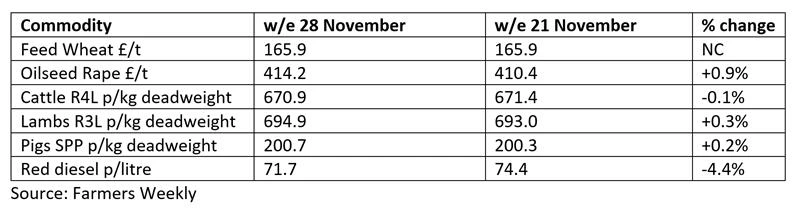
Ag inflation update
According to Defra’s latest Agricultural Price Indices data, the increase in the value of agricultural outputs slightly outpaced the rise in inputs over the past year. In the 12 months to the end of September, the price index for outputs was up by 5.1%. The biggest contributors were cattle & calves (+4.2%), milk (+1.3%) and fresh fruit (+0.6%). Wheat fell by 0.8%. In terms of inputs, overall prices rose by 2% over the same period. Fertilisers & soil improvers were up 1.6%, but compound feed dropped 0.6%.
The headline
IHT changes detailed
The government is claiming that an additional 60 farming estates a year will no longer pay any Inheritance Tax (IHT) and 130 will pay less, following changes included in last week’s Autumn Budget.
As part of her controversial speech, Chancellor Rachel Reeves announced that the £1 million allowance for agricultural property relief and business property relief will be transferable between spouses and civil partners, to bring it in line with the treatment of the nil-rate band and residence nil-rate band.
This change will apply to widows and widowers, including those where the first death was many years before 6 April 2026, which is when the hated family-farm tax is due to take effect.
It also does not matter if the first spouse to die owned the farm or other agricultural assets, the government says.
Including the £325,000 nil-rate band, this means that a surviving spouse can pass on £2.65 million free of IHT to their beneficiaries.
The government claims only “375 of the wealthiest estates claiming agricultural property relief, including those that also claim for business property relief”, are now likely to be liable to pay IHT. It reckons almost 75% of estates will escape the tax altogether.
News in brief
New environmental plan
A revised Environmental Improvement Plan for England was published by Defra yesterday (1 December). The five-year roadmap includes new targets for cutting air pollution by 30% and creating or restoring 250,000 hectares of wildlife-rich habitats, 110,000 hectares more than had previously been committed. There is also a new target to halve the presence of damaging invasive species compared with 25 years ago.
Read The Rural Report for details of a major natural capital investment opportunity.
Batters’ tenancy call
Minette Batters has revealed more of the recommendations contained in her Farming Profitability Review, which Defra has yet to publish. Baroness Batters said the new Tenant Farming Commissioner should have statutory powers to intervene in disputes between landlords and tenants. In addition, only “active” farmers should have access to new support schemes, she reckoned.
Unfair dismissal change
Farms and estates could benefit from a watering down of some of the proposed changes contained in the Employment Rights Bill. In order to get the bill through parliament on schedule, the government has bowed to pressure from industry and peers and scrapped the right of employees to claim unfair dismissal from day one of a new job. The right, which currently kicks in after 24 months, will now take effect after six months.
Pig disease worries
Spain, the EU’s largest pork producer, has just announced its first cases of African swine flu (ASF) in over 30 years. If the outbreak in a herd of wild boar disrupts the country’s significant export trade with China, surplus meat will be looking for a new home, which could pile more pressure on pork prices here. The National Pig Association says it is concerned that weak controls at the UK’s borders make its members vulnerable to the disease, which is now present in 13 EU countries. The UK is currently classified as ASF-free.
Bluetongue in Northern Ireland
Meanwhile, Northern Ireland’s Department of Agriculture, Environment and Rural Affairs has just confirmed the likely presence of bluetongue disease in two cows from a farm near Bangor, County Down. A 20km Temporary Control Zone (TCZ) has been introduced, and movements of susceptible species (cattle, sheep, goats, deer and llamas/alpacas) on or off premises within the TCZ are now prohibited while officials carry out further investigations. It marks the first time the disease has been recorded on the island of Ireland.
Climate change threat
A new report from the OECD claims that climate change is likely to overtake land-use change as the main driver of biodiversity loss by 2050. Outlook on the triple planetary crisis: Stakes, evolution and policy linkages calls for much greater coordination regarding measures to mitigate the three-pronged impact of climate change, land-use change and pollution. It says, for example, that expanding the use of renewable energy may have an adverse impact on biodiversity.
Trees to replace oil
Such issues may also hang over the EU’s ambitious new bioeconomy strategy that aims to ramp up the production of wood-based organic materials as an alternative to things like plastic packaging and synthetic textiles. This, it says, would help mitigate climate change by cutting fossil-fuel usage as well as reducing the bloc’s dependency on oil and gas imports. Although the strategy, which is aspiration-heavy and detail-light, has been welcomed by some, others have pointed out that there is already a finite source of trees in the EU and focusing on increasing the use of wood in construction would be more sensible.
Rural Report out now
The Autumn Winter 25/26 edition of The Rural Report, our thought-leading publication for rural property owners and their advisors, is available now. Full of insight from leading landed estates and our Rural Consultancy experts, it’s a must-read.
Properties of the week
Hants organic land available
Two picturesque organic farms at Overton, near Basingstoke, formerly part of racing driver Jody Scheckter’s Laverstoke Estate, are attracting firm interest. Turrill Hill is a 946-acre unit that includes three farm cottages, a wide range of livestock buildings, 607 acres of arable land, 208 acres of pasture and 106 acres of woodland. The guide price is £14 million. Berrydown Farm, priced at £8 million, comes with a four-bed brick-and-flint house, 431 acres of mixed farmland and 64 acres of woodland. For more information, please contact Will Matthews.
Historic Kent estate home to rent
Knight Frank’s Rural Consultancy team in Kent has an intriguing option on offer. Newhouse at Mersham, near Ashford, which was once home to Countess Mountbatten of Burma and Lord Brabourne, is part of the idyllic 2,700-acre Hatch Park Estate. Now available to rent, the nine-bed period property costs £6,995 a month. For more information, please contact Katie Bundle.
Discover more of the farms and estates on the market with Knight Frank
Property markets Q3 2025
Development land – Market hiatus
Greenfield and urban brownfield land values remained flat in Q3, according to the Knight Frank Residential Development Land Index, taking the annual price decline to 5%. At a national level, housebuilders are deferring many decisions until after the Autumn Budget, when reforms to taxation and planning may clarify the government’s policy direction. The prevailing uncertainty is likely to weigh on delivery for several quarters. Some 43% of respondents to Knight Frank’s survey of more than 60 small and volume housebuilders expect housing starts to fall through the fourth quarter of the year, while 45% expect land values to fall further.
Farmland – Prices dip
According to the Knight Frank Farmland Index, which tracks the value of bare agricultural land in England and Wales, the average price of land fell by just 1.6% to £8,719/acre over the third quarter of the year. That equates to an annual fall of 6.8%. As ever, the market remains highly localised, and where there is competitive bidding, prices have even been going up in some locations. Download the full report for more insight and data.
Country houses – Budget uncertainty
The average price of country houses has fallen by 5.4% so far this year, according to the Q3 edition of the Knight Frank Prime Country House Index. Properties worth below £1 million dropped by 4.7%, while those worth over £1 million lost 6.7% of their value. Owners of higher-priced properties are particularly concerned about any further property taxes being announced by Rachel Reeves as part of her Autumn 2025 Budget, which is due to be delivered at the end of November, points out Tom Bill, Head of UK Residential Research.
