

A year that forced rural businesses to act
The past year has not been defined by a single shock for rural Britain, but by the steady accumulation of pressure.
23 December 2025
Decisions that had been deferred for years are now being brought forward, not because conditions have improved, but because standing still has become harder to justify.
Drawing on conversations with landowners, farmers and estate businesses across the country, our rural team have seen how long-standing challenges have begun to converge. Inheritance tax reform and rising costs have brought difficult questions to the surface, while regulatory change and subdued markets have narrowed room for manoeuvre. Together, they have created an environment where delay increasingly carries its own risk.
What has emerged is not a sudden shift in confidence, but a change in behaviour. Viability is being reassessed, uncomfortable realities confronted and decisions taken on the basis of current conditions rather than future reassurance. For many, this past year has marked the point at which waiting stopped being neutral and started to shape outcomes.
Succession conversations are being forced earlier
That urgency is most clearly visible in succession planning. Inheritance tax has acted as a catalyst for conversations that many families had managed to defer, often for decades. Claire Whitfield, Partner, says that while some families are still reluctant to engage, many have been forced into discussions they might otherwise have postponed indefinitely.
“Out of all the challenges around inheritance tax, what it has really created is a need for families to talk,” she says. “Some were putting off discussions about succession and what the future looked like, but this has forced them to broach the subject. And actually, it’s far better to do that in life rather than in death.”

Viability is replacing tradition as the priority
Once those conversations begin, they tend to move quickly beyond ownership into more fundamental questions about viability. Claire says the removal of reliable support mechanisms has sharpened focus on what genuinely works within a business.
“Farmers can no longer rely on being supported in the way that they were. They need to have a hard look at what works for their business and what doesn’t. There’s no point running something that isn’t viable. A business has to be profitable if it’s to sustain itself and the people around it.”
The process has been uncomfortable, but she believes it has also brought a degree of clarity and control back into decision making.
“People are being forced to plough their own furrow. That brings pain, but it also brings autonomy.”
A land market that functions, but without momentum
That same realism is evident in the land and estates market. Activity has not stopped, but it has become highly selective, with progress dictated less by sentiment and more by pricing discipline. Will Matthews, Head of Farms & Estates Sales, describes a year that functioned without momentum.
“There were enough transactions that you could just about get away with it,” he says, “but there’s been no real churn. No sense of energy in the market.”
With few owners under pressure to sell and a buyer pool that remains narrow, misaligned expectations have become the biggest obstacle.
“We’re dealing with the same buyers we’ve seen for the last ten years. There are very few new entrants, and very few people who actually need to sell,” Will says. “That sounds positive, but it does mean things just sit there.”
Pricing discipline is determining outcomes
Pricing, he adds, is where most deals succeed or fail.
“If you go out at the right price, you will sell. If your head is still in Covid pricing, it will just sit. For high quality arable land, £11,000 - £12,000/acre is a good result now.”
Capital is still available, but confidence remains fragile.
“There is massive wealth out there. The issue isn’t money, it is sentiment,” he says. “The UK is simply less attractive than it was.”
Financial pressure is driving structural reviews
Financial pressure has changed the nature of advisory work coming forward. James Shepherd, Partner, says 2025 has seen a rise in strategic portfolio reviews, particularly for institutional landowners, driven by concerns around cash flow, efficiency and the risk of assets becoming a future liability.
“Clients are worried about consolidation and costs they may not be able to fund in the future,” he says.
What has shifted is how quickly those reviews translate into decisions. Greater use of data and digital tools is helping clients understand their options more clearly and move faster once the information is assembled.
“Once the data is on the table, the conversation changes very quickly,” James says. “It stops being about possibilities and becomes about priorities.”
With little expectation of external support easing pressure, analysis is increasingly followed by action. “There’s no one coming around the corner with a bucket of money,” he adds. “Decisions have to be made.”
Natural capital expectations have reset
That same realism has also tempered expectations around environmental markets. James says the wider mood around natural capital has shifted, shaped by slower development activity and a more cautious policy environment, which has reduced the level of demand many had anticipated.
“The idea that nature markets would bail out UK agriculture hasn’t materialised,” he says. “That expectation has eroded pretty quickly.”
While biodiversity net gain and other mechanisms remain in place, he says the pace at which private finance has come forward has been slower than predicted, forcing a reassessment of how these opportunities are used.
“Natural capital still has a role,” James says. “But it works best as part of a resilience strategy. It should be a bonus, not the basis for decision making.
Regulation and costs are adding complexity to decision making
Alongside these financial pressures, regulation has become a more immediate and sometimes contradictory influence on behaviour. Jess Waddington, Partner, highlights housing regulation as an area where policy intent and lived experience do not always align.
“We’re seeing real examples where tenants want long term security, but the removal of fixed terms actually makes them feel less secure,” she says. “Lots of tenants liked renegotiating three-year agreements with fixed rent increases. Taking that away removes stability that both sides valued.”
Rising employment costs are feeding through quickly as well, affecting both estate-run enterprises and the businesses that operate from rural property.
“Minimum wage and national insurance rises have a big impact on our clients’ businesses, but also on hospitality, leisure and agricultural businesses operating out of their properties,” Jess says.
Against this backdrop, she argues that understanding the asset base has become fundamental rather than administrative.
“To truly manage your business, you need to understand what you actually have and how you measure it,” she says.
English wine highlights the risks and opportunities of oversupply
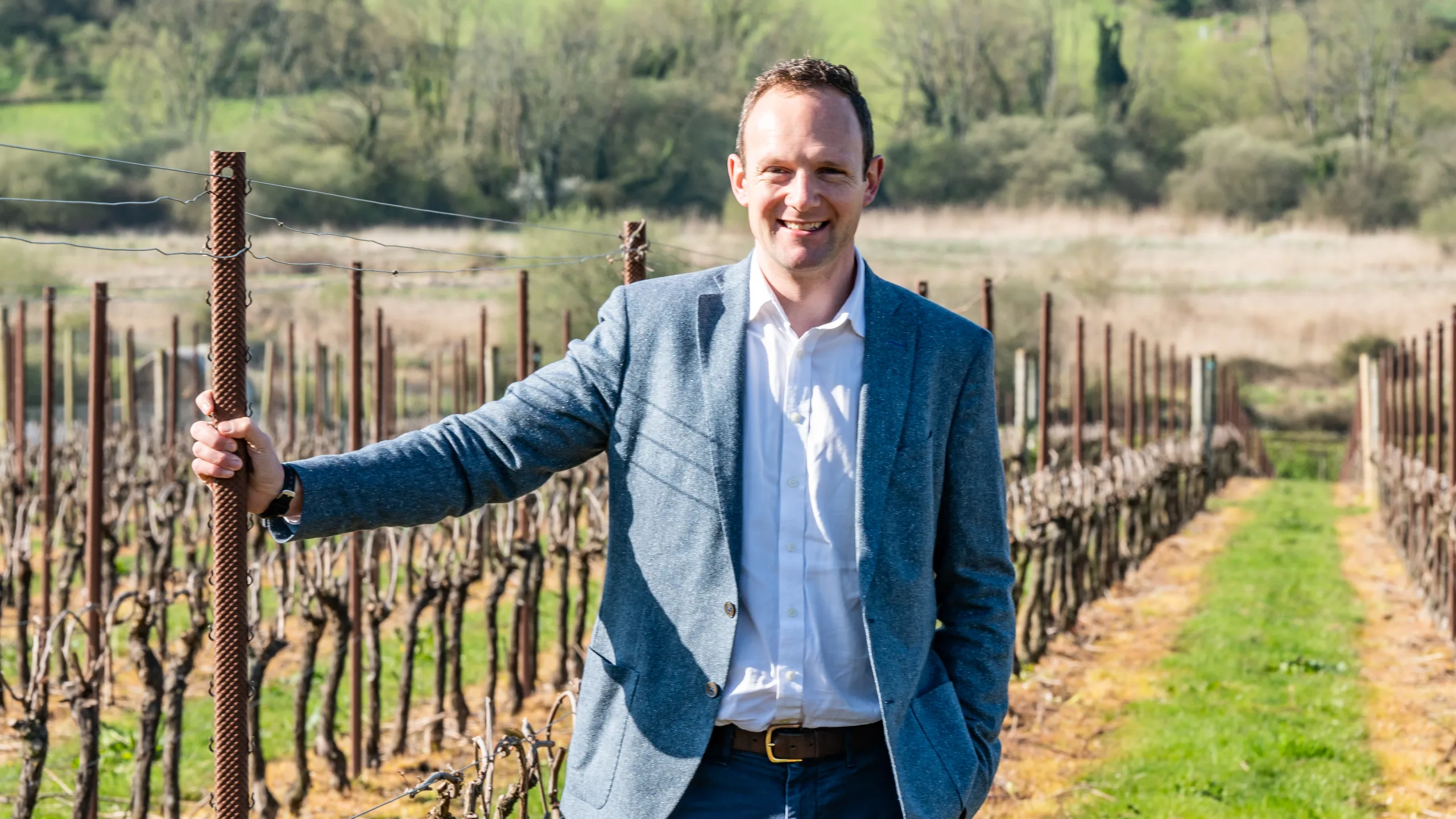
The English wine sector has experienced many of these pressures in a compressed timeframe, offering a clear illustration of how quickly market dynamics can shift. Ed Mansel Lewis, Head of Viticulture, says a surge in production has reshaped the landscape almost overnight.
“There’s suddenly been a very significant rise in the volume of wine available. Vineyards planted between 2015 and 2017 have come through at the same time as the 2023 harvest. There’s a lot of wine about, so it’s been a cautious year.”
Expansion plans have been paused as a result, with businesses waiting for the market to settle. At the same time, pressure has created opportunity.
“There’s an emerging market for acquiring distressed businesses. Buyers are looking to pick up existing vineyards rather than planting new ones,” he says.
His advice reflects a wider lesson for rural businesses.
“Don’t go out and buy bare land and plant it. Wait for businesses with surplus vineyards and acquire those instead. You avoid the five year wait and the economics are far better.”
Despite short term strain, he remains confident in the sector’s fundamentals.
“English sparkling wine has an undisputed international reputation now.”
Decisiveness will separate progress from stagnation in 2026
As the sector looks towards 2026, the distinction between businesses that are moving forward and those that are standing still is becoming increasingly apparent. Progress is being shaped less by confidence and more by clarity, with pricing reset to reflect reality, viability tested honestly and decisions taken on the basis of what is known rather than what is hoped for.
“The government is not going to save people,” says Claire. “However uncomfortable it is to hear, businesses have to stand on their own two feet.”
Across our rural business, the same pattern is emerging. Where difficult issues are addressed early, businesses are retaining flexibility and control. Where decisions are deferred, options continue to narrow.
2025 may be remembered not as a year of sudden change, but as the point at which waiting stopped being a strategy, and repositioning became unavoidable.
For more information or to speak to one of our team, visit: https://www.knightfrank.co.uk/commercial/rural-property
