

The Rural Update: Work with landowners, not against them
Your weekly dose of news, views and insight from Knight Frank on the world of farming, food and landownership.
11 November 2025

Viewpoint
It is always tempting for governments to turn to legislation when they are faced with thorny electoral challenges. In Scotland, land ownership is such an issue with politicians under pressure to address the country’s concentrated ownership structure. Around 50% of privately owned land is in the hands of 0.008% of the population, according to campaign group Community Land Scotland. The Scottish Land Reform Bill, which was passed last week, is the government’s latest attempt to remedy the situation and includes the power for ministers to split up larger estates when they come up for sale. However, as Scottish Land & Estates points out, communities already have the “right to buy” under such circumstances. Property rights are the bedrock of any democracy and provide the foundations for a strong economy; undermining those rights seems unnecessarily divisive when Scotland is trying to attract more private investment to drive economic growth in its rural communities.
Sign up to receive this newsletter and other Knight Frank research directly to your inbox
Commodity markets
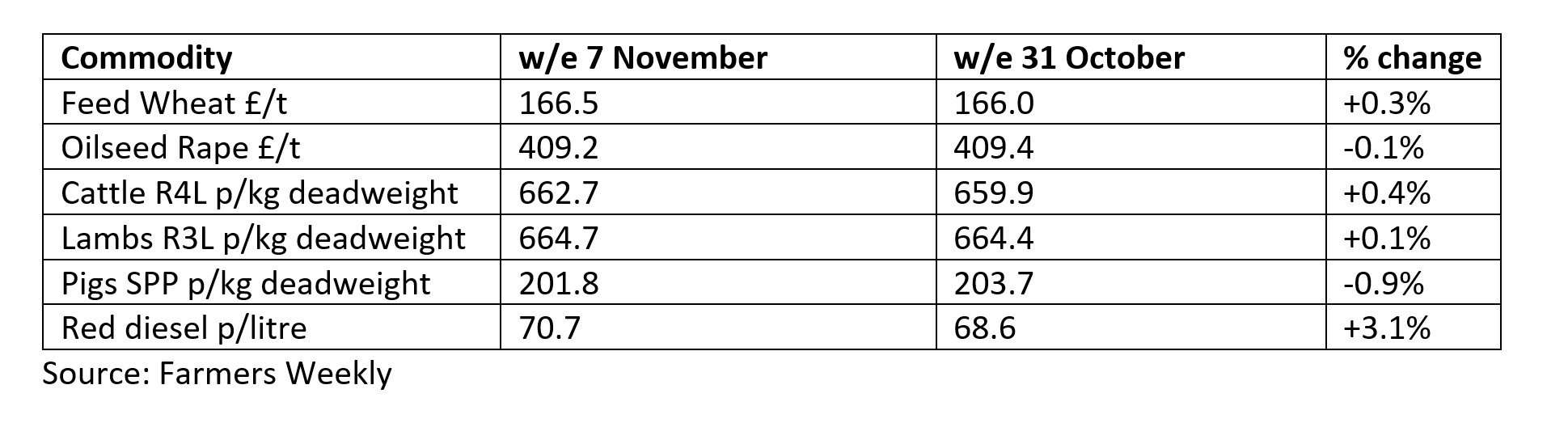
Pig price slide
Declining EU pork prices are pulling back values in the UK. Deadweight prices have fallen for nine weeks in a row and are now sitting at just under 202p/kg, the lowest point since January 2023, and almost 5p/kg below the price being paid 12 months ago. EU prices are over 50p/kg lower.
Milk worries
The UK’s dairy farmers are also suffering from falling prices as global commodity markets slump. Butter prices fell 15% in October, mild cheddar dropped 9% and skimmed milk powder slid 5%. Milk producers on cheese contracts have been hit hardest. Somerset cheesemaker Parkham Farms, for example, has slashed 8p/litre off its November payments, according to the AHDB milk price league table.
The headline
Scottish land reform
The Scottish government will now be able to split up larger estates following the passing of the country’s controversial Land Reform Bill last week.
Under the new legislation, ministers have the power to split up landholdings of over 1,000 hectares (2,471 acres) when being sold, provided that it is in the public interest to do so.
The bill also grants greater protections and compensation for tenant farmers and small landholders should they be removed from their holdings.
A consultation about the powers of the Tenant Farming Commissioner and alternative options for dispute resolution will be launched in the coming weeks, said Rural Affairs Secretary Mairi Gougeon.
“Tenant farmers and small landholders are vital to the fabric of our rural communities, and these reforms will help them to make a decent living on their holdings and make improvements on the land they work on.
“It will allow them to work in a way that promotes sustainable and regenerative agricultural production, and – possibly most importantly – be protected from being removed from their holding without fair compensation.”
However, Sarah-Jane Laing, Chief Executive of lobby group Scottish Land & Estates, said the bill was unlikely to achieve its aims.
“Whatever your stance on land reform, this is junk law. The reality is that many of the bill’s provisions are so badly drafted that it will take years of additional work by government and others before they can be implemented in practice.
“No one emerges as a winner from this – not government, not landowners, not rural businesses, not communities, and certainly not the taxpayer who will bear much of the cost of the added bureaucracy.
“The government has also missed a major opportunity to revitalise the tenanted farming sector. Instead of encouraging more people to let land, it has chosen to penalise them further by introducing new, financially punitive compensation measures.”
News in brief
Rural Renters’ Rights
The recently approved Renters’ Rights Act will have a number of implications for rural landlords, but Jess Waddington of our Rural Consultancy team says there is no need to panic. “My advice to rural landlords is to think calmly and rationally and not to rush into decisions before the full detail of implementation and secondary legislation is clear. Practical and intelligent advice will be key in ensuring landlords are not put at risk by the changes. Read Jess’s full guide to the new legislation.
Natural England refocus
The government’s environmental quango Natural England has just launched a new, more farmer-focused strategy, Recovering Nature for Growth, Health and Security, outlining how it will help the government realise the commitments it has made as part of its Environmental Improvement Plan. Among the changes Natural England says it will make are a “shift from isolated interventions to nature recovery happening at scale”, “increasingly enabling and trusting others to deliver for nature” and a move from “treating symptoms to tackling root causes”.
Council farms review
Defra’s latest review of smallholdings let by local authorities across England reveals that agricultural holdings contributed a net £5.3 million to council coffers in the 2023/2024 financial year. Across the 33 authorities that contributed to the review, 101 new tenancies were granted, 48 of which were to new entrants, and 127 were terminated. Almost 1,120 acres were disposed of. In Staffordshire, the Reform-led administration has said it will halt a planned sale of council-owned farms.
Woodland carbon fund
The government has announced that it is exploring a new £250 million Woodland Carbon Purchase Fund that will offer upfront payments to landowners to plant carbon-rich woodlands to help hit its net-zero targets. A second national forest in the Oxford-Cambridge corridor was also confirmed, with a competition launching in early 2026 to determine the third forest’s location in the Midlands or North of England.
Insurer funds flood plan
Admiral, the insurance company, has also just committed £600,000 to a five-year scheme that will see it fund natural flood mitigation works on three estates owned by the National Trust in Somerset, Snowdonia and Cumbria. Interventions, such as rewetting bogs, reshaping eroded peat and creating ponds, will help hold water higher in the catchment areas, reducing peak flows downstream, as well as boosting biodiversity and sequestering carbon.
Batters’ plan submitted
Former NFU President Minette Batters has submitted her farm profitability review, which was commissioned by former Defra Secretary Steve Reed earlier this year. Baroness Batters said the review contained 50 recommendations, including simpler planning regulations and measures to combat labour shortages. Defra said the review will be published by the end of November.
Rare breed beef boost
The Rare Breeds Survival Trust (RBST) has teamed up with steak restaurant Hawksmoor to launch a scheme connecting farmers and restaurants. The partnership will see RBST bring eligible native breed farmers together in RBST Regional Hubs, helping Hawksmoor to source rare and native breed beef from each of the UK's regions. The programme launched in south-west England last week, with the establishment of RBST Regional Hubs elsewhere in the UK to follow in 2026.
Poultry housing order extended
Anybody in England keeping more than 50 chickens or other types of poultry will have to keep them housed, following an announcement from the UK’s Chief Veterinary Officer on Thursday, 6 November. A GB-wide Avian Influenza Prevention Zone (AIPZ) is also in place and requires all keepers, whether they have pet birds, commercial flocks or just a few birds in a backyard flock, to undertake enhanced biosecurity measures to mitigate the risk of further outbreaks of the disease. Measures include disinfecting footwear and cleansing and disinfecting housing and concrete walkways on a continuous basis.
Bovaer review requested
The Danish Food and Veterinary Administration has requested one of the country’s leading universities to investigate claims from farmers that the use of the controversial methane-reducing feed additive Bovaer has been affecting the health of cows. Use of the additive or other methane-reducing feed regimes is now mandatory in Denmark. The announcement earlier this year by dairy co-op Arla that it was trialling Bovaer in the UK sparked a furious backlash from some consumers and climate-change sceptics.
Methane pledge scrapped
The UK government, meanwhile, has scrapped plans to announce a pledge to reduce livestock methane emissions by 30% by 2030 at the COP30 climate summit in Brazil. Farmer groups around the world, including the NFU, have been critical of the proposals, arguing that current methodologies used to calculate carbon emissions overstate the impact of methane from livestock production.
Sign up for Rural Report
The Autumn Winter 25/26 edition of The Rural Report, Knight Frank’s thought-leading publication for rural property owners and their advisors, is launching in November. Full of insight from leading country estates and our Rural Consultancy experts, it’s a must-read.
Properties of the week
Hants organic land available
Two picturesque organic farms at Overton, near Basingstoke, formerly part of racing driver Jody Scheckter’s Laverstoke Estate, are now available to buy separately. Turrill Hill is a 946-acre unit that includes three farm cottages, a wide range of livestock buildings, 607 acres of arable land, 208 acres of pasture and 106 acres of woodland. The guide price is £14 million. Berrydown Farm, priced at £8 million, comes with a four-bed brick-and-flint house, 431 acres of mixed farmland and 64 acres of woodland. For more information, please contact Will Matthews.
Historic Kent estate home to rent
Knight Frank’s Rural Consultancy team in Kent has an intriguing option on offer. Newhouse at Mersham, near Ashford, which was once home to Countess Mountbatten of Burma and Lord Brabourne, is part of the idyllic 2,700-acre Hatch Park Estate. Now available to rent, the nine-bed period property costs £6,995 a month. For more information, please contact Katie Bundle.
Discover more of the farms and estates on the market with Knight Frank
Property markets Q3 2025
Development land – Market hiatus
Greenfield and urban brownfield land values remained flat in Q3, according to the Knight Frank Residential Development Land Index, taking the annual price decline to 5%. At a national level, housebuilders are deferring many decisions until after the Autumn Budget, when reforms to taxation and planning may clarify the government’s policy direction. The prevailing uncertainty is likely to weigh on delivery for several quarters. Some 43% of respondents to Knight Frank’s survey of more than 60 small and volume housebuilders expect housing starts to fall through the fourth quarter of the year, while 45% expect land values to fall further.
Farmland – Prices dip
According to the Knight Frank Farmland Index, which tracks the value of bare agricultural land in England and Wales, the average price of land fell by just 1.6% to £8,719/acre over the third quarter of the year. That equates to an annual fall of 6.8%. As ever, the market remains highly localised, and where there is competitive bidding, prices have even been going up in some locations. Download the full report for more insight and data.
Country houses – Budget uncertainty
The average price of country houses has fallen by 5.4% so far this year, according to the Q3 edition of the Knight Frank Prime Country House Index. Properties worth below £1 million dropped by 4.7%, while those worth over £1 million lost 6.7% of their value. Owners of higher-priced properties are particularly concerned about any further property taxes being announced by Rachel Reeves as part of her Autumn 2025 Budget, which is due to be delivered at the end of November, points out Tom Bill, Head of UK Residential Research. Read more of Tom’s numbers and insight.
