

The Rural Update: Autumn Budget fails to inspire
Your weekly dose of news, views and insight from Knight Frank on the world of farming, food and landownership.
26 November 2025

Viewpoint
Rachel Reeves’s omnishambles budget woes continued when the contents of her speech were leaked today by the government’s own Office of Budget Responsibility shortly before she was due to deliver it. However, most of her key measures, such as freezing Income Tax thresholds and a new “mansion tax”, had already been revealed, so no big surprises had been expected.
Arguably, the uncertainty induced by months of leaks and kite flying has done more damage to economic confidence than the budget itself. It was telling that the Deputy Speaker rapped the government prior to Reeves’s speech, stressing that parliament was the place for major policy announcements to be first made.
As expected, there was no U-turn on the hated family farm tax, although allowing 100% relief to be transferred between spouses will be helpful for some families. It was incongruous, though, to hear Reeves claim that she was proud to use her budget to deal with injustices. How is making some elderly or unwell farmers feel that it would be better if they die before April next year not an injustice?
And a call for evidence on how to make the UK tax system more attractive for entrepreneurs seems to fly in the face of last year’s decision to apply Inheritance Tax on business assets, and today’s announcement to hike the tax on dividends, which many entrepreneurs use to pay themselves. Further taxes on landlords will also hit efforts to provide affordable and sustainable homes for rural communities. Today’s budget will have done nothing to boost confidence in the countryside or inspire the capital investments that agriculture and the rural economy desperately needs.
Sign up to receive this newsletter and other Knight Frank research directly to your inbox
Commodity markets 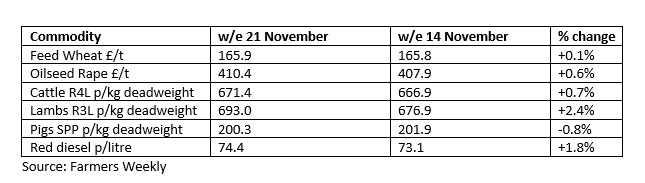
The headline
Budget blues
The content of the Chancellor’s second Autumn Budget was widely leaked prior to its delivery by Rachel Reeves today (26 November), but the main headlines affecting farms, estates and other rural businesses are summarised below.
The biggest revenue raider was freezing Income Tax thresholds for another three years until April 2031.
An annual High Value Council Tax Surcharge of £2,500 will be applied to homes worth over £2 million. There will be four price bands with the charge rising for each band. Houses worth over £5 million will be hit with a £7,500 charge. The surcharge will be paid to central rather than local government. There will be a consultation on reliefs, exemptions and deferrals with the scheme being introduced in April 2028.
There was no U-turn on the family farm tax, but the transfer of 100% Inheritance Tax relief on the first £1 million of the value of an agricultural property can now be transferred between spouses.
The minimum wage for over 18s will be raised from £10.00/hour to £10.85/hour, while the national living wage moves from £12.21/hour to £12.71/hour.
The basic and higher rates of dividend, savings and property rental taxes will be increased by two percentage points.
The fuel duty escalator will remain frozen until September 2026.
A 3p/mile charge on EV vehicles will kick in from April 2028. Owners of plug-in hybrids will pay 1.5p/mile.
UK mayors will have the power to add a visitor tax to overnight tourist stays.
Reduced business rates on hospitality venues will become permanent.
The tax on online gambling has been hiked to 40%, but no increases have been applied to in-person betting or horse racing.
Read the take of Tom Bill, Knight Frank’s Head of UK Residential Property Research, on the budget
News in brief
New CLA leader talks tough
Gavin Lane has taken over from Victoria Vyvyan as President of the CLA. Making his first speech at the organisation’s annual Rural Business Conference last week, Lane had a tough message for the Labour government regarding its planned Inheritance tax changes: “Whether through ideology, inexperience, or a fundamental misunderstanding of how family businesses work, this government is treating intergenerational asset transfer as a problem to be solved rather than the foundation of sustainable, long-term investment. They've absorbed economic theories about wealth inequality without grasping that breaking up family businesses could destroy the very stability we need to solve national challenges.”
Defra minister admits mistakes
Also speaking at the CLA conference, the new Defra Secretary of State Emma Reynolds failed to address the issue of Inheritance Tax, but she did admit mistakes were made earlier this year when the Sustainable Farming Incentive scheme was shut down with no prior warning and other environmental agreements were set to expire with no new options in place. “That’s why I acted quickly - extending Countryside Stewardship Mid-Tier agreements and opening applications for the new and improved Higher-Tier offer,” she said. Read Reynolds’ full speech.
Labour MPs protest farm tax
Opposition to Chancellor Rachel Reeves’s hated “family farm tax” has even crossed the political divide. Several members of the Labour government’s Rural Research Group joined farmers protesting outside parliament last week. The protests continued today as a number of farmers drove their tractors into central London prior to Reeves’s second Autumn Budget, when it was expected she would confirm the Inheritance Tax changes.
CSS Mid-Tier deadline
Tomorrow (27 November) is the deadline for anybody who wants to accept the one-year extension of Countryside Stewardship Mid-Tier agreements. As discussed above, farms and estates with agreements due to end at the end of this year faced the prospect of having nothing to replace them with until the extension was belatedly announced in October by Defra.
Green heat scheme expanded
Rural homeowners and landlords looking to boost their EPC ratings or replace existing fossil-fuel heating systems can now get funding for air-to-air heat pumps as part of the government’s Boiler Upgrade Scheme. Support was previously limited to ground and air-source heat pumps but has now been expanded to include a £2,500 discount off the cost of installing an air-to-air heat pump, which provides heat in winter and cooling in summer.
Welsh organic boost
Huw Irranca-Davies, Wales’ Minister for Rural Affairs, has just announced an extra £3 million of funding for the country’s organic farmers. Speaking at the Winter Fair earlier this week, Irranca-Davies said: “As we transition to the Sustainable Farming Scheme, I want to let organic farmers know of the ongoing support so that they can make informed business decisions as they plan for next year.”
Game bird release ban
Defra has emphasised that game birds must not be released into the wild while the whole of England is covered by an avian influenza prevention zone. Check out the government’s latest bird flu regulations and advice.
COP30 fertiliser plea
Although delegates at this year’s COP meeting in Brazil failed to agree on any cuts to fossil fuel use, a plan to curb global fertiliser use was released. The Belém Declaration on Fertilisers says more should be done to enhance nutrient-use efficiency and reduce emissions from fertiliser production as a key pathway to delivering climate goals, protecting and restoring nature, and ensuring food security for all in an equitable and just manner.
EU sustainable forest delay
Meanwhile, the European Council is pushing for another year’s delay to the EU’s flagship deforestation regulations that aim to ensure all products like chocolate, coffee, beef, wood and rubber consumed in the bloc are legally produced and “deforestation-free”. However, a new report from environmental advocacy group Global Witness claims that leading chocolate brands, some of which have supported the delay, are using beans sourced from deforested land in Liberia, West Africa, which has upped output following the surge in cocoa prices.
Rural Report out now
The Autumn Winter 25/26 edition of The Rural Report, Knight Frank’s thought-leading publication for rural property owners and their advisors, is available now. Full of insight from leading landed estates and our Rural Consultancy experts, it’s a must-read.
Properties of the week
Northumberland fishery for sale
Continuing the Rural Update’s Christmas gifting guide, a stunning 107-acre Northumberland salmon and sea-trout fishery on the River Tyne at Riding Mill, near Corbridge, would make the perfect present for the angler in your life. Farnley Fishing includes the renowned 570-metre Farnley beat, which has yielded some of the largest salmon caught on the Tyne, and offers a variety of attractive pools and runs suitable for both fly and spinner, interspersed with shallower glides ideal for wading. The guide price is £1.75 million. For more information, please contact Edward Douglas-Home.
Historic Kent estate home to rent
Our rural team in Kent has an intriguing option on offer. Newhouse at Mersham, near Ashford, which was once home to Countess Mountbatten of Burma and Lord Brabourne, is part of the idyllic 2,700-acre Hatch Park Estate. Now available to rent, the nine-bed period property is available for £6,995 a month. For more information, please contact Katie Bundle.
Discover more of the farms and estates on the market with Knight Frank
Property markets Q3 2025
Development land – Market hiatus
Greenfield and urban brownfield land values remained flat in Q3, according to the Knight Frank Residential Development Land Index, taking the annual price decline to 5%. At a national level, housebuilders are deferring many decisions until after the Autumn Budget, when reforms to taxation and planning may clarify the government’s policy direction. The prevailing uncertainty is likely to weigh on delivery for several quarters. Some 43% of respondents to Knight Frank’s survey of more than 60 small and volume housebuilders expect housing starts to fall through the fourth quarter of the year, while 45% expect land values to fall further.
Farmland – Prices dip
According to the Knight Frank Farmland Index, which tracks the value of bare agricultural land in England and Wales, the average price of land fell by just 1.6% to £8,719/acre over the third quarter of the year. That equates to an annual fall of 6.8%. As ever, the market remains highly localised, and where there is competitive bidding, prices have even been going up in some locations. Download the full report for more insight and data.
Country houses – Budget uncertainty
The average price of country houses has fallen by 5.4% so far this year, according to the Q3 edition of the Knight Frank Prime Country House Index. Properties worth below £1 million dropped by 4.7%, while those worth over £1 million lost 6.7% of their value. Owners of higher-priced properties are particularly concerned about any further property taxes being announced by Rachel Reeves as part of her Autumn 2025 Budget, which is due to be delivered at the end of November, points out Tom Bill, Head of UK Residential Research.
