

Middle East Conflict Clouds Rate Outlook and Budget Plans
Energy market volatility has driven borrowing costs higher, which has forced mortgage lenders to reprice. How long the Middle East conflict lasts will determine the impact on the housing market and the fiscal choices in the autumn Budget.
12 March 2026

Spare a thought for anyone sitting on a mortgage pricing committee this week.
The job of setting loan terms must be challenging when the number of rate cuts on the horizon moves around so dramatically in such a short space of time.
The reason is the roller-coaster ride on energy markets since the end of February as the Middle East conflict has unfolded.
An expectation of rising inflation means the five-year SONIA swap rate closed at 3.9% on Monday, which compares to 3.5% before the conflict started and was the highest figure in almost a year.
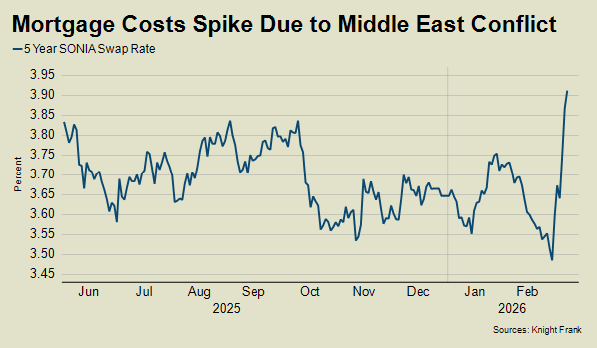
Swaps, which are based on future rate expectations, are used by lenders to price fixed-rate mortgages.
With mortgage approvals currently 10% below the five-year average, lenders are keen to build their loan books and have reacted quickly to small market movements in recent months. However, in the current risk-averse climate, rates tend to climb more quickly than they fall.
Trump Ambiguity
For the best steer on what happens next, committee members should perhaps be monitoring the social media feed of US President Donald Trump.
Everything, including the impact on UK inflation, hinges on the length of the current conflict, but his latest comments on when it would end were ambiguous. Soon, but not this week, was the gist.
As a result, drawing longer-term conclusions about what the conflict means for the UK housing market is not straightforward. That said, one statistic that will alleviate the impact of higher borrowing costs is that 36% of homes in England are owned outright versus 29% with a mortgage, as the latest English Housing Survey shows.
Understanding what it means for London’s position on the global stage is also complex.
The city’s long-standing reputation for stability comes into sharper focus during moments of geopolitical volatility. However, such events don’t tend to mark sharp inflection points in the property market and the headlines generated in the early days of the conflict are unlikely to have a meaningful impact on people’s longer-term property decisions.
Longer-lasting changes in behaviour will, like everything else, hinge on how long the disruption lasts.
On The Table
Last week’s episode of the Housing Unpacked podcast with Pepperstone analyst Michael Brown explored how events in the Middle East may affect the Bank of England’s future decisions and why he thinks that multiple rate cuts this year are still on the table.
Today’s episode looks further into the future and analyses how the conflict could affect the choices facing the Prime Minister and Chancellor. Guest James Nation was a special advisor in the Treasury when the conflict between Russia and Ukraine began in 2022 and explains how global energy price shocks present a dilemma for governments.
“It’s like trying to pin the tail on a moving donkey,” he said. “Officials will quite rightly tell the government to stay patient and not intervene yet, but you are acutely aware that the public are anxious and you are under a lot of pressure to show that you’ve got a grip.”
Tight Headroom
We also explore how the energy price shock could influence the autumn Budget. Higher borrowing costs and increased defence spending may reduce the government’s financial headroom, which could force further tax rises.
“If we see this current economic situation extended, then undeniably you will have speculation on headroom being diminished,” said James. “They are not going to do anything broad-based but may look at discreet revenue raisers like the corporate bank tax.”
Would property feature again? The government has said High Value Council Tax bands will only increase in line with inflation from 2029/30 and, as James points out, “even a Chancellor to the left of Rachel Reeves won’t want to do anything that holds back the housing market.” He also doesn’t rule out further demand-side support measures.
Following Labour’s recent poor result in the Gorton and Denton by-election, does James believe events in the Middle East will stall a leadership challenge to Keir Starmer?
“It doesn't change the fundamentals, but it might delay things,” he said. “The Ukraine invasion in 2022 bought Boris Johnson time and Labour MPs will largely rally around but I don’t think they will start to believe that Keir is the right leader to win them a second term and for that reason he remains vulnerable.”
