
The New Frontier - Your weekly science and innovation update - 4th September 2026
04 September 2026

Driverless fantasies
Decades of science fiction fantasies about self-driving cars finally met the London curb on Thursday, when Uber and Wayve launched the UK’s first autonomous ride-hailing service. Request an UberX, Uber Electric, or Uber Comfort, and you may be matched, at no extra cost, with a Wayve-powered Ford Mustang Mach-E travelling anywhere in London except the airports. Fewer than 20 cars are on the road at launch.
The future still comes with a chaperone. TfL has licensed the cars as conventional private hire vehicles, so a trained safety driver remains at the wheel. Removing them requires an Automated Passenger Services permit from the DVSA, Vehicle Certification Agency registration, and TfL’s consent. Although the permit regime came into force on 15 May 2026, no operator had completed the first stage or applied for a permit by late August. Full implementation of the Automated Vehicles Act is not expected until the second half of 2027.
Britain is therefore entering the robotaxi race at a slower speed. Driverless services already operate commercially in more than 20 cities across America, China, and the Middle East. London, by contrast, is starting with a handful of supervised cars, while Waymo and Baidu’s Apollo Go wait to enter the same regulatory queue.
The reason is not simply bureaucratic inertia. Britain is trying to establish a rigorous safety and liability regime before allowing deployment at scale. London also presents a much tougher technical test than the orderly grids of cities such as Austin and Atlanta. Its narrow streets, irregular junctions, and dense mix of buses, cyclists, and pedestrians create a far less predictable driving environment. A phased introduction is defensible. The danger is that necessary caution becomes avoidable delay, allowing overseas operators to collect more data, refine their systems, and achieve commercial scale first.
Sovereign ambitions
The week’s other coming-of-age moment belonged to Flower Labs. On Monday, the Cambridge University spinout launched Endeavor 1.0, a “frontier-class” AI model that it says is competitive with leading OpenAI and Anthropic systems on some tasks.
For most companies, adopting AI has meant accepting a "landlord". The leading models are reached through closed interfaces run by a handful of US firms. Everything the customer builds on top sits on rented ground. Models that can be run in-house have been available, but until now, less capable. Flower Labs proposes another route. Its newly launched model is available either as a service Flower operates or installed inside a customer's own systems. The firm, founded in 2023 and backed by some £23 million, counts the NHS and JPMorgan among its clients. Nicholas Lane, its chief scientist and a Cambridge professor, told the Times that Europe should not have to rent its intelligence indefinitely from a few American companies. For a bank, hospital, or government department, that could allow sensitive information to be processed within a controlled private environment. Flower’s wider federated-learning technology can also enable models to learn across separate datasets without bringing the underlying records together in one place. In practical terms, private deployment transfers part of the computing burden from Flower to the customer.
Rather than spending billions of pounds training a frontier model entirely from scratch, Flower has built on mature capabilities developed by the open-weight AI ecosystem. It has then added its own continual pre-training, targeted post-training and system integration, including UK-specific knowledge and reasoning developed through Lizzy, the smaller sovereign model it released earlier in 2026. This approach potentially lowers one of the largest barriers to entry in frontier AI. A British challenger does not need to replicate every dollar of research and computing investment made by the largest American companies before it can compete.
The state writes cheques
Sovereignty was also the theme at the National Wealth Fund, which anchored a £100 million funding round for Abingdon battery-materials company Nexeon with a £52.6 million commitment, alongside Korea Development Bank and Honda Xcelerator Ventures.
Nexeon develops silicon anode materials that can make lithium-ion batteries more energy-dense and faster to charge. The investment will support a UK pilot manufacturing facility, expand the company’s manufacturing technology unit and help convert its R&D into commercial production.
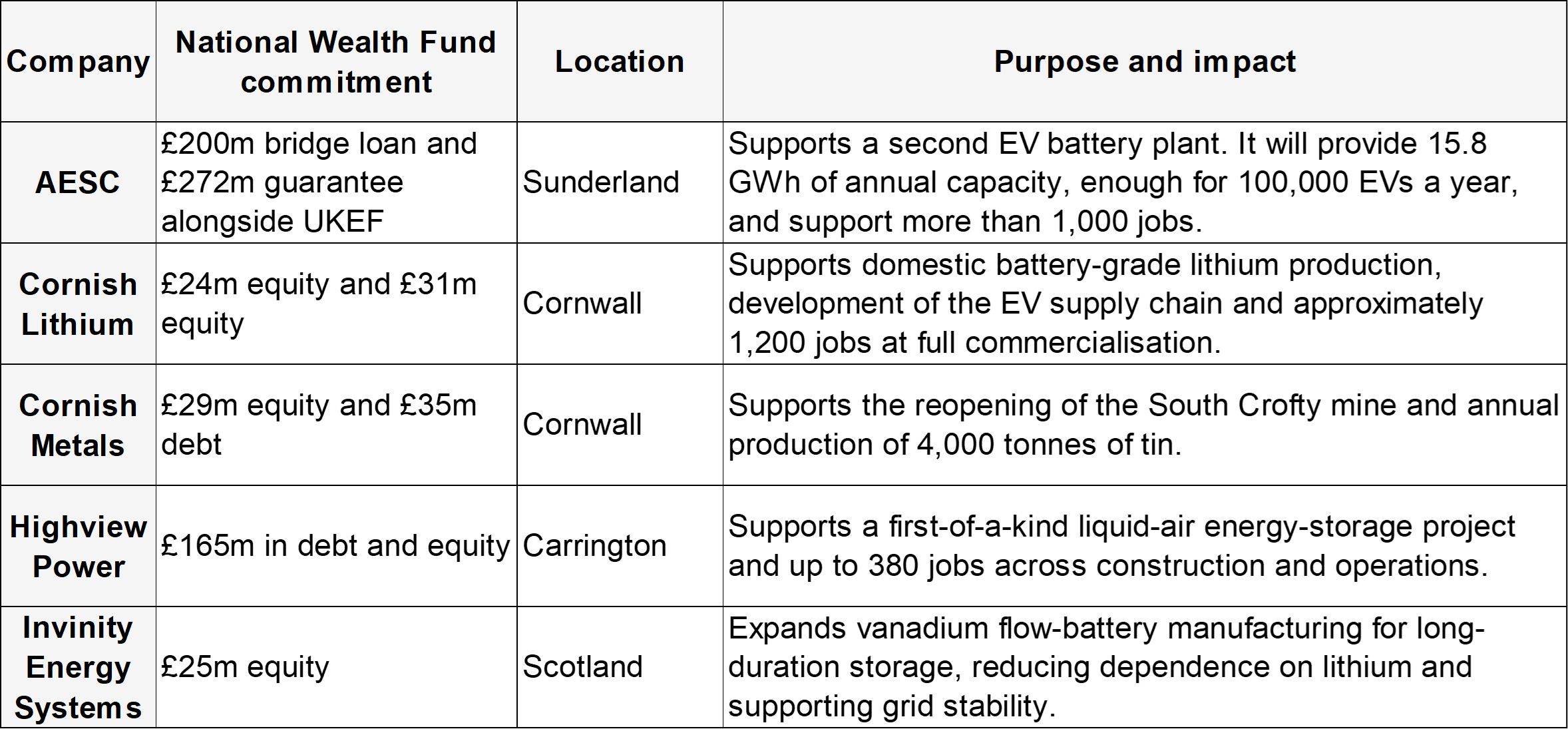
The investment builds on £781 million already committed by the National Wealth Fund to five battery supply chain and energy storage projects. Together, the projects span domestic raw-material production, battery cells and long-duration energy storage.
The announcement follows a joint report from the National Wealth Fund and the Clean Technology Partnerships Initiative.
Its conclusion is stark. Britain is expected to require 115 GWh of batteries annually by 2035, including nearly 100 GWh for cars, but it remains well short of the manufacturing capacity needed to meet that demand. China produces 70% to 90% of batteries and more than 85% of key battery materials, while European manufacturers face an estimated 30% to 50% cost disadvantage because of factors including higher electricity prices and weaker economies of scale.
The UK’s problem is not a lack of science. It is the gap between invention and industrial scale. The report proposes using public debt and guarantees to attract large cell, cathode and component plants, including joint ventures with established overseas manufacturers. It would then use equity to back British companies whose recycling, materials and next-generation battery technologies are ready to move into commercial production.
Clustering is central to the strategy. Battery production is more competitive when cell plants are located close to materials processing, recycling, research institutions, skilled labour and customers. The report identifies co-located LFP cell and cathode manufacturing as a near-term priority, with advanced recycling among the UK’s strongest longer-term opportunities.
A two-way street
The transatlantic traffic ran in both directions this week. New York’s Modal Labs, the $4.65 billion serverless AI infrastructure company, is completing its European expansion with a 40-desk office near Marble Arch. It joins OpenAI, Anthropic, Cursor and Cohere in the US AI wave taking central London space.
Going the other way, London’s Scan.com raised $220 million, comprising a $90 million Series C led by Noteus Partners and $130 million of debt. The company plans to build the largest medical-imaging network in the US after doubling revenue to an annual run rate of $165 million.
The human premium
What does all this automation do to people? Pay them more for being human, apparently.
The Wall Street Journal reported that EY’s US business is committing $100 million this year to bonuses for “human skills”, including judgment, adaptability and business acumen, alongside AI experimentation. Awards can reach $25,000, five times the previous cap. KPMG and PwC are making similar moves.
If the value of the firm migrates towards judgment, mentoring and client relationships, the office is increasingly justified as the place where those activities happen. That supports demand for high-quality, collaboration-rich space, even if AI reduces some junior workloads and changes future headcount requirements. Talking of which, my fantastic colleagues recently discussed the impact of AI on the workplace. Click here to listen. AI and jobs: What's next for the workplace? | Intelligence Talks
In other news...
The British Business Bank has also invested $20 million in Cheshire-based Redx Pharma as part of a funding round to accelerate development of a potential treatment for Crohn’s disease. The investment will help retain Redx’s research, intellectual property and skilled employment at Alderley Park, strengthening the North West life-sciences cluster. Read more about the Redx Pharma investment.
Britain has become the first foreign partner to gain access to Ukraine’s Avengers AI Labs battlefield dataset under an agreement signed on 24 August. Pilots are already under way with Bristol’s Sintela, Oxford’s Mind Foundry and London’s Skyral through the UK Government programme.
Sign up to Knight Frank Research.
