

Investor sentiment towards the sector remains positive, despite quarterly volumes being low
Knight Frank’s quarterly review of the key development and investment themes in the UK student property market - Q2 2026
07 August 2026

Subdued activity
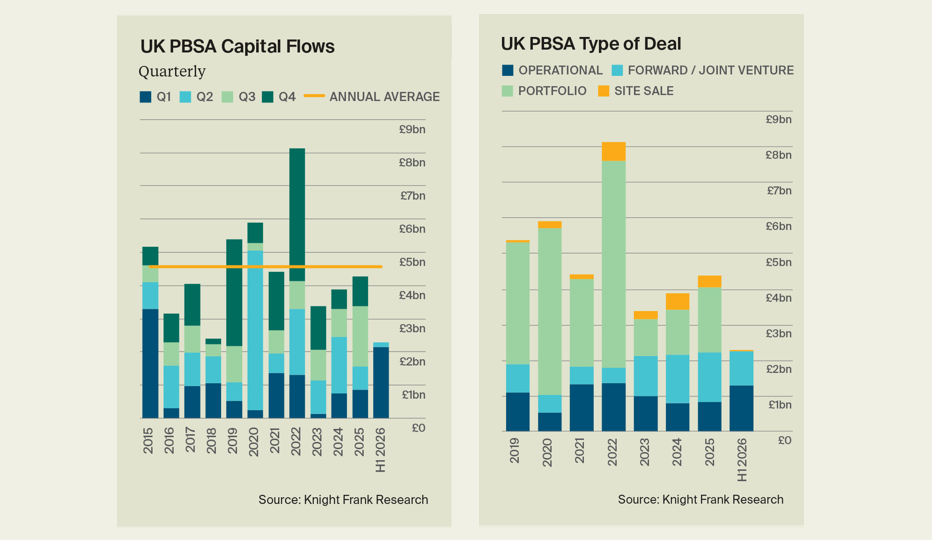
Investors deployed £164 million into UK purpose-built student accommodation (PBSA) during Q2 2026, bringing total investment volumes to £2.3 billion at the halfway point of the year. While the quarter recorded one of the lowest turnover levels on record, year-to-date activity remains ahead of 2025, supported by a strong start to the year. A total of 13 transactions completed during the quarter, below the five-year Q2 average of 17 deals. Despite healthy levels of investor interest, activity softened over the period as pricing negotiations remained a feature of the market. Persistent gaps between buyer and seller expectations have, in some cases, contributed to elongated transaction timelines and delayed deal execution. Against this backdrop, prime direct-let yields in London are circa 4.75% NIY, with regional prime pricing approximately 5.50-5.75% NIY for the same product type.
A market in waiting….
While activity slowed in Q2, market intelligence points to a stronger pipeline beneath the surface. Knight Frank is currently tracking more than £1.5 billion of UK PBSA assets under offer, highlighting continued investor appetite for the sector. However, while capital remains available, conviction is taking longer to translate into transactions. Buyers continue to seek evidence of value and pricing discipline, resulting in extended marketing periods, enhanced due diligence and more conditional deal structures. As a result, the current pipeline should not be assumed to convert in full before the end of the year.
Operational assets continue to dominate trading activity, accounting for 64% of transactions completed year-to-date (21 deals). This trend is expected to persist through the remainder of 2026, with investors favouring income-producing assets that offer embedded rental growth at attractive entry pricing. Land transactions accounted for 24% of activity (eight deals), while joint-venture and forward-funding structures represented the remaining 12% (four deals), reflecting a more selective approach to development risk in the current environment.
UCAS, June deadline
As of the June deadline, a record 695,740 applicants applied to UK universities, a +4% increase from last year. UK students make up the majority of applicants at 547,390 (+4% YoY). International applicants who applied to undergraduate courses via UCAS have risen to 148,350, up 7.1% on 138,460 last year. Whilst positive, UCAS data only reflects a partial view of undergraduate international admissions.
The proportion of June applications that stated they intend to live at home for the upcoming cycle also rose to 35% (+1%). While this is not a direct correlation for those requiring accommodation, it can be used as a proxy for wider affordability concerns, and the rise of the commuter student in some locations.
Conviction in core markets
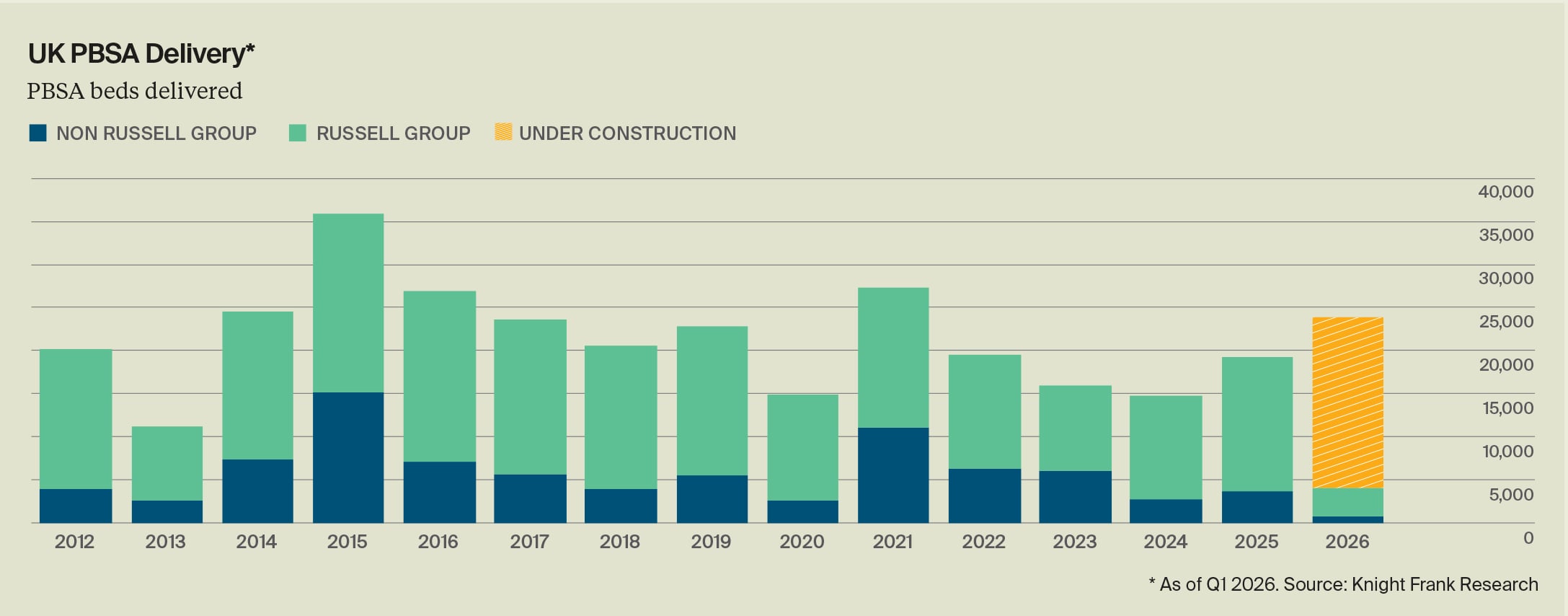
Developer conviction remains firmly concentrated in the UK's leading university markets. In 2025, 19,200 new PBSA beds were delivered across the UK, of which 81% were located in Russell Group cities, reflecting developers continued focus on the markets perceived to offer the strongest depth of student demand and long-term investment liquidity. As of Q1 2026, approximately 3,500 new PBSA beds had been delivered across the UK, with 93% located in Russell Group markets.
A further circa 19,000 beds are currently under construction and scheduled for completion ahead of the 2026/27 academic year, with 95% concentrated in Russell Group locations. Should all schemes complete as planned, total annual delivery would marginally exceed the 10-year average of approximately 21,000 beds per annum.
However, the development environment remains challenging. While the delivery pipeline is active, developers are facing a more complex operating environment that continues to place pressure on scheme viability. Build cost inflation, elevated financing costs and procurement risks are impacting both new starts and the progression of future schemes.
Hold for now
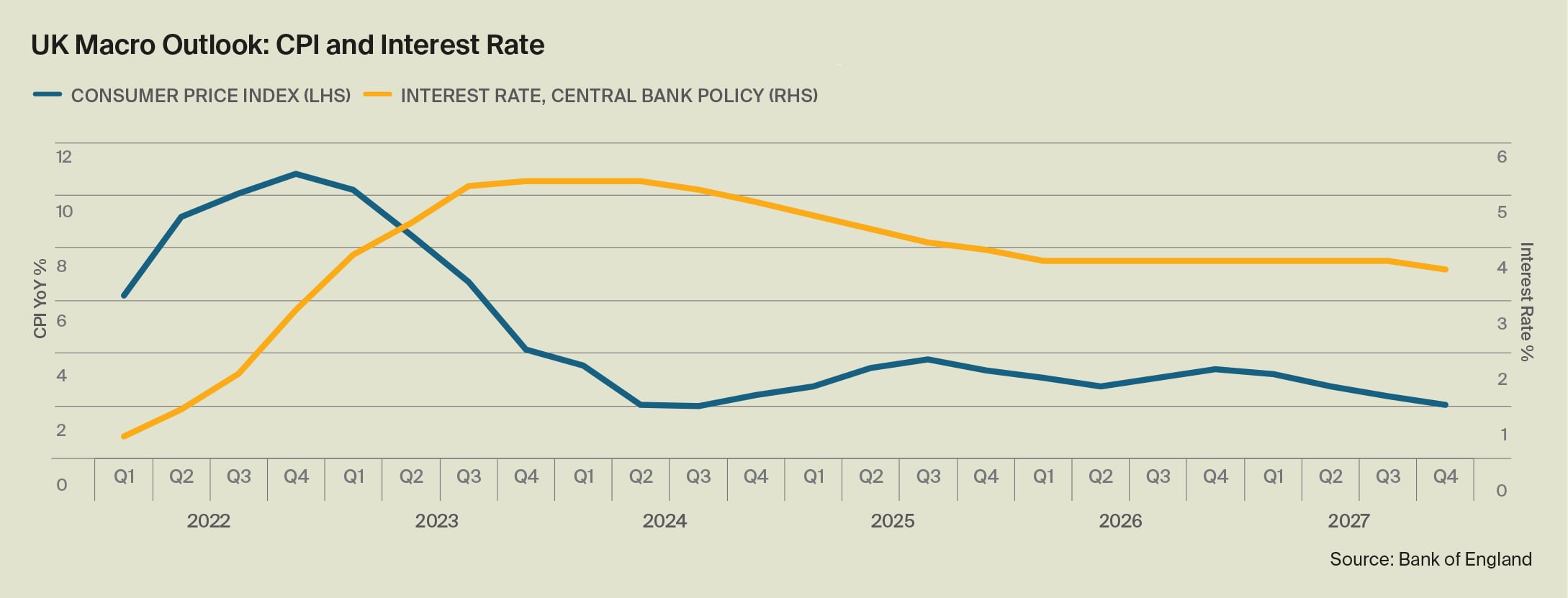
The Bank of England maintained the base rate at 3.75% during the July meeting, with policymakers citing ongoing geopolitical uncertainty and the potential inflationary impact of higher energy prices. While concerns remain around the outlook for inflation, the Monetary Policy Committee signalled that any sustained easing in price pressures could support a more accommodative monetary environment than current market expectations imply. For PBSA investors, the decision reinforces a broadly supportive backdrop. The prospect of lower borrowing costs over the medium/long term should improve debt market liquidity and support investor underwriting, particularly for larger lot sizes and development-led opportunities. However, a degree of caution persists as geopolitical risks and inflationary pressures continue to cloud the path of future rate cuts. While occupational fundamentals remain compelling, many investors are likely to maintain a disciplined approach to pricing until there is greater clarity on the direction of monetary policy.
3% is the new 2%
The Bank of England's latest forecasts suggest inflation is likely to remain above target in the near term, reflecting ongoing volatility in global energy markets and wider geopolitical uncertainty. While inflation is expected to moderate over the medium term, policymakers continue to highlight a range of potential outcomes, reinforcing the view that the path back to the 2% target is unlikely to be linear. Risks to the inflation outlook are tilted to the upside relative to its central target of 2%, current forecasts suggest the consumer price index (CPI) picking up over the rest of 2026 and averaging about 3.4% in Q4.
Risk-Free Rates vs CRE Returns
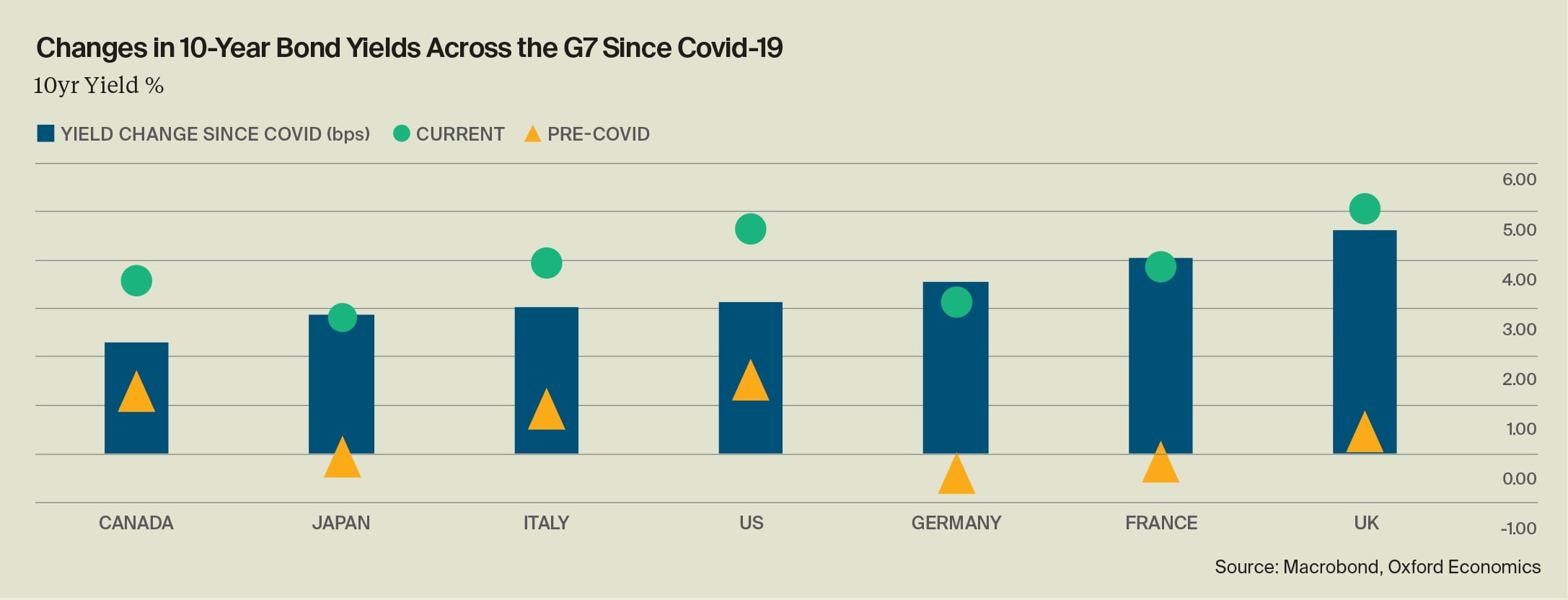
UK government bond yields have come under renewed pressure in recent months, reflecting a combination of fiscal concerns, geopolitical uncertainty and a weaker domestic growth outlook. At the peak of market volatility to date in 2026, the UK 10-year gilt surpassed 5.17%, its highest level since 2007. While higher sovereign bond yields have been a global phenomenon since the covid pandemic era, the UK has experienced one of the most pronounced adjustments among G7 economies. For real estate investors, gilt yields remain a critical benchmark. As the risk-free rate rises, the return premium required for property investment comes under greater scrutiny, placing increased emphasis on asset pricing and income growth prospects – however, the relationship is not always straightforward. While gilt market volatility may continue to influence pricing discussions and capital allocation decisions, PBSA's appeal remains rooted in its ability to generate resilient income streams supported by structural demand drivers. Consequently, investor focus is increasingly centred on markets and assets capable of sustaining rental growth or rental reversion, rather than those relying solely on yield compression to drive returns.
Research


Student Property


Knight Frank Capital Advisory and Planning


Sign up to Knight Frank Research.
