
The cost of building keeps rising
Plus, is the government mulling a return to Help to Buy?
06 August 2026

The surge in mortgage rates due to the conflict in the Middle East and its impact on housing demand has been well documented. It is only now, as more data emerges, that the scale of the pressure from rising build costs is becoming clear.
Input cost inflation rose at the fastest rate for nearly four years during May, according to S&P Global’s UK Construction Purchasing Managers Index. The June survey registered another sharp increase – though not as steep as the previous month’s reading – driven by higher raw material prices, wages and transportation bills. Around 53% of respondents to that survey reported a rise in costs, while only 1% signalled a reduction.
Only a fraction of UK building materials pass through the Strait of Hormuz, but steep increases in energy, freight and insurance costs are felt through supply chains globally. The price of fabricated structural steel in the UK climbed on average 13.1% during the year to May 2026, according to the latest available official figures. Gravel, sand, clays and kaolin rose 12.2%, while bituminous mixtures based on natural and artificial stone surged 11%.
As a result, build costs are forecast to rise 4.7% in 2026, up from 4.4% last year, according to the Building Cost Information Service (BCIS), before easing over the medium term.
Amplifying risk
Weak sales rates, build costs and persistent uncertainty around scheme viability weighed on residential development land values in Q2, according to Knight Frank's Residential Development Land Index (sign up here to receive the full report next week)
Greenfield land values fell 5.5% during the quarter, taking the annual decline to 3%. Prime central London land values declined 1% over the quarter, leaving values 3% lower year-on-year. Urban brownfield land values fell 2.5% during the quarter, extending the annual decline to 5%.
The stop-start nature of the conflict and the resulting volatility in borrowing cost expectations has made it harder for developers to underwrite projects with confidence – particularly larger developments where longer delivery timelines amplify risk. That said, successive inflation readings have come in below expectations, raising the prospect of lower mortgage rates during the third quarter.
Political uncertainty also created headwinds during Q2, though those have since diminished. Angela Rayner's appointment as Housing Secretary signals a degree of policy continuity, while the government has reaffirmed its commitment to deliver 1.5 million homes during this Parliament, keeping housing supply at the centre of its agenda.
Planning delays
Our quarterly survey of more than 35 small and volume housebuilders points to further declines in housing delivery in the months ahead. Eight-in-ten developers said site visits and reservations declined during Q2, and nearly six-in-ten expect reservation volumes to underperform in 2026 compared to a year earlier. As a result, a little under half expect start volumes to decline further in Q3, with the same proportion expecting no change. About 60% expect land values to fall further, while the remaining 40% expect the land market to trade flat.
Planning delays remained the most frequently cited challenge facing developers, identified by 64% of respondents, followed by buyer sentiment (52%) and the short-term outlook for the UK economy (48%). Buyer sentiment overtook planning as the biggest anticipated headwind during the third quarter, cited by 58% of respondents, while half continued to identify planning delays as a key constraint. A third chose the short-term outlook for the UK economy, though material costs and availability (29.2%) and the low level of active registered providers (RPs) for S106 affordable homes (29.2%) are are rising up the agenda.
The delivery of Affordable Homes is likely to be overhauled in the months ahead. A major expansion of council housebuilding lies at the core of Burnham’s policy platform, and he’s called for better use of public land and more delivery via mayoral and combined authorities. This is likely to mean more support for local-authority-led delivery, an increased focus on social rented housing and a greater role for public sector delivery vehicles, all of which will need to sit alongside existing housebuilder and institutional investment models.
Help to Buy?
The government's housebuilding policy has been broadly positive, but delivery figures suggest it hasn't yet gone far enough to reverse the impact of higher costs – for developers, buyers and investors – and an onerous regulatory system. Whether the government will introduce a new buyer incentive system similar to Help to Buy has been subject to considerable speculation despite regular official statements that no such scheme is being considered.
Annual results from Homes England show the Treasury booked a £1.24 billion profit on the state’s portion of Help to Buy loans that have been paid off, alongside £500 million in interest payments, according to a Times write up published over the weekend.
The report also says housing minister Matthew Pennycook is "actively reviewing" the return of Help to Buy, despite a housing department spokesperson insisting this weekend that "there are no current plans" to introduce a new scheme. "There is now widespread acceptance within Whitehall that the government's attempts to revive housebuilding have not gone far enough," the paper adds.
Chart of the month
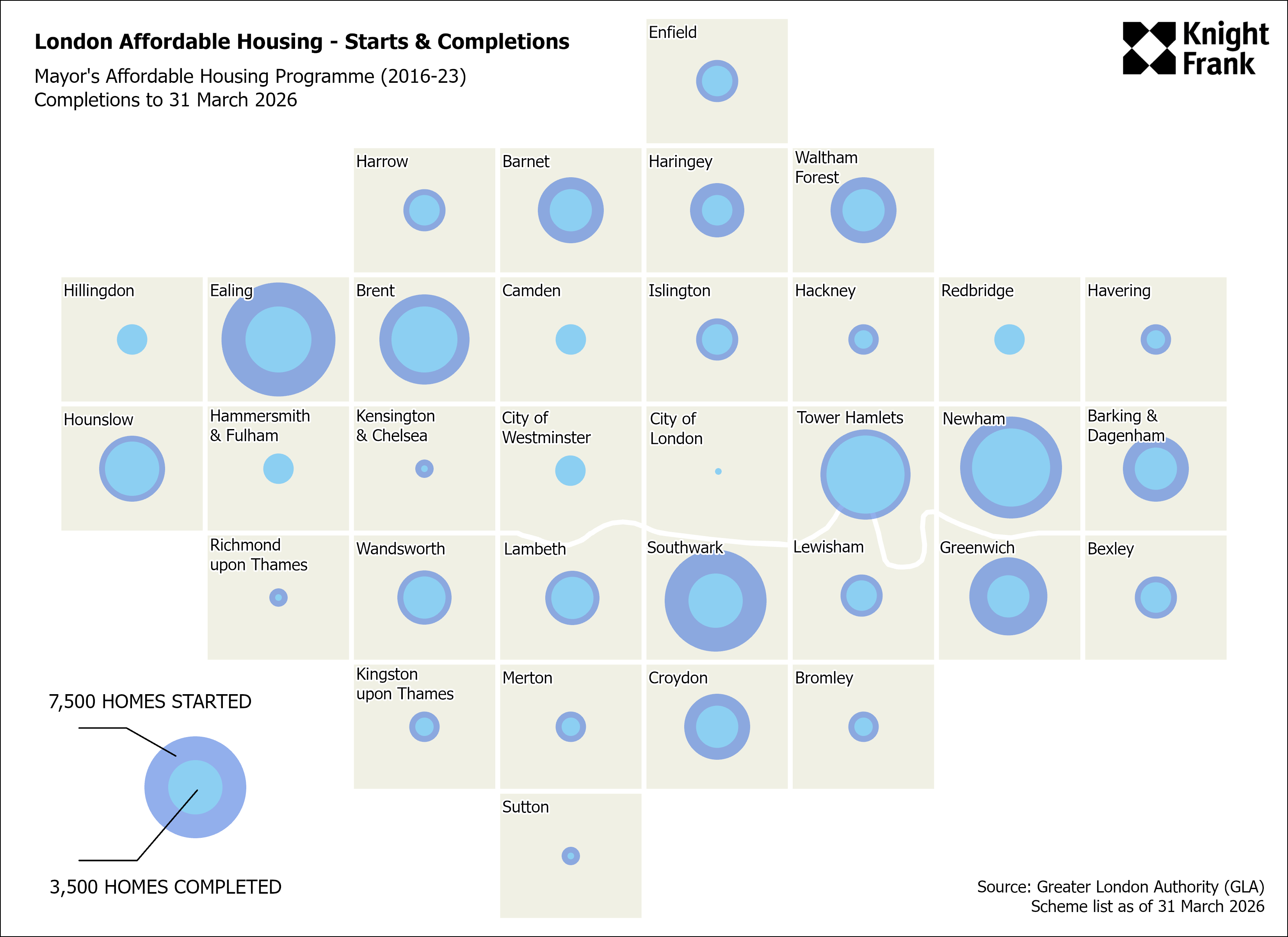
Delivering homes of any tenure in London is challenging – take the GLA's latest data showing site-by-site affordable housing starts and completions across London. It confirms that construction started on 116,495 affordable homes between 2016 and 2023. Yet, just 77,275 of those homes are now complete.
That leaves a gap of 39,220 affordable homes which started on site at some point between 2016 and 2023 and – in the three years since to March 2026 – have still not yet completed. Some of these homes will complete during 2026, but a quick look at the detailed list provided by the GLA shows many are on sites which are not yet being built, other sites have delivered fewer homes than intended.
Understanding what is driving this gap, and how it can be addressed, is critical to boosting housing delivery across all tenures. It's hard to ignore the latest Molior data which shows a sharp contraction in private housing development activity across the capital in recent years. Given the extent to which affordable housing delivery is intertwined with the private development pipeline, the gap between affordable housing starts and completions is likely to be a symptom of the broader slowdown in London's housing market.
Sign up to Knight Frank Research.
